For the current edition of the Venice Biennale, the Bulgarian Pavilion serves as the headquarters of The Federation of Minor Practices, a shady, imaginary research organisation operating at some point in the near future, when society as we know it has ceased to exist. Located within a typically Venetian time-slip of a building on the banks of the Grand Canal, The Federation of Minor Practices occupies just one room, in which four films and a computer game act like spyholes back to the early 21st century, when the seeds of what is described as “post sovereign” society were sown.
The installation’s speculative nature benefits from the cloistered atmosphere of this former monastic complex, founded by the Jesuits in the 15th century as a place for the care of the sick. It’s easy enough to suspend reality inside such high walls, though the ecclesiastical connotations of the setting, itself located within the immersive fantasy of Venice, provide a background hum of western civilisation, against which we are invited to contemplate the demise of society as we know it.
What with one thing and another going on in the world right now, it’s easy enough to accept the end of days narrative – and possibly even to embellish it for oneself – which is just as well, since the artists themselves vouchsafe very little, and the installation lingers in the mind more as a notably unsettling experience than anything more tangible.
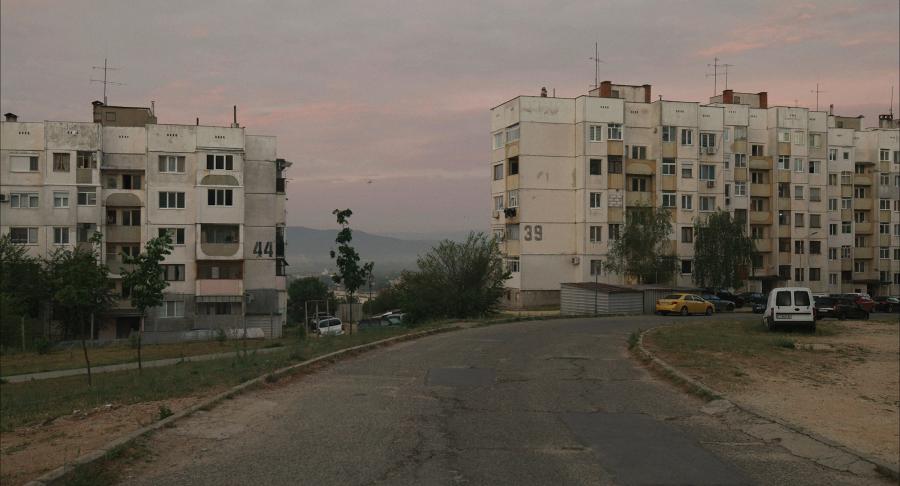
Of the four films three are played on a continuous loop, with the fourth – Rayna Teneva’s Geography Is Destiny (pictured above), which explores the coexistence of commercial rose harvesting and arms manufacture around the Bulgarian town of Kazanluk – feature length and less frequently screened.
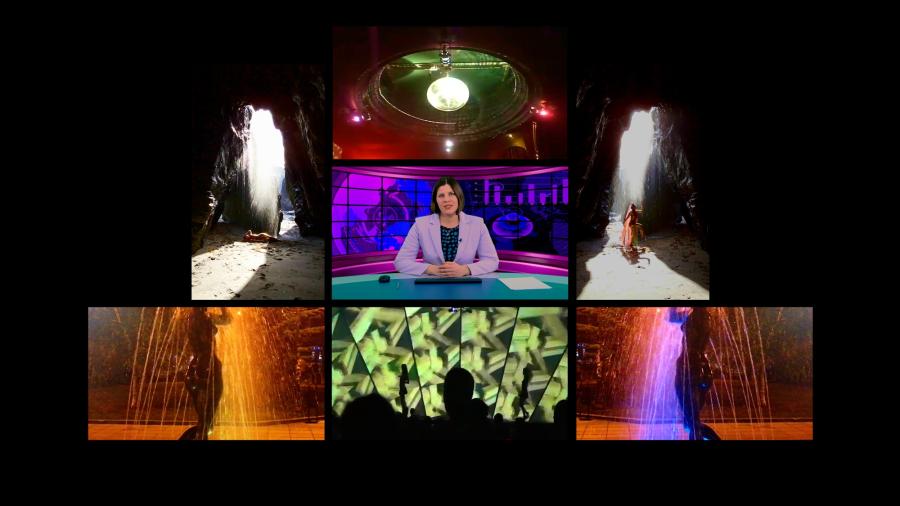
The other three are significantly shorter, with Gery Georgieva’s UWU Channel Radiance (pictured above), presenting footage of a news anchor reporting on future events in what seems to be AI-generated gibberish, and the quickest to exhaust its stock of ideas. Hands down the most grippingly unpleasant is Veneta Androva’s Spray and Pray (pictured below), in which chaos is wreaked by disinformation-spreading “mushroom websites”, so named because they pop up and then disappear, having established and monetised some particular poisonous untruth. In Bulgaria, it turns out, mushroom websites are a significant problem, but the film’s wider plausibility comes from its proximity to our current battle with online influence, which sees news sites in thrall to clicks, and malign influences worming their way through locked doors and into vulnerable, malleable minds.
Beautifully constructed, intelligent and thought-provoking, Maria Nalbantova’s Swamp Song (main picture) is a film about Bulgaria’s precious Dragoman Marsh, where the tension between decay and regeneration, destruction and survival is explored in the web of relationships that bind people to other animals and the environment in this vast area of wetland.
Of the four films, this and perhaps Geography is Destiny, best fulfil the vision of curator Martina Yordanova, for whom the films, seen from the near-future perspective of The Federation of Minor Practices, present significant elements of the near past, are intended to be galvanising rather than depressing.

Though I entirely failed to get to grips with it, the game furthers a narrative of empowerment: informed by the films, the game adds an actively participatory element, so offering visitors agency over the envisioning of a society as it is rebuilt from the ground up. “It's in the title”, says commissioner Dessislava Dimova, of Bulgaria’s National Gallery. “The minor practices, even the fact that it's a game, kind of coerces you in a light way. You don't feel like you have to make a revolution, but you play, and the decision you make through play is already a form of action - you are empowered to make choices and to see where they lead you and how you can change things.
Perhaps this is what is meant by “care” a word that appears high up in the pavilion’s introductory text but feels markedly absent in the depersonalised environment of the installation. Similarly, there is a hidden but implicit feminism at work in the project which was conceived and realised in just three weeks, by an all-female team. “What would the world look like if it was ruled by women?”, asks Yordanova. It is not a question addressed directly by any of the content, and yet the entire project is the result of female-only input and collaboration.
As Europe burns, the “minor practices” advocated by this group of Bulgarian film-makers feel almost quaint – the present feels suddenly very much less malleable than they suggest, and we are still very far from the female leadership that could bring about the collaborative action that The Federation of Minor Practices demands.