Sharp suits swapped for combat fatigues, a people’s commander: you’d think that Max Webster’s production of Shakespeare's surprisingly nuanced propaganda history-play would have special resonance in a week which has seen horrors and heroism unleashed in equal measure. Yet despite input from former Royal Marines Commando Tom Leigh, this is too much of a gimmicky show of war to chime with what’s churning us up now.
Parallels with President Zelenskyy have been overstated in previous reports: despite plenty of lines about mercy which leap out at us, plus the key idea of “all things are ready if our minds be so”, and even that little touch of Volodya in the night before the Battle of Agincourt, King Harry is no hero – setting off on a campaign of dubious legitimacy, turned to acts of violence in the thick of war. We wouldn’t have time to muse on this if Kit Harington (pictured below) were more compelling.
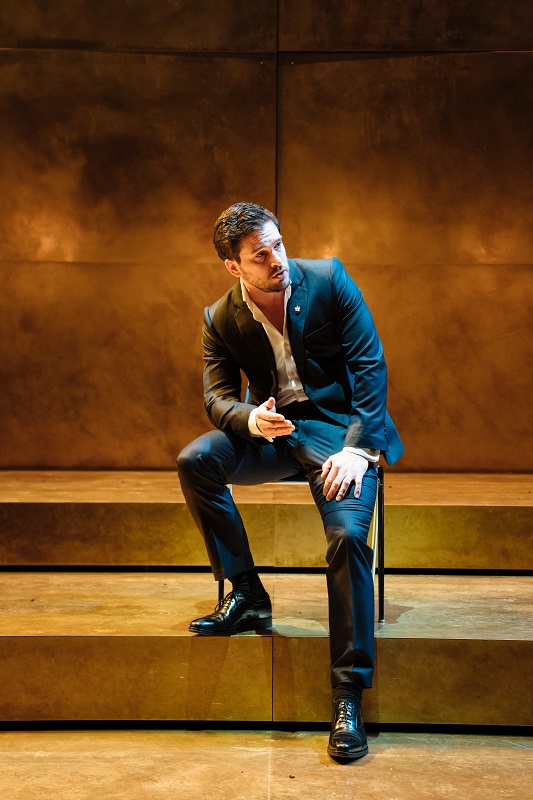 He walks the walk, but talks Shakespeare's talk too raspingly too much of the time (has he been shouting too much without proper support?). The sense is here but not the charisma that makes us hang on every word. It doesn’t help that the “Once more unto the breach” speech is noisily underscored, as if Webster were aspiring to mainstream Hollywood style. The night meditation is too public; quieter, more introspective timbres would draw us in to the king’s head more convincingly. The St Crispian’s Day speech has presumably been toned down from tub-thumping rhetoric, but it passes for nothing.
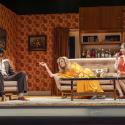
It all begins so promisingly. After the Chorus’s Prologue, Millicent Wong getting the sense if not the sound right as she asks us to imagine what in fact is going to be too palpably underlined with special effects, we get part of a scene between Prince Hal and Falstaff from Henry IV Part One, our hero’s first action being to vomit in a nightclub, and the rejection of Sir John from Henry IV Part Two. I was instantly reminded of the last Shakespeare production I saw here, a truly great one in the shape of one of Phyllida Lloyd’s women’s-prison Shakespeares. which grafted crucial scenes from HIV2 on to the first part. But though we get more context to try and make us be moved when Mistress Quickly relates the death of Falstaff, it doesn’t work, and the Boar’s Head Tavern brigade are the least well acted characters in the drama. Fortunately we get a very strong performance from Stephen Meo as Welshie Llewellyn to give backbone to the later semi-comic scenes, and the edge of his inflicting pain upon Danny Kirrane’s Pistol, an “Eng-er-lund” yob, with compulsory leek-eating is powerfully done. 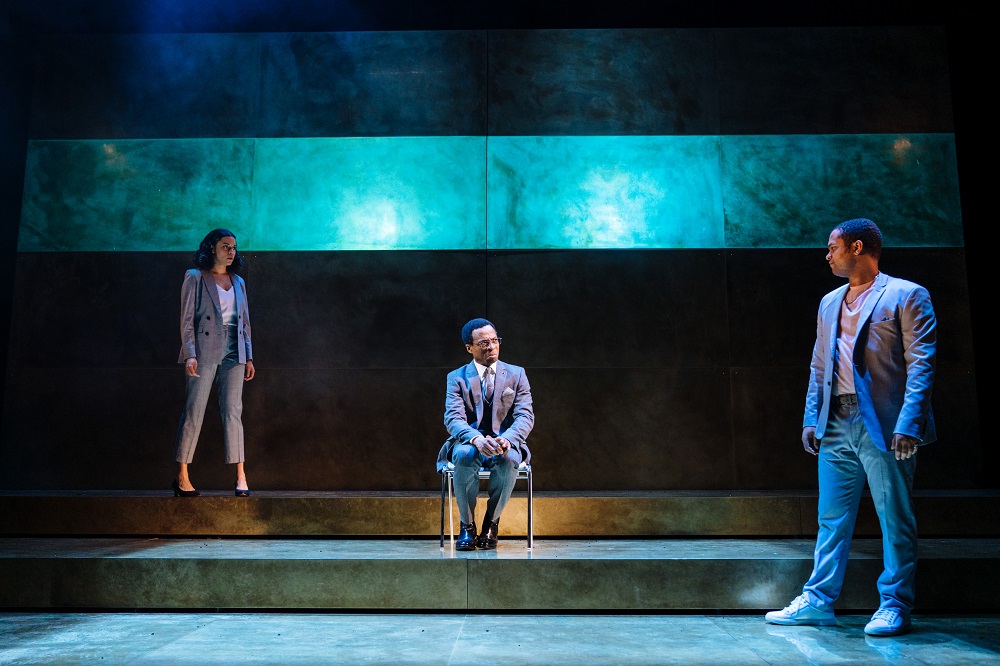 Scenes waver between strong and week. As a King of France speaking in his native tongue, Jude Akuwudike authoritatively leads the opposition, with a deftly-characterised Dauphin from Olivier Huband. The encounter with Kate Duchene’s Exeter is memorable, and Duchene here gives us the most musical verse-speaking of the evening. French Katherine’s English lesson from not-so-old gentlewoman Alice is splendidly parried by Anoushka Lucas and Marienella Philiips; the royal’s reluctance and fire as she endures Harry’s idea of courtship towards the end also hits home. (Pictured above: Lucas, Akuwudike and Huband).
The introduction of a vocal quartet singing English music from across the centuries is promising, but meshes uneasily with Andrew T. Mackay’s otherwise cliched score. It must have seemed like a good idea to have bass-baritone Adam Maxey deliver Purcell’s radical Cold/Frost song from King Arthur in the heat of the battle, but it counterpoints awkwardly with the fighting: an embarrassment at a time when we feel the horror of the real thing. Andrzej Goulding’s video design is striking, if over-used. There’s plenty to relish in an evening which is rarely dull, but less would so often be more from the clearly talented Webster.