You wouldn’t be surprised, in the programme for Elevator Repair Service’s adaptation of F Scott Fitzgerald’s jazz age masterpiece The Great Gatsby, to find instructions for gentle exercises to stave off deep-vein thrombosis. With a run-time of eight hours, during which every single word of the novel is spoken on stage, in one sense Gatz is no adaptation at all. It’s a marathon of textual faithfulness, a triumph of great literature over the much fabled waning modern attention span, and something of an endurance test during which "tender is the tailbone" starts to seem like a good subtitle.
But it’s not just the length that makes this show – which premiered to loud acclaim in New York in 2010 and opened in London last night as part of LIFT 2012 – an intriguing theatrical event. In retelling the story of fiction’s most nihilistic love triangle and elusive anti-hero, it becomes a play about the uniquely engrossing and interactive act of reading. And for most of these eight hours, we watch a man doing just that.
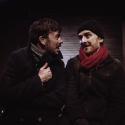
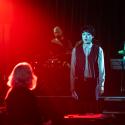
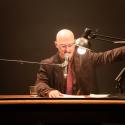
The overlap of fiction on reality is deliberately inexact. But the impact can be unevenSitting down at his desk one morning, a Midwestern office worker finds his computer on the blink and a copy of a great American novel in his in-tray. In between dutiful jabs at the escape button, he begins to read to himself – at first non-committally, trying both the dry humour and the strange portentousness on for size; then experimentally, stumbling over hard-to-pronounce names and sheepishly having a go at characters’ voices; and finally with almost complete absorption, the voice of narrator Nick drowning reality down to a submerged murmur, just as Nick himself is gradually sucked into the Long Islander’s flamboyant lives. The relationship between the two worlds becomes more intricate as office events, from the slamming of a window to the explosion of sexual tension, start to parallel those in the book. Soon the reader’s colleagues are standing in for Fitzgerald’s characters. During the closing passages, actor Scott Shepherd puts the book down and addresses us directly, capping an extraordinary performance that’s all epic casualness and heroic ease. Until then, he reads. He reads squashed up on a sofa at a party full of spilling breasts and wobbling drinks, almost edged out of the scene by its very exuberance. He reads prostrate under a table, as the hungover Nick waits for the first train home. And in the third act, over well-earned cigarettes and whisky, he reads the enigmatic Gatsby (Jim Fletcher, pictured above right) the truth of the man’s own history, to both their evident surprise.

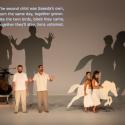
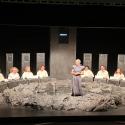
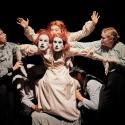
The overlap of fiction on reality is deliberately inexact. But the impact can be uneven. From the props to the performances, John Collins’ production can’t always decide between going for it on the drama, or playing up a comic gap between the demands of the plot and the resources at hand – cue a few too many gags hingeing on amateur hamming, or a cleaning spray fussily used to represent rain and tears. Daisy (Lucy Taylor)’s coarse, brutal husband Tom (Robert Cucuzza) converts pretty neatly from the bullish office security guard with keys jangling aggressively at his hip. Gatsby himself emerges from the quiet, aloof figure of the office boss. With his pale looming face, he’s a caricature of solemn inscrutability. Put him in a mismatched pink suit and you get a clownish Gatsby no Leonardo di Caprio would ever recognise, but one which plays on that sense of pitiful un-belonging. At times the office doors and windows seem to serve as portals into the novel, through which waltzes seep, tyres roll from crashed cars, and Nick spies Gatsby for the first time, isolated in a square of light. (Cast pictured above © Mark Barton)
But what Gatz plays with most meaningfully, with help from lighting designer Mark Barton, is the novel’s heightened sense of time, from the party guest who declares he has been "drunk for over a week now" to the surreptitious ripening of summer into autumn and the sudden horror with which Nick realises he’s just turned 30. In the office, time is frozen by a broken clock and obscured by fizzing strip lights. But the collapse of Gatsby’s dream takes place on a stage filling with elongating shadows.
Lasting as long as your average office day, Gatz offers a chance to fully immerse yourself in a novel (and hot damn it really is a good one) – something most of us probably haven’t done since the last summer of our own youth. Brilliant theatre? Not always. Worth the arse ache? And then some.
- Gatz is at the Noel Coward Theatre until 15 July