Hi. I’m Steve, creator of the solo show bearing my name on the Edinburgh Festival Fringe, and I’d like to make something perfectly clear: I’m alive. I’m not dead.
I’m nearly certain of that now, though there was a stretch when it became something of an open question. It was confusing. In some ways, it still is.
Which is partly why I’m here in Edinburgh performing a one man show with the not especially subtle title Steve Burns: Alive. Over the years I’ve become considerably more confident about the nature of my continued existence. I eat. I sleep. I pay taxes. My knees hurt now for reasons I don’t completely understand. But one nagging question remains, and it’s kind of a doozy. I was hoping you might help me think it through.
The question is: Is this real?
Look, I know that sounds like freshman year ontology after a long bong rip, but you can hardly blame me for asking. For roughly seven years I was the only living, carbon based organism on an otherwise fully animated children’s television show called Blue’s Clues. Everything around me was a cartoon. My best friend was a dog made of felt. I sang songs with a bar of soap. I had meaningful conversations with a mailbox. I was a somewhat pessimistic actor named Steve playing a relentlessly optimistic character, also named Steve, the only real human in a universe made of construction paper, sparkles and glitter glue. Spend seven years like that and see how confident you remain about the nature of reality.
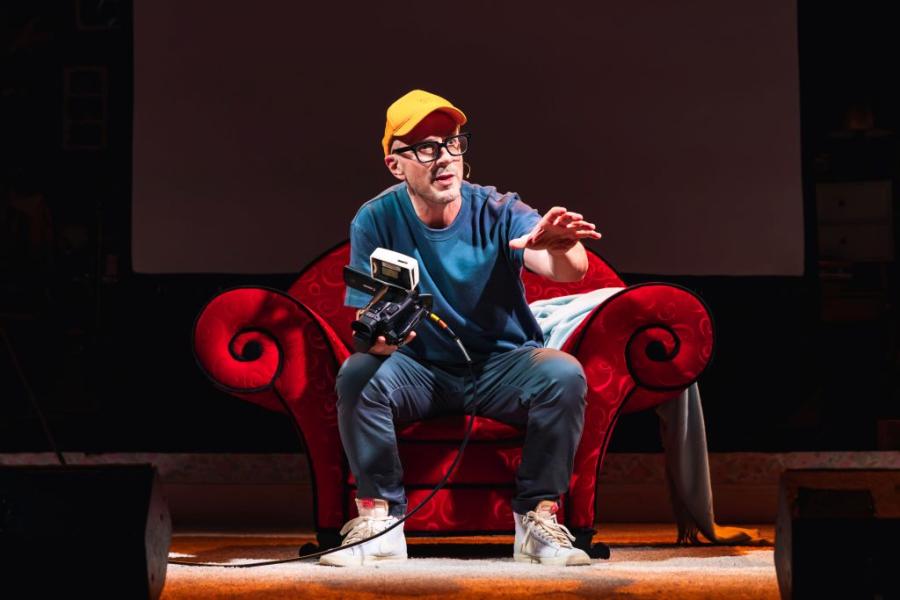
The show got surprisingly big. Really big. Bigger than Sesame Street for a while. It aired in 37 countries, and at the centre of the whole thing was this very simple idea. Every episode I’d walk up to the camera and ask one question: “Will you help me?” And then I’d wait. Really wait.
This was actually a very important part of the show. I was supposed to leave enough time for a kid at home to answer. So I’d stand there looking into the camera, waiting for a three-year-old somewhere in Ohio or Brazil or Melbourne whom I obviously could not see or hear. And they would answer. Of course I couldn’t hear them. I knew that. I was standing on a soundstage in New York looking into a camera. But something happened in that space anyway. Millions of children became convinced that I was talking specifically to them. More surprisingly, after a while I started to feel like maybe I was too.
I’ve spent years wondering what that made me. A performer, obviously. Maybe a friend. Sometimes I’ve wondered if it made me a kind of con man, which sounds worse than I mean it to. I knew I couldn’t see them. They knew, on some level, that I lived inside their television. But we were both agreeing to something. And whatever that something was, it felt real - at least to me.
If you don’t remember any of this, genuinely, that’s fine. That might actually be better. You don’t need to know me from the show to understand what it’s like to wonder which version of yourself is the real one. This, it turns out, is a universal struggle. Mine just happened to become unusually public. While I was making the show, the internet decided I had died.
There were different versions. I’d overdosed. I’d wrapped a car I never owned around a telephone pole. I’d been murdered. I’d been replaced by a lookalike, which is honestly a little insulting to both of us.
The rumors got so widespread that my mother once called me crying from a McDonald’s because a stranger had just informed her, with complete confidence, that her son was dead. And I had to explain to my mother that I was not dead - while talking to her on the phone. Eventually the producers sent me on what can only be described as a proof of life tour. The Today Show.
Magazine interviews. I even danced with Busta Rhymes on live television specifically to demonstrate that I continued to exist. None of it worked.
And none of it was true, obviously. I knew I wasn’t dead. But let me tell you something you probably already recognise. When enough strangers confidently agree about something, even something completely false, that agreement starts to have a weird kind of weight. I could say I was alive. The internet could say I was dead. And the internet was louder. This was a long time before social media became what it is now, before all of us got used to watching thousands or millions of people agree on some twisted version of reality in real time. But I think I learned something from it that I didn’t really have words for then. If enough people tell you something about yourself, eventually some small part of you starts to wonder if they know something you don’t. So there I was, twenty six years old, standing in the middle of my own urban legend, slowly beginning to doubt my own being.
And what made all of this harder was that I was also living with undiagnosed severe clinical depression. That is not an ideal condition when your job is to be the happiest man in North America. We get into that onstage, of course. This is the Fringe Festival, after all, where oversharing about your mental health seems to be mandatory.
That part is still difficult for me. I’m not especially practiced at connecting with three dimensional human beings. I’m better than I used to be, I think. But there is still something about a camera that feels easier to me. So I spend a surprising amount of the show talking to one. I use it the way I always have.
To connect while hiding. To be present and absent at the same time.
I can look directly at you without actually having to look at you. And I know that’s strange. Except maybe it isn’t anymore?
We’re all living through cameras now. We talk to little glowing rectangles. We want to know that somebody is there. That they can see us. That they can hear us. That whatever this thing is between us is actually happening. I don’t know. Maybe I’m making too much of it. I genuinely don’t have this figured out. That’s sort of the point of the show. I’m still trying to work it out, in real time, on a stage in Edinburgh, in front of you.
And after all these years, I seem to have ended up more or less the same place. In front of a camera. I have a question. I’m looking at you. And I could really use your help.
Will you help me?
- Steve Burns: Alive is at Belly Button: Cowgate through 30 Aug
- The Edinburgh Fringe runs until 31 August
- More theatre reviews on theartsdesk