The aftermath of school massacres for those left behind, and the pros and cons of restorative justice have become two strong themes for drama in recent years. Writer Fran Kranz combines the two, in an intense, claustrophobic piece that attacks both the brain and the heart.
Mass has had an unusual journey: Kranz originally conceived it as a play, before turning instead to film (of the same name, in 2022), but then reworking it for his intended medium, which has its world premier at the Donmar. I haven’t seen the movie, so can’t compare; but it is perfectly at home on stage, and especially the intimate space that the Donmar offers, giving a sense that we’re eavesdropping on four people trapped with each other in some sort of purgatorial cat and mouse.
It is some years after a school shooting, in which several children were murdered before the lone student who killed them turned the gun on himself. The parents of one of the victims, Jay and Gail (Adeel Akhtar, Lyndsey Marshal) have asked to meet those of the killer, Richard and Linda (Paul Hilton, Monica Dolan). It’s a formal meeting, one of restorative justice, held in a room of an episcopal church – a bright, calm, neutral space in which Kranz, director Carrie Cracknell and the actors offer a real-time showdown.
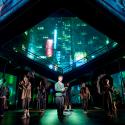
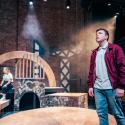
Designer Anna Yates has created a convincing, tangible, two-storey environment – what might be a social room for the church, or a play space (young children’s drawings are stuck, rather poignantly to a glass partition), with a kitchen behind, and light streaming in from windows above. A member of the church and a teenage boy (Susie Trayling, Amari Bacchus) are preparing the room, she skittish, trying too hard to make everything perfect, he curious but also a little churlish. When the moderator, Kendra (Rochelle Rose) arrives, their extended small talk serves as a slow-build whose banality actually cranks up the expectation and tension.
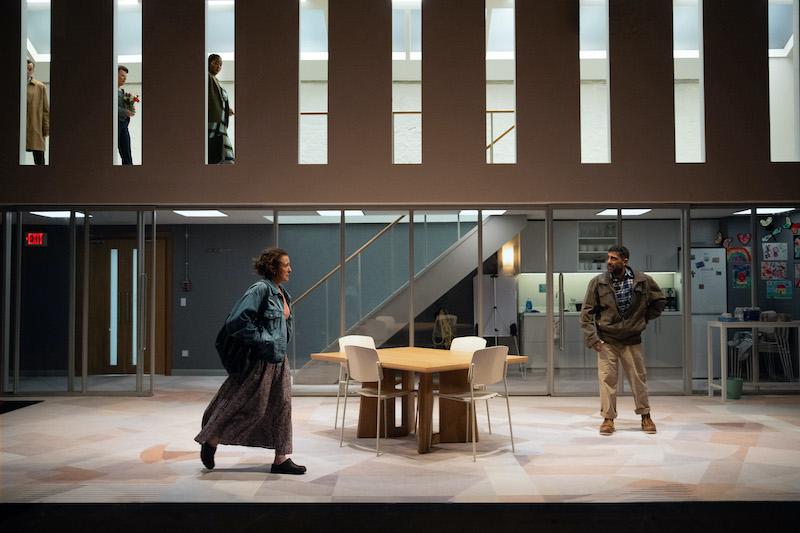
When the four parents arrive, these three withdraw. Jay and Gail are first, she telling her husband: “I don’t think I can do it,” and he assuring her, “We’re OK.” This is pitiably inaccurate: none of these devastated people are at all OK.
Linda arrives with flowers. She and her husband are thanked for agreeing to the meeting. They sit. The opening exchanges are tentative, awkward. There’s the talk of attorneys, of angry letters and regrettable words, confrontations of the past that they want to put behind them. These people have been sparring for years, it seems, but now they are finally face to face. What they hope to achieve from the meeting – to understand, to forgive, to be forgiven – amounts to a closure that would seem impossible. But try they must.
In the first instance, the blocking of the play seems hopelessly restrictive, the backs of some actors obscuring the faces of others; but Yates has created an imperceptibly slow yet extremely effective revolve, of the table alone, allowing a full reveal of the intricacies of this tormented exchange. Jay and Gail are understandably setting the agenda. They say that they want to listen, to heal, not to interrogate. But Jay can’t help but launch into a gun debate, with Richard taking the bait and only making matters worse with his matter-of-fact delivery and misguided determination to be objective. Gail tries to bring it back to the boys – her son, Evan, and Hayden, his killer. She wants to know why.
Over the next hour these four will wrestle with this very question. How well did Richard and Linda know their son, was there an inkling of his murderous instinct, his intentions, did they try anything to deal with his isolation and moods? Why didn’t they speak out more, after the massacre? Deep down, Jay still wants them to suffer, and to admit that their son was an evil madman. Richard and Linda, vilified for years, denied the space or respect for their own grief, quietly bring home the reality of their guilt and pain. The quartet will accept that Hayden has destroyed all their lives; along with the loss of their sons, and the fallout for their surviving children, these are marriages that have been shredded by the experience.
It’s an impossible, circular conversation, the usual questions about the validity of restorative justice accentuated when it is not the perpetrator who is present, but his parents. Is forgiveness the only solution for Jay and Gail? And should Richard and Linda even have to be forgiven for the actions of their teenage son?
James Graham’s Punch recently won the Olivier Award for best new play for its powerful account of restorative justice, while We Need to Talk about Kevin (book and film) chillingly conveyed the nightmare of a teenage killer’s mother. Mass may not leave audiences quite as shaken, or stirred, as either, and it feels like it's straining at times to cover all its bases; nonetheless, it does succeed as an absorbing, thought-provoking, deeply saddening battle of fragile souls.
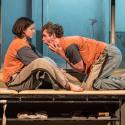
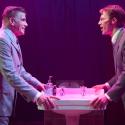
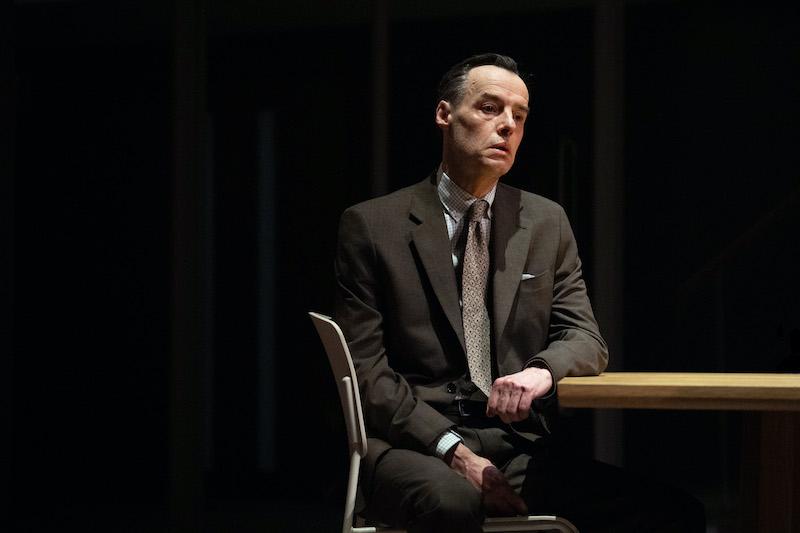
The actors are uniformly excellent. Akhtar, returning to the Donmar after his great turn in The Cherry Orchard in 2024, is a study in coiled fury. Marshal quietly expresses the almost impossible quest to understand the unfathomable. Hilton’s Richard (pictured above), absurdly formal in his brown suit and slicked back hair, reveals estrangement with just one lonely hand reaching out towards his wife, but not met; and when accused of knowing nothing about the victims, looks as though he will snap in half when revealing that every single bullet wound in every child is etched deep into his memory. Dolan is heartbreaking when finally revealing her most residing and tormenting memory of her son.
Cracknell, fresh from her triumph with Arcadia at the Old Vic, marshals all of this with economy and precision, deftly introducing some unexpected catharsis and a glimpse of value, in this bleak encounter, for the young lad watching from the wings.