“Wagatha Christie” – I salute the bright spark who coined the term – describes, for those who don't follow such fripperies, the social media spat between footballers' wives Rebekah Vardy and Coleen Rooney (married to Jamie and Wayne respectively), which later became the subject of an multimillion-pound court case.
In October 2019 Rooney posted a now famous “reveal post” on her social media; for months, she wrote, she had been doing some sleuthing to find out who was leaking stories from her private Instagram account about her and her family to The Sun. By a process of elimination and by planting false stories, she deduced: “It’s... Rebekah Vardy’s account”. Cue denials and failed attempts at sorting the silly mess, and it – unbelievably, you may think – ended up in the High Court in 2022 when Vardy sued Rooney for libel. The case took seven days to complete.
Now Liv Hennessy has adapted the verbatim court record and, in an inspired theatrical device, inserts two pundits as if they were analysing the action from the sidelines; while they add comedy value, they also fill in context in the story and explain some obtuse legal points as well. The production was in the West End briefly last year but is now having a “normal” run.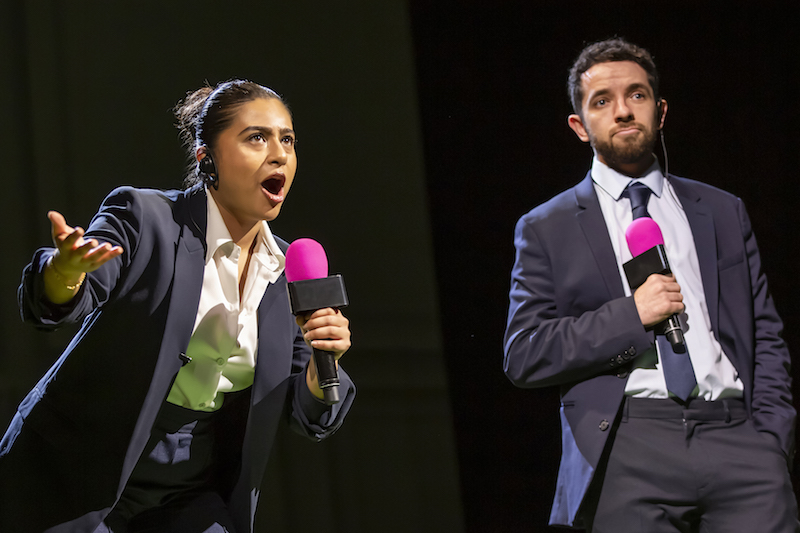 Verbatim plays, however well edited, can sometimes struggle, but not here because the lines seem to write themselves. While being cross-examined, Vardy says: “If I’m being honest”, to which David Sherborne (Rooney's QC) responds: “I would hope you are being honest, since you’re in the witness box in the High Court.”
The performances are excellent. Lucy May Barker as Vardy is all moues and bravado, while Laura Dos Santos plays it straight as the aggrieved Rooney; but then Vardy has all the best lines, not least her reference to the size of former lover Peter Andre's penis and her withering WhatsApp descriptions of Rooney.
Tom Turner and Jonnie Broadbent are suitably sneering as the QCs, while Halema Hussain and Nathan McMullen (pictured above) threaten to steal the show as the pundits. Polly Sullivan's courtroom set is simple but stylish and Lisa Spirling's production tells the story efficiently, even if the pace noticeably drops in the second act.
You don't have to like football to like Vardy v Rooney because it's not about the beautiful game; it's about privacy and responsibility in the age of social media but also about how badly people can behave while convincing themselves not just that they are innocent, but that they are victims too.