The Channel 5 drama Power: The Downfall of Huw Edwards does what it says on the tin. We watch the fêted newsreader from initial online contact with a 17-year-old from Cardiff - called “Ryan Davies“ here - to his arrest three years later, his sense of omnipotence shattered. Edwards’s family are noises off, and his work is represented by one BBC producer; only Ryan’s life is explored in any depth.
This partial view is understandable given that Mark Burt’s screenplay is based on exclusive chats with the real Ryan, his family and friends, but not on material provided by Edwards and his family. (The producers claim he declined to contribute to the project; his legal team are calling the drama “unfair” because they were shown only a completed version and weren't approached to confirm its facts.) Ryan’s grooming by Edwards did not appear on the eventual charge sheet, and his true identity has never been revealed. So Burt’s script represents something of a journalistic scoop, though not as fully formed a drama as viewers might like.
The incidental music is a clue to its intentions, an austere composition for violins that scrape arpeggios set to make the nerves jangle, as if the tension here is: “Will Huw Edwards get caught?” For those who managed to sleep through the slow seeping of revelations back in 2022, the title makes the answer patently obvious. This attempt at moody tension continues throughout, urging the viewer to move on to: “Will Ryan fall into his trap? Will he get caught?” Again, for those who tuned out or don’t remember, yes to both questions, but has remained a shadowy figure until now.
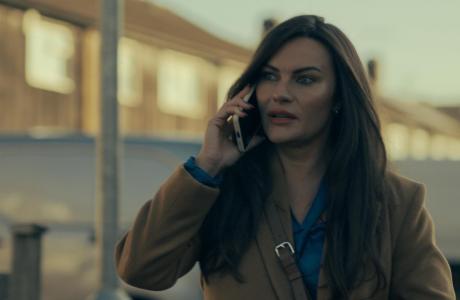
It was his suspicious mother who started the pushback against Edwards’s behaviour, aided by her husband, Ryan’s stepfather, a “nonce”-hater who went to confront Edwards when he found out the newsreader was visiting Cardiff for a tryst with Ryan. He was also the person, it seems, who realised the best attack was via the press, and soon Scarlet Howes of The Sun (Chanel Cresswell, pictured below) is in the family’s living room, being given the material for a career-making exposé.
What gives the piece its dramatic motor if the details of the case are limited and much of what it recreates is already known? Is what wasn’t previously known worth basing a drama on? Just about. We have a context for assessing Edwards’s victim, living on an estate with a soundtrack of constantly barking dogs, his home a morose, underlit place where his stepfather is openly hostile to him and his mother is worn down by the aggression. And being able to reproduce the texts between the two men works to chilling effect.
Thanks to these texts, we learn that Edwards called Ryan “baby” and wanted to be addressed as “Daddy” in return. There’s something horribly mechanical about their relationship, as if Edwards is practised at this, instructing Ryan matter-of-factly in how to set up the PayPal account where payments for his videos of himself will be deposited. Through the evidence provided to the police by Alex, the go-between who connected Ryan to Edwards, we also know Alex supplied Edwards with indecent images of children, and that the three he confessed to were in Category A, the highest on the indecency scale, involving children as young as seven. (Alex told the programme-makers, and the police, he sent Edwards many more than that.)
Ryan’s relationship with Edwards, as depicted here, then becomes a standard dom-sub one, where Ryan is lured into an emotional connection that may or may not have been remotely real for Edwards. But it is real for Ryan, who naively does all he can to satisfy the stern condition Edwards had first greeted him with: “BE LOYAL!” The two eventually meet, though sexually it is not a successful encounter, we learn. They openly stay in the same room at a country house hotel, where other guests recognise Edwards at once. He revels in his control over Ryan, a mirror image of the status he wants to be given in the wider world - a man, he announces in a voice-over, who’s too “important” to be vulnerable. It’s hubris with toxic consequences.
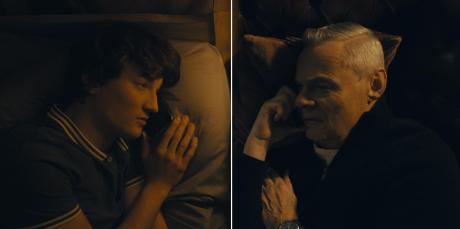
But there is a void where a deeper delve into the men’s psyches could be. We are bystanders at this event, and the onus is on the actors to deliver the compelling subtleties the script isn’t strong on. Osian Morgan’s Ryan (pictured below left) emerges as a simple kid who wants enhanced buying power, mainly for the latest trainers, but also to escape his unhappy home, which he does by moving in with his female bestie, Sash (Aisha Maye Hunte), a punky peroxide-haired misfit who starts seeing Edwards as a cash-cow. Has Ryan been scarred by his encounter? It's hard to be sure of that.
It’s Martin Clunes who manages to flesh out the emotional landscape. For the second time in recent months, after his standout turn as a bestial Mr Earnshaw in Wuthering Heights, he delivers an unlikeable man, somehow transforming himself into the slimline, bullet-headed news presenter, whom we see pounding the pavements in jogging gear and beating seven bells out of a punchbag.
Clunes is subjected to regular close-ups, in which his familiar perky features seem to morph into Edwards’s, the angle of the raised eyebrow just right over fierce eyes, the mouth severe and shut tight, the voice a sinister bark when he’s angry, the left arm resting on his newsreader desk. (His trademark ears, Clunes told an interviewer, were somehow stuck close to his head.) He’s dictatorial verging on cruel, but pathetically panicked when he realises his secret life has been unmasked.
We get a sense of his predatory sexuality when we see him masturbating furiously to one of Ryan’s videos. But that’s a rare sighting of anything carnal. The script doesn’t milk our fury at this pillar of the Beeb, the sober bard at the Queen’s funeral, though presumably many will feel it; and it doesn’t betray any sympathy for Edwards, later said to be suffering from severe depression, as if he is a victim too. It carefully doesn’t lambast The Sun, either, whose investigations have been fed into the script. The tabloid is projected in an even-handed, almost anaemic way, with its editor, Victoria Newton, portrayed as a canny operator who senses she risks public condemnation if she attacks Edwards too strenuously.
The best moment comes in the last minutes, when the script veers off-piste and imagines Edwards in his usual newsreader mode, crisp and emphatic, giving his final bulletin - about his own transgressions. He explains his conviction, defining in clinical, disturbing detail the legal categories of indecent imagery under which he is being charged. Then he gives a curt: “And that’s it from me” and is gone. It’s the kind of flourish the piece needs more of. Instead, it’s a drama seemingly designed not to shock too much or crush too many toes.