Immigration…immigration… immigration… that’s what we need! Not the words of record-breaking, tap-dancing trumpeter Roy Castle, rather it’s the gist of a Times leader from 1853 (admittedly, fairly heavily paraphrased). It was just one of the eye-opening discoveries in Ian Hislop’s engaging BBC Two documentary about the birth of one of the most divisive political issues of the last 100 years, as he looked at surprising historical pinch points and used them to shed light on their future shocks.
Britain’s open-door policy in the mid-19th century was, we were told, an issue of moral importance. For many, it defined Britishness: our arms were open to the world. In the light of recent events and the general nature of discourse in the Brexit referendum and following election, it’s an attitude that’s barely recognisable now. Much of what followed, however, was eerily familiar.
The press recognised the value of stories that scare and threaten their readership
Hislop’s investigation into what happened when the numbers of people arriving increased – particularly East London’s Jewish community – was very telling. Workers were put out at the pressure this placed on wages. Then, as now, the anger was directed at the new arrivals rather than a system that is stacked against them and employers unable or unwilling to pay a decent wage.
Then, as now, a posh man with a bullish attitude, in this case William Evans-Gordon, stepped forward shouting meaningless platitudes about “taking back control” from the “foreign invaders”. Then, as now, the toxic climate led to the rise of racist thugs. The British Brothers’ League were like a Victorian EDL but stronger on spelling, judging by their poster (pictured below). “British homes for British people!” they cried, before descending into the more traditional right-wing rhetoric of stock anti-semitism.
They weren’t alone. The revelation that Mancherjee Bhownaggree, an Indian-born Conservative politician, was elected to Parliament as MP for white, working-class Stepney was astonishing. He won on a staunch anti-immigration ticket, but any suggestion that his campaign literature, hammering home relentless accusations about the dangers of “pauper aliens”, bears any resemblance to Tory peer Baroness Warsi’s 2005 election pamphlet is going too far. Hers had pictures on it for a start, and a whole range of fonts.
Even then, the press recognised the value of stories that scare and threaten their readership. Panic sells. Hislop’s interview with Anna Chen about the invention of the “Yellow Peril” to stoke utterly unwarranted fear and suspicion about the small, law-abiding Chinese community in Liverpool could have come straight from the Sun or Daily Mail.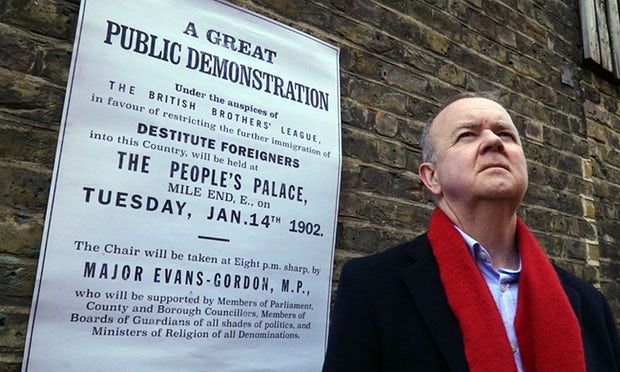 Speaking of which, we need to talk about Katie. Sorry, but the segment of the show in which former Sun columnist Hopkins tried, with staggering chutzpah, to claim her description of Syrian refugees as “cockroaches” was, in some way, a tribute to their enduring stamina, was like watching someone smear their own shit on a child’s face and claim that they’d only done it to protect them from sunburn. “It’s not whipping up hate,” she claimed, “there’s a lot of stuff you can’t say,” while blaming liberal elites for closing down discussion. There’s plenty you can say, but inciting hatred is a crime. I’d lock her up. Better still, deport her. Syria should do nicely.
Thankfully, there were some enlightening examples to counter. I had no idea, for instance, that the young Conservative Winston Churchill was so fervently for open-door immigration that he abandoned his party over the issue. Lady Lugard, who worked tirelessly for Belgian refugees during the First World War, was also new to me. Finally there was Jennifer, a woman who has opened her home to Syrian refugee Mario, showing the compassion and empathy that appear to have been surgically removed from Hopkins.
Hislop’s ending plea for an “open mind” policy, in which we rigorously test the facts surrounding the debate, was a welcome conclusion but, I fear, an unlikely outcome. We live in a society where racism has been legitimised by people repeatedly telling us that it’s not racist to hate foreigners. The population has been split and pitched into a terrible and largely intractable tussle for control of its borders. And in a tug-of-war, it’s those willing to throw their weight around who generally win.