How much more can Jeremy Clarkson’s body take? The fifth season of his reality show about his Oxfordshire spread, Diddly Squat Farm and pendant pub, could have been borrowed from the Book of Job.
Neatly winding up season four with an impending heart attack, this time, as headlines have announced, he calmly reveals to his team that he also has aggressive prostate cancer to tackle. But not until his drought-addled crops have been harvested, of course.
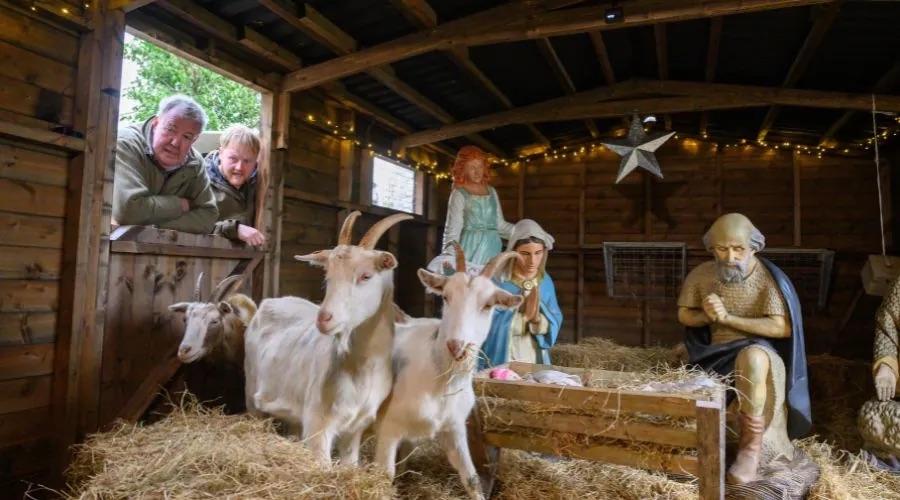
The sheer fortitude of the man is compelling. As each sunny day prompts him to tot up his blessings, you just know a big “but” is coming, delivered in his solemn, biblical-epic voice, streaked with irony, as the universe launches its latest slings and arrows at him. Torrential rain, drought, Storm Darragh, goats in his Santa’s grotto (pictured below, watched by Clarkson and Kaleb), TB testing, travellers camping in the pub car park: he has to cope with them all. He invests in what he calls "EasyCare sheeps', and loses one almost immediately to apparent heartbreak.
Even so, he finds the headspace and energy for new ideas. In one fascinating episode, he and regular sidekick Kaleb Cooper travel to the Netherlands to see how innovative farmers there use high-tech to increase yields and cut costs. The couple running a floating, fully sustainable dairy farm on a river in central Rotterdam are inspirational. Kaleb’s brain almost bursts.
Back at Diddly Squat, a driverless tractor duly arrives, the ultimate Clarkson toy. He can stand with a handset, sending it through its preprogrammed motions, like a dad at a park pond steering a battery-operated little boat. This is a monster piece of equipment, bigger even than his beloved “Lambo” tractor. He also gets Dutch farmer Jacob to bring over his self-invented scanner, which can make a detailed map of a field’s variable soil quality; the "AgBot" can then be programmed to raise and lower its muck-spewing accordingly. If I told you which animals provided the muck, you might not believe me.
Another foe appears this season, more despised than all the rest: Rachel Reeves. (Though, ever the gentleman, it’s a Keir Starmer effigy Clarkson burns on his Guy Fawkes bonfire.) Reeves’s Budget effectively condemning family farms to sell up if they have more than £1 million in “assets” (eg, a typical dairy herd alone) is now a prime target of his considerable ire. Ditto Defra, a regular in his crosshairs. He joins a protest march at Westminster, moved to expose the false claims in Reeves’s Budget speech.
All the usual cast members are back — the gloriously incoherent Gerald, aka “G-dog” (pictured below, far right, with Kaleb and Lisa); Charlie Ireland the farm manager, aka "His Cheerfulness”, bringer of bad news; Dilwyn the vet. Only Simon and his combine harvester are missing. But Kaleb — who has his own harvesting deadline, the imminent arrival of his third child — has invested in a secondhand combiner, so he can now, for the first time, perform that role himself. His face radiates the satisfaction of a man doing what he loves. (Five minutes between contractions? No sweat, plenty of time to get to the hospital.) This season, the list of people and events Kaleb has never heard of is added to, but in a gently teasing way. It’s clear the bantering bromance between him and Jeremy is strengthening.
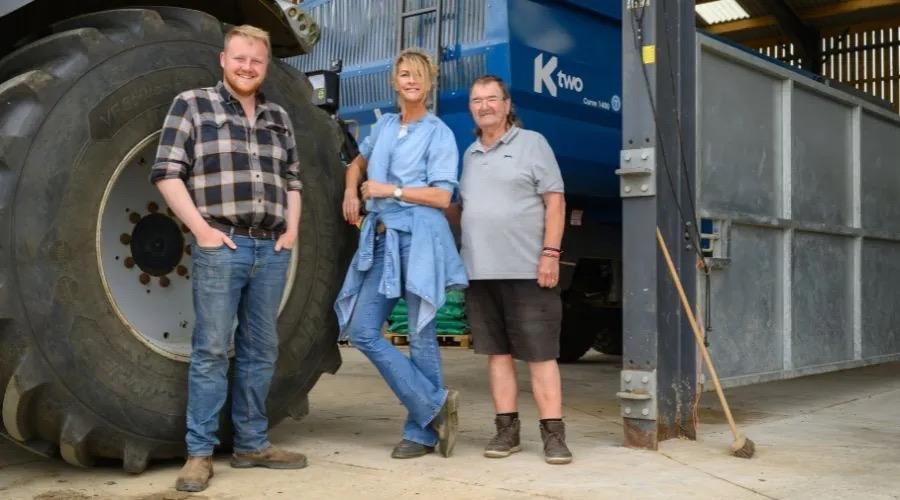
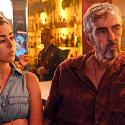
With Jeremy’s prostate under the surgeon’s knife, his hardy girlfriend Lisa (pictured above, centre) has to step up and learn to back a grain trailer into a barn. As usual, she is more than equal to the task. Any suspicion that she might have Petit Trianon tendencies are dispelled this season, though her contributions do tend to be fluffier than Jeremy’s: raising gaggles of "geeses" for slap-up banquets at the pub; breeding puppies and a half-dozen little Valois "sheeps", the K-pop stars of the ovine world; and, best of all, creating a snail colony, whose by-product, mucin (slime), she plans to use in ointments and cosmetics.
Equally enterprising is hippie Hannah, who can identify birds from their song alone, a skill she learned in Africa while nursing a little bird that had started nesting in her hair. (Only at Diddly Squat.) Hannah draws up a fascinating map of the farm’s birdlife, but then goes mano a mano with Kaleb when she learns he has been baling up the remains of the harvested fields for silage — vital winter food for the cows, but a miserable death for the little skylarks nesting invisibly in the stalks, she argues; their numbers are dramatically dwindling thanks to modern farming practices. Clarkson has to play referee in this impossible bout, which he does with impressive politeness and common sense.
Elsewhere he is pushed to the limits, especially about his new life as a man with a dodgy ticker who has to avoid stress and eat those well known “meat-accessories” called vegetables. So, he notes mordantly, all the “sheeps” he raises for his pub menus are off-limits. “A petulant little child”, Lisa calls him. But he is also a man with unexpectedly moving ties to his livestock, quietly sniffing as animals that have been condemned to death by Defra, or sheer economics, are herded into the abattoir lorry.
The formula of the show hasn’t changed since its inception, 10 years ago: lyrical shots of the natural world, jostled by the raw realities of farming life and a stream of Clarksonisms. (“Tractoring” is my favourite.) But the man in the show has changed. He’s still a petrol-head, drooling over sexy machines, but he has becomes a conduit for the farming community’s unhappiness at their treatment by officialdom. He rightly dislikes the term “national treasure”, but he’s definitely an ambassador for the farming life and a shopwindow for its many pluses, as well as its minuses. “Why do people farm? Jesus Christ!” he rages. Yet even from his hospital bed he is projecting being back for a sixth season.
- All eight episodes of Clarkson’s Farm 5 are available on Amazon Prime
- More TV reviews on theartsdesk