Marc Quinn is used to making a spectacle of himself. In Self (1991 and ongoing), a life-sized cast of his head was filled with his own blood. It was a stark and sobering reflection on what we all share, the universality of the most basic of human elements. But with the works in his new show Allanah, Buck, Catman, Chelsea, Michael, Pamela and Thomas, "spectacle" becomes the operative word, and universality is nowhere to be found.
In these sculptures, produced over the last two years, Quinn has chosen to produce portraits of people who have elected to undergo radical and repeated cosmetic surgery, hormone treatment, or tattooing and piercings. This work is no longer a look at what all humanity involuntarily shares, but rather what a certain infinitesimal section of the population has chosen to do to themselves.
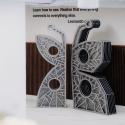
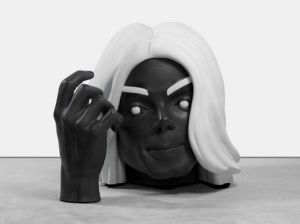 The Ecstatic Autogenesis of Pamela is a bronze of the television actress, silicone to the fore as she thrusts her breasts skywards. This is, perhaps, the acceptable face of cosmetic surgery, a woman who owes her career to artificial enhancement, but whose interventions now seem (at least in Hollywood) normative. One stage further down the road are two marble heads of Michael Jackson, Man in the Mirror and Man in the Mirror (Monochrome Reversal), one a white marble face, one black (pictured above right).
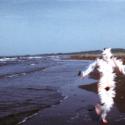
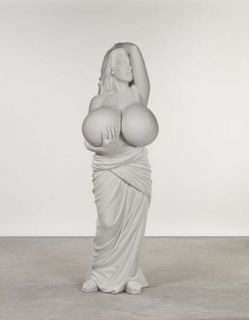
And then there are the extremes: a portrait of Chelsea Charms (pictured below), whose breasts, the press material finds it necessary to tell us, weigh 52 lbs. And Buck and Allanah, two porn stars who have undergone transgender surgery, but remain in a halfway state, having sex, Allanah's penis penetrating the male Buck’s vagina. Buck, in a separate piece, poses with cigar, tattoos and vagina; each of these appendages is presented as no more essential than the others: they seem all to be lifestyle choices. It doesn’t take a visit to Dr Freud to recognise a series of pathologies – sometimes a cigar is not just a smoke.
 My discussion has focused thus far on psychology, pathology and sexuality, not on the art, for, despite Quinn’s reliance on traditional materials and styles, the art is dull beyond imagining. It is competent, certainly, on a technical level, but it is also facile and bland in presentation, relying entirely on pathology to create interest. The two Michael Jackson pieces would look at home in Disneyland, or as balloons in the Thanksgiving Day parade down Fifth Avenue: they are pure mainstream commercial art.
Quinn, in a very obvious attempt to ward off the suggestion that he has created a 21st-century freak show, has stressed the agency of his models, suggesting that they are artists in their own right – outsider artists – who work on themselves instead of on canvas. He compares them to the embryo sculptures he produced a couple of years ago, and thinks "the transformation from embryo to fully grown adult is much more extreme than anything that any of the models have undergone". True, perhaps, but that change is both involuntary and universal. The same cannot be said for his models, who have not only been driven by their own psychodramas to these extremes, but are now reduced by the artist to a fetishised commodification of these psychodramas. Not an edifying spectacle.
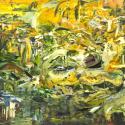
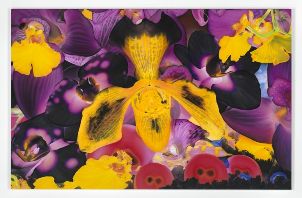 By contrast, Quinn has continued to make his lush, saturated flower paintings (Photoevaporation, pictured right), and they remain satisfyingly strange, neither one thing nor the other, finding an eerie no-man’s-land between photography and painting. On the walls of the White Cube, they manage to remain above the fray, on another level entirely from the sculptures they surround.
- Marc Quinn: Allanah, Buck, Catman, Chelsea, Michael, Pamela and Thomas at White Cube, Hoxton Square until 26 June
- All images by Roger Wooldridge, courtesy White Cube