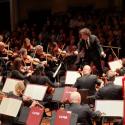
This Barbican concert began with a Mendelssohn overture and ended with a Haydn symphony. But on stage were the BBC Symphony Orchestra and Ilan Volkov. What did you expect in between, a Mozart piano concerto? Not likely. Instead they gave the first performance of No.48 (night studio) by Richard Ayres. English-born but resident in the Netherlands and working mostly on the Continent, Ayres has impeccable post-Minimalist credentials (studies with Louis Andriessen and Morton Feldman) which do no more than hint at how his music behaves – like a kid in a well-stocked acoustic sweet-shop. Or at a fairground.
The opening of No.48 was a characteristic Ayres refrain, a frantic merry-go-round of bells and piccolo alternating with earthy brass that brought the 20-minute piece to a yah-boo-sucks anti-closure. In the middle, a pocket primer to good old classical music, structured (if that’s quite the word) by a tape part that’s part German radio announcer, part Beckett radio play. Twenty-second sonatinas, symphonies and concertos come and go, each lugubriously announced (Allegro – Adagio – Scherzo) and punctuated by the click of a door latch, steps, a sigh.
Is No.48 a parody of our attention spans? Or of our tenacious attachment to art-culture and certainties that harden into prejudices? Is the orchestra in the room, misbehaving when our man has popped out? Or is it in his head? Ayres’s music is baffling, and it’s meant to be, but it’s also funny and unnerving, like Beckett, or indeed the art of Philip Guston which Ayres claimed was an inspiration for the piece. Guston was an inveterate lucubrant – hence the subtitle – and No.48 paints a picture in sound of a man alone, with only his thoughts for company. The speed at which it cuts between Austro-German clichés reminds us that we think faster than we listen.
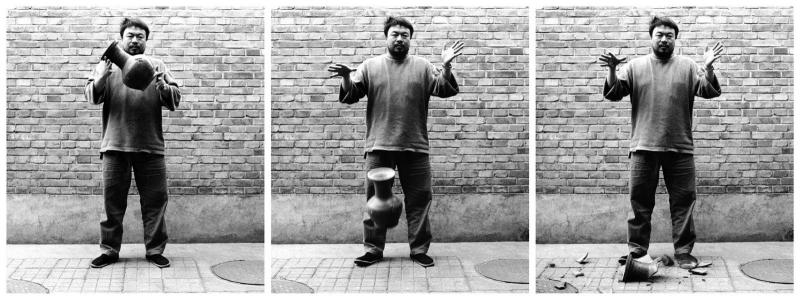 Listening for the continuity traced in classical narratives would miss the point. We bring different eyes to Rembrandt and Ai Wei Wei. Indeed Ayres and Ai share a weary fascination with the past and the weight of history which is captured by Dropping a Han Dynasty Urn, 1995, presently on display at the Royal Academy (and pictured above). However, Haydn got there first, as he always does. The slow movement of Symphony No.52 is to all intents athematic, no less than Ayres. Stuff happens, then it stops. On paper it looks far easier to play than Ayres’s copiously orchestrated candyfloss, but every phrase needs a direction and commitment that were lacking here. The tigerish ferocity of the first movement had its teeth extracted. The minuet was pretty, and pretty aimless.
In the Calm Sea and Prosperous Voyage which Mendelssohn wrote as a prototypical tone-poem after Goethe’s texts, the BBCSO made a much more convincing simalcrum of an early 19th-century orchestra than Haydn’s late-18th band, not through unpractised aping of manners such as pure tone and clipped phrasing but the transparency that naturally arises from their expertise in new music. Volkov revealed all the instrumental colours of Mendelssohn’s painterly eye and ear including a naturalistically piercing piccolo breeze and a piping naval trumpet trio to announce safe arrival in port. Beethoven’s vocal-orchestral setting of the same Goethe poems was far more generic, or so it seemed here, and the men of the BBC Singers returned after the interval for more aquatic Goethe – Schubert’s Song of the Spirits upon the Waters. It was, all in all, a typical Volkov programme, lacking polish but more than compensating with music to make you listen afresh.