Perhaps it was the thought of “Blue Monday”, which fell a week ago, that stimulated the choice of Lili Boulanger’s D’un soir triste as the opening piece of this concert. Certainly there can be few short pieces of music filled with such unremitting misery from start to finish.
Anja Bihlmaier, the BBC Philharmonic’s principal guest conductor, is normally not one to wallow in lugubrious gloom – far from it. But she entered the spirit of music written by the tragic composer who died very young in 1918 and whose last work this was, completed not long before her demise in piano trio form. It was later orchestrated by her sister Nadia, following indications in the manuscript, so it is to the two of them that we are grateful for the sound of its thick textures and mournful, slightly modal harmonies, the only shafts of light coming from occasional upward-rushing anacrusis figures and a final major chord.
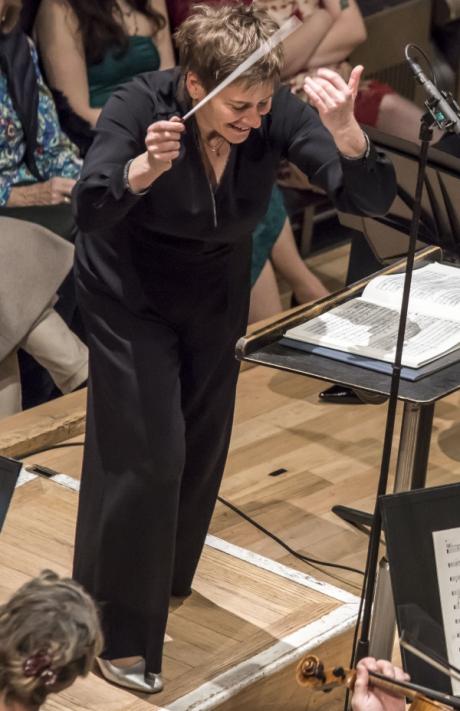
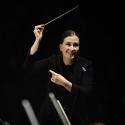
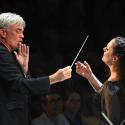
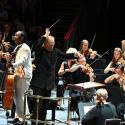
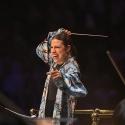
Anja Bihlmaier (pictured left) built it into a set of climactic paragraphs and highlighted those touches of positivity, for what they were worth, making an impressive peak of its central moment of huge timpani thuds (thanks to Tim Williams) and brass chords, and allowing the solos for violin (leader Zoë Beyers), viola (Steven Burnard) and cello (Peter Dixon) to gleam amid the darkness. Perhaps it was projected as a reflector of the mood of the big work still to come, Bartók’s Duke Bluebeard’s Castle. Perhaps it was all an essay in an intellectual discipline which I never knew existed until last week, when promotional material for a partnership event between Manchester Metropolitan University and the Royal Northern College of Music came my way. “Gothic Studies” even includes Beethoven in its remit, apparently… well, he was a rum kind of cove.
But before the darkness descended (literally, in the Bridgewater Hall for that hour-long second part of the concert), Anja Bihlmaier lightened the mood with Kodály’s Dances of Galánta, and what a contrast that was. Mock lugubriosity, followed by swaying rhythms, crazy tempo changes and finally frantic scampering, in the verbunkos style, all projected with utmost clarity and virtuosity by the Phil – it was infectiously cheerful and really fun. The opening horn solo and the welcome return appearance of John Bradbury as principal clarinet for the glorious cadenza-style moment were among the solo highlights, as were those from Alex Jakeman’s flute and Jennifer Galloway’s oboe, and the collective string sound was wondrous to behold.
Gothic Studies material or not, Duke Bluebeard’s Castle is not just a two-character opera but an essay in Symbolism, a genre that reached its heyday in the early 20th century, and it can be done (though it wasn’t on this occasion) with a prologue that invites an audience to look for a personal or universal meaning in its tale.

Judith, the bride-to-be of Bluebeard, seeks to know what lies behind the seven locked doors of his castle. They turn out to reveal a torture chamber, an armoury, his treasury, a secret garden, the vastness of his realm, a pool of tears, and finally the fate of his three previous wives – who still live, though never speaking now. It works almost better as a staged cantata than an opera, and was performed with stage and house lighting according to the colour scheme prescribed in the libretto. Singing it in English, with the words displayed on a screen in case they weren’t all audible (and they rarely all are, such is the power of the orchestral forces in the score), made its content unavoidably clear – blood a constant theme, fear a mutual experience.
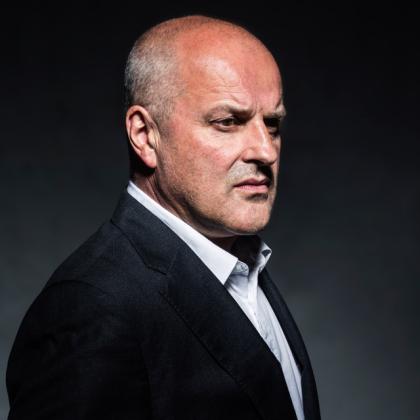
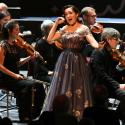
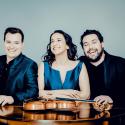
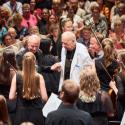
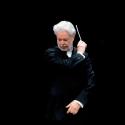
For soloists two exponents who hardly could be bettered were on the platform: Jennifer Johnston (pictured above right), whose remarkable range, creamy tone and stunning top notes were heard as Judith with English National Opera in 2024 (when she stepped in at very short notice to save a performance, singing from the wings after the briefest of rehearsal, with widely-praised results); and Christopher Purves (pictured left), whose Bluebeard for Opera North in 2019 was considered one of the best. You could tell why: her high notes are strong, pure and warm, the sense of foreboding fighting with affection and curiosity (“… for I love you!”, she sang with eloquent, emphatic chest voice near the opening); his wonderfully polished walnut tone never more aptly carrying both power and vulnerability and expressing the English words caressingly.
The orchestra’s role in Duke Bluebeard’s Castle is as important as the soloists’: the scenery is really in the music, and its aural colours are every bit as vivid as any stage lighting. Anja Bihlmaier brought all of that, and fluidity of phrase as well as brilliance and precision to the performance, and saved the best of the tension and climactic power for the opening of the seventh door. I’ve heard the organ and extra brass used with a bit more spectacular effect for the C major vista of door five in this hall, but that tends to make the music into an arch shape in which nothing ever quite matches the mid-point, whereas the drama requires the final revelation to be the greatest, which in this case it certainly was.
- To be broadcast on Radio 3 on 5 March
- More classical reviews on theartsdesk