The billing for this all-Schubert concert, "Spira Mirabilis and Kate Royal", was a little misleading, since they did not actually share the stage at any point, the two halves being clearly separate events. First came the hour-long Octet, played by members of Spira Mirabilis, followed by half an hour of songs with Kate Royal accompanied by Malcolm Martineau.
Now, there are no laws against presenting a salon evening of music by Schubert. In fact, it’s been going on for nearly 200 years, and it’s called a Schubertiade. It might even have been a selling point. But then, shouldn’t the Octet, with its symphonic length if not structure, have come in the second half? It was all a bit puzzling. Why not just have Spira Mirabilis play the whole concert and have done with it?
It all worked, and yet it was curiously uninvolving
The answer – or at least part of it – is in the ethos and raison d’être of the group. More of a collective than an orchestra, its principal if not only purpose is the musical betterment of its members. The point for them is the rehearsal process, and they only work on one piece at a time. In musical terms, it’s rather noble; for traditional programming purposes, a bit of a nightmare. But their undoubted musicianship, coupled with a sense of difference, certainly makes them interesting – they bring a chamber sensibility even to orchestral repertoire, always playing without a conductor, sometimes in mufti, often in non-traditional settings. The confusion seems to have spread, with the Southbank Centre’s artistic director’s introductory note in the programme stating that "their performance of the Octet without a conductor promises to be a new experience of this great work of chamber music" – it would be extremely unusual for it to be performed any other way.
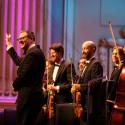
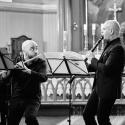
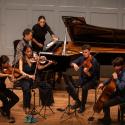
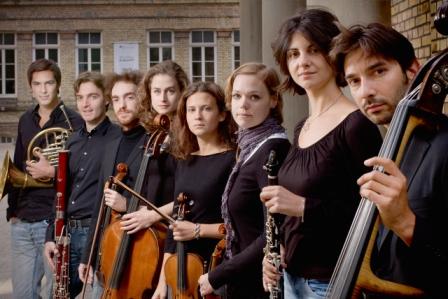 This fact itself meant the group (pictured right) was completely exposed. There was no novelty value – just eight musicians in concert dress sitting at eight music stands. It just had to be right – and by and large, it was. The communication of a group that has spent a lot of time rehearsing was obvious: a gesture here, a nod there, a smile at the end of a movement, the perfectly balanced interplay between the first violin and clarinet. It all worked, and yet it was curiously uninvolving, feeling mostly as if they were playing to each other and for themselves, rather than trying to take the audience with them. It was also a very well-mannered performance, concentrating on beautiful tone and subtle articulation, though perhaps to a fault: until the stormy last movement, it felt as if the limiter was set on mezzo forte. The piece is certainly most demanding on the first violin, and Lorenza Borrani – also leader of the Chamber Orchestra of Europe – is a tremendous player and showed it. But all in all there was more here to admire than get swept away by.
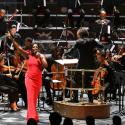
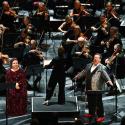
Kate Royal’s short recital after the interval was all about communication with the audience. Her operatic experience was brought to bear in a very sympathetic and poised performance of 10 of Schubert’s songs from the lighter end of the scale – an exquisitely mournful "Abendstern" notwithstanding. Her "Im Frühling" was a particular highlight, conveying the bittersweet reminiscence of the text with a wistful lightness of touch. Have these songs been sung with more depth and gravitas? Of course, but part of the beauty of them is that they accept all sorts of interpretations.
Malcolm Martineau, probably the most recorded accompanist of his generation, was engaged, sensitive and flawless as usual. It is hard to imagine him ever having had a bad day at the office.