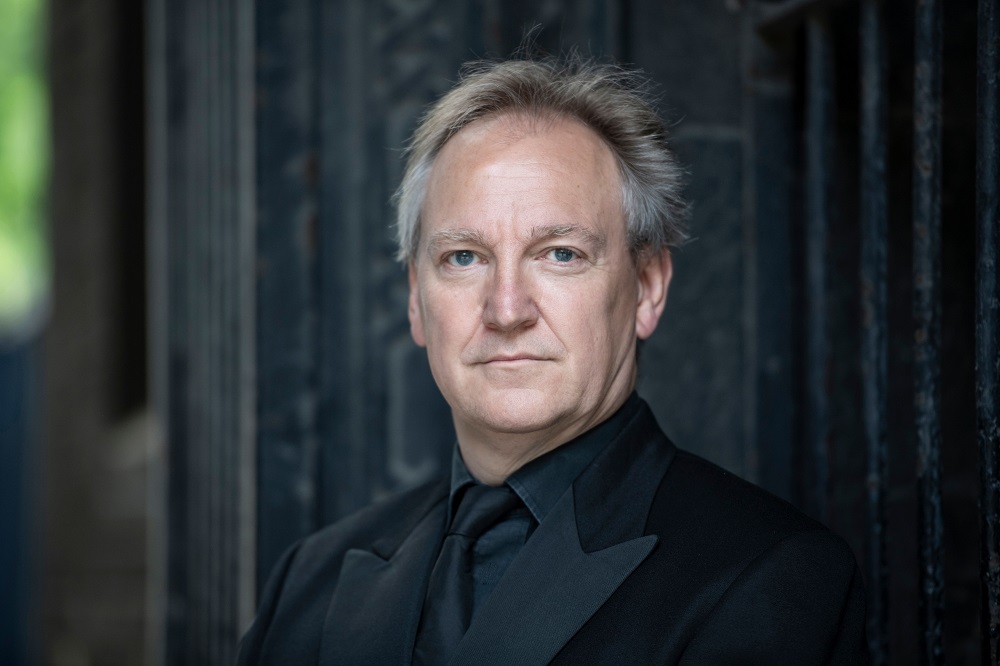
While the big choral societies are asking, with good cause, why they remain silenced when it’s OK for football fans to sing on the terraces, the top voices of smaller ensembles are being heard again by select audiences. Not so small, in the case of the 24-strong young opera choruses of Garsington (times two, the groups divided between operas) and Grange Park Opera. Tenebrae in the wide-spread group its director Nigel Short (pictured below by Sim Canetty-Clarke) offered us in the welcoming space of Saffron Hall came close at 20 singers, and expressively unsurpassable in a typically ambitious programme.
 Tenebrae have done the rounds with the first half of the programme, but I hadn’t experienced it live. Hearing Purcell’s “Thou knowest, Lord, the secrets of our heart” at the still heart of Croft’s Burial Sentences was a deeply moving experience, the beauty of the Biblical settings perfectly articulated throughout. Frissons came in Lotti’s Crucifixus – the shock of those harmonic suspensions must have been as great at the time as the revolutions of Wagner’s Tristan und Isolde the following century. And the three top Cs of the soprano in the solo quartet of Allegri’s Miserere, perfect each time, came from a distance: as Short put it, Saffron Hall furnished a perfect antechapel. That made the joining of the two choirs at the end of the sequence all the more effective.
The 20th and 21st century strand begged for proper programme notes; though the works were listed on a single page, it’s important to know the poets set, and read the texts when the composers favour a sumptuous sound rather than textural acuity – Tenebrae can’t be blamed for favouring line over consonantal clarity in Jonathan Harvey’s Song of June, a typically luscious-mystical setting of a Wilfred Owen poem and Bob Chilcott’s carol Before the Ice, more conventional but still going for sound over sense; you wouldn’t have known from what we heard that Chilcott combines an Emily Dickinson poem with the Latin responsory for Christmas Day “O magnum mysterium”.
 Texts were clearer, because the composers took care to make them so, in Richard Rodney Bennett’s exquisite marking of Donne’s words for The Seasons of His Mercies, with tenor soloist Julian Gregory (pictured right) giving us a unique other-worldliness, and Eric Whitacre’s infallibly hypnotic Sleep, taking us from the half-restless expectation of sleep to the very cusp (this is where a programme note would have enriched the experience: Whitacre tells us that he set Robert Frost’s Stopping by Woods on a Snowy Evening, was denied permission to use it by the Frost Estate and turned to Charles Anthony Silvestri for new words to the music. The result? “I actually prefer Tony’s poem now”. The latest twist is that the Frost poem has since entered the public domain unexpectedly).
The official end to the concert was the perfect Evensong anthem, Harris’s typically sumptuous Bring Us, O Lord God, with the two antiphonal choirs overlapping in ever more ecstatic responses and a ppp ending such as only Tenebrae can manage. Tallis’s “If Ye Love Me” made a perfect postscript. I do recommend, incidentally, that you build a day or an afternoon around a future concert in Saffron Hall; take the train to Audley End, do a big (or short) walk around the estate and arrive at the concert in time for aural refreshment. The 5pm event provided the perfect excuse on Saturday, reflecting both the shadows of the woods and the bright blue skies.