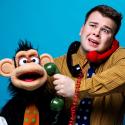
Clowning, despite its association with great funnymen such as Joseph Grimaldi and Charlie Chaplin, has always had a dark underside of melancholy or even menace. More latterly it has been thought of in terms of “low” arts such as circus and street theatre, and so it perhaps shouldn't come as a surprise that fear of clowns, coulrophobia, is in the Top 10 list of phobias, up there with spiders, enclosed spaces and vomiting.
Understandably, then, clowning – even the physical-theatre style developed by Jacques Lecoq – is an acquired taste, perhaps more so in modern comedy where wordsmithery is considered a higher form of attainment. So it's unusual these days to see a comic who does the first half of his show without a word being spoken; such is Becaves, performed by Doctor Brown, aka American comic Philip Burgers, who trained at École Philippe Gaulier clown-theatre school.
There are several false starts at the opening of Becaves as the music stops and the lights go out, but nothing, except silence, follows. At the third or fourth time, Brown appears on stage, trapped in a black gauze that he eventually rips down and wraps himself in. So far, so predictable.
What follows is a series of wordless gags, which are strangely not that visual – unlike, say, The Boy With Tape on His Face. Brown, dressed in a silk dressing gown and nightcap, flirts with the front row, calls several of them on stage to perform pointless tasks such as lifting each other up, and pretends to eat an unpeeled banana.
Slowly, however, his mad, absurdist world starts to make sense and the laughs come more readily. My favourite gag is literally a throwaway one, as Brown – having pretended to stick chopsticks in various orifices - pulls them out with much ceremony. With his back to the audience he then gathers a large bunch of chopsticks, as if from his belly, and throws them to the floor with a huge sigh. Maybe you had to be there, but I laughed long and hard at that simple and silly joke.
He does a very funny, very sexual mime of The Peking Opera, and at this point, more than halfway through the show, Brown starts to speak, albeit in made-up Chinese interpreted through a member of the audience to whom he is quietly feeding the English translation. As Brown describes pleasuring a woman (complete with graphic hand actions), his interpreter tells us he is saying, “It's 5th century... or 6th century.”
Brown finishes on a cheap nude gag which I think - who knows with these mime artists, as it's all in the interpretation, innit? - is about us, the audience, defiling the artist, who prostitutes himself for our entertainment. But that's to think too hard about a show that's weird but ends up being rather wonderful in its own way.
- Doctor Brown is at Soho Theatre, London W1 until 1 October