Swiss director Marcel Gisler’s film tells a story that is hardly new – but neither, sadly, is it old, as in about a thing of the past. That professional football continues to be homophobic, a world in which it is virtually impossible for a star player to come out as gay while continuing to play at the top of the game, is no secret. Two decades on from the suicide of Justin Fashanu, the destructive consequences are all too well known; recent fictional reminders, such as John Donnelly’s The Pass (made into an accomplished film by Ben A Williams two years ago), suggest that little has changed.
Where that Russell Tovey-starrer concentrated its action into intense bursts, the more nuanced Mario takes time to develop (arguably, slightly too long) as it tells the story of Max Hubacher's title character, whose ascent towards a professional football career runs in parallel with his first love – and ne’er the twain can meet. The phlegmatic Mario is a rising star in the Under 21 team of YB Bern, with promotion in sight; he certainly lives for his football, even if he’s rather obviously playing out his father’s ambitions as much as his own.
The 'market value' of a player who’s been outed falls dramatically
When outsider Leon (Aaron Altaras) is brought into the team – Leon has only come from Germany, but in these Swiss ‘burbs the concept of “outsider” is exaggerated, while his good looks suggest a Mediterranean type – an element of rivalry kicks. Both play as forwards, a duplication that could complicate future prospects, but rather than stimulating rivalry Mario’s coach counsels him to “seek interaction”. The two duly end up sharing a flat, and few viewers will be surprised by how that interaction progresses.
Leon is certainly the more forward of the pair, while for the more gauche, even callow Mario it’s his first love. (There’s irony, or perhaps not, in the fact that Hubacher would be a shoo-in for anyone needing to cast a young Putin.) But such powerful feelings aren’t enough to make him disregard the certainty that the faintest rumour would wreck any future in the professional game. When the rumours do start circulating – no surprise there, given that this seems a rather vindictive, small-town world, with a locker-room atmosphere that’s heavier on vindictive jibes than eroticism – their moment of decision approaches remorselessly. Closing-reel developments catch the increasingly desperate and destructive deceptions required to maintain stadium image intact (fake WAGs by now long in mandatory tow). It’s not over-complicated in dramatic development, but the film plays out with telling power, backed by performances from its two leads that do convince about their attachment.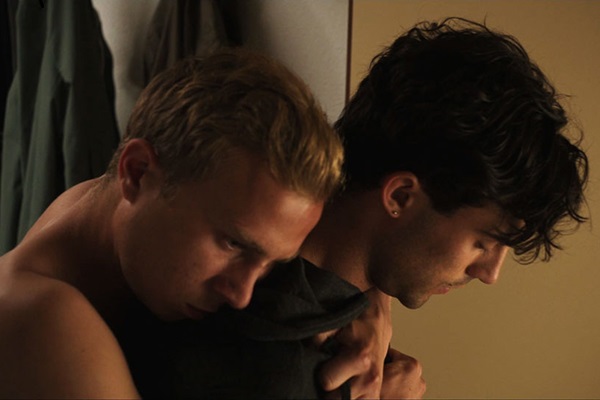 What Gisler certainly captures is the hypocrisy behind the system itself. It takes Mario’s otherwise lugubrious coach to point out that club management not only has to be seen to be treating the issue with appropriate sensitivity, but that the “market value” of a player who’s been outed falls dramatically. In one of the extras here, “Breaking Taboos”, the director recalls how the president, now openly gay, of Hamburg St Pauli (the club features in the film, and like YB Bern clearly wasn't afraid of the association), used exactly that phrase to him.
Mario tells a sad story, one that leaves us to ponder just what makes football’s determination that such secrets be kept so categorical. It’s not management – which readily suggests help from therapists to players known to be gay – nor surely the majority of fans who have long moved on; "sponsors" get cited, while the press certainly sticks to old guns. Gisler concludes his commentary by hoping that the film will “keep discussion alive”, though he admits he remains in the pessimistic camp. Unlike his actor Altaras, whose optimism shines through: Mario needs to be shown in football youth training camps, he suggests. Sadly that’s not likely to be happening in this country, given that the film was given an 18 certificate for “strong sexual images, sex references”. Astounding: the BBFC really should get out more.
Overleaf: watch the preview for Mario