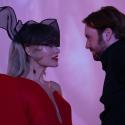
When filming Vivre sa vie in 1962, Jean-Luc Godard made his wife and star Anna Karina wear a wig resembling Louise Brooks’s black-lacquered art-deco bob. Karina’s Nana was less immaculately coiffed than Brooks’s Lulu in G.W. Pabst's Pandora’s Box (1929), however, and her hair didn’t taper into pincers, like those that lay against Lulu’s cheeks. Nana is more vulnerable than her iconic antecedent – her glum stares at the camera replacing the devastating smiles Lulu bestows promiscuously.
Godard’s fourth feature (and third with Karina) ostensibly traces Nana’s downward spiral as an aspiring 22-year-old actress who, separated from her husband and unable to pay her rent, is forced onto the Paris streets; her willingness to be controlled by a callous pimp seals her fate. Godard deployed a vérité documentary style but ordered the story in 12 chapters (or tableaux), using Brechtian narrative absences and disruptions (Nana's flirtatious dance, her chat with the philosopher Brice Parain), as well as visual surprises (shots that pan away from their subject), to draw attention to Nana’s social plight and her existential responsibility to herself.
The film’s quoting of gloomy facts from a 1959 book about prostitution anticipated the use of homelessness statistics in Ken Loach’s Cathy Come Home (1966). Godard’s acknowledgment of the political oppression inherent in the sexual exploitation of women recalls the revelation in Pandora’s Box that Lulu has devolved into a bargaining chip for the unscrupulous. Yet his true subject is Karina and their troubled marriage, threatened (as the director suggests in his voiceover narration of a Poe story) by his celebration of her image at the cost of her person. But what a performance by Karina and what an image! Woody Allen couldn’t help but pay homage to Nana by reimagining the graffiti shot (above) with Penélope Cruz in Vicky Cristina Barcelona.
The inclusion of three early Godard shorts and an archival interview with Karina make this BFI DVD one of the year’s best.