The regular scriptwriter for Yorgos Lanthimos’s films, Efthimis Filippou, has worked with another director, Karim Aïnouz, on Rosebush Pruning. It’s a film that bills itself as “inspired by” Marco Bellocchio’s 1965 satire, Fists in the Pocket, but deals in the same kind of lurid surrealism as Lanthimos’s off-kilter yarns.
This is a narrative that’s by turns enigmatic and unsubtle. Bellocchio’s starting point is there – the son of a large, dysfunctional family, in which one child is epileptic and one parent blind, sets about downsizing it – but in Filippou’s hands it’s become a cluttered story of outrageous egotism and psychopathy.
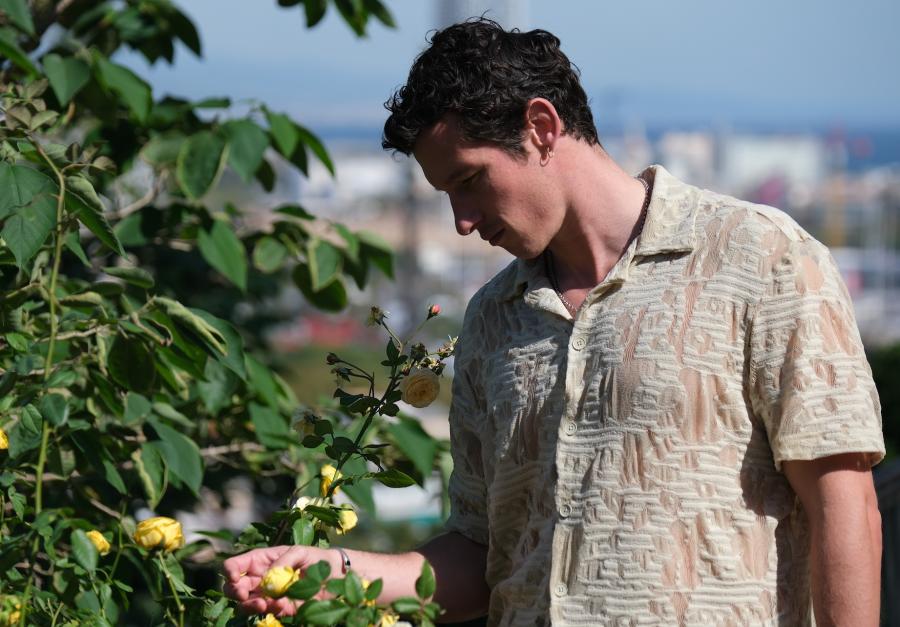
The unsubtle part is the running metaphor of the passion of Edward (Callum Turner, pictured above), a fashion-obsessed idler, for roses, which he dreams of ejaculating all over. Families, he declares, are like rose bushes, in need of cutting back. We soon understand why Edward thinks this when we see the family closer up. What they lack isn't anything material – they are loaded New Yorkers living in a modern house with a pool in coastal Catalonia – but they believe themselves to be starved of sufficient quantities of love. Their relationships with each other are mostly abusive and, in some instances, incestuous. They regularly claim to love one of their siblings, but also to hate one of the others, whom they see as blocking this love. Their blind father (Tracy Letts) is the most hated, a cruel patriarch with a nightly ritual of “teeth-cleaning” in which the youngest son, Rob (Lukas Gage), must lend a hand. All have a motive for eradicating the others.
The family runs on self-styled myths and ideologies. Presumably, they take their cues from their blind father, for whom fashion is also a governing creed: he regards a description of somebody he hasn’t met as incomplete without a detailed rundown of what that person is wearing, and who designed it. Rob idolises the Versaces, with all the passion of a novitiate; sister Anna (Riley Keough), a hysteric who sees a sexual predator in every man, including the butcher, favours an eccentric wardrobe – pale aquamarine knee-high boots on a sunny day, a bright magenta dress worn for lounging around at home where nobody can see her. She’s pleasuring herself, in every sense.
Only older brother Jack (Jamie Bell) seems like an outlier, a “straight” man with a toehold in the recognisable world – he can drive a car! – along with an apparently straight American girlfriend, a contemporary classical guitarist called Martha (Elle Fanning), who’s the only wholesome-looking freckled blonde among these dark-haired dandies. All of the siblings are too rich to need to work. Anna does the cooking, Edward records little essays for posterity, Robert masturbates and cuts himself, indulging his fascination with blood, a predilection he shares with Jack, who seems to especially like having sex with Martha while she Is menstruating.
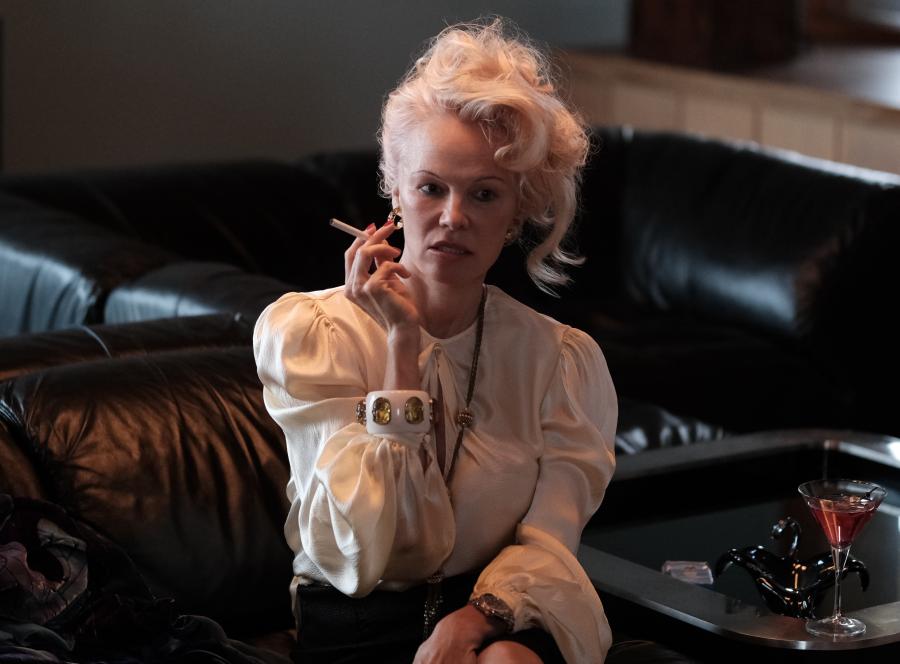
In this claustrophobic world, there is no maternal figure, though we see the Mother (played by Pamela Anderson, pictured above) in flashbacks. The family myth is that she is “buried” in the woods, though nothing actually remained of her body after an attack by wolves. Each month the whole family visits the grave to leave a lamb’s corpse there for the local ravening wolves. They watch a pack arrive before driving home to their bizarre enclave, whose entrance is guarded by six iron deer sculptures. They also gather regularly at the naked statue of their mother in an internal courtyard. Another myth is that when she first flashed her ultra-white teeth at her husband, they blinded him permanently
At the family’s heart is a Big Secret, which Edward stumbles upon and the pruning commences, initially ingenious, all of it psychopathic, its thematic status unclear. Is this the end-game of the me-generation, a state of narcissism that produces no real emotions, no heirs, nothing tangible at all, and seems to taint all around it? Or is there a more specific commentary going on here about the vacuity of the rich as a social group, their inability to empathise or relate to anything outside the self-referential world they have constructed around themselves, with its bizarre passions and esoteric practices? It’s not clear that’s intended. And how are we to view Martha in this context, whose apple-pie innocence starts to shift as she is drawn closer to the family, and who ends the film with an enigmatic cold look that's far from guileless.
The A-listers who flock to Filippou’s scripts almost make this one worth watching, Letts in particular, who gives a masterclass in how to project corrupt, unseeing autocracy. Teeth-cleaning was never this sinister or repellent. But ultimately the film is playing a self-indulgent game where the satire isn’t sharp enough, the wit isn’t that funny and the “pruning” becomes more perfunctory as the plot canters on, its metaphorical potency lost long before the final reel.