The man who made Interstellar, Tenet and Oppenheimer can hardly be accused of not thinking big. Now, with The Odyssey, he’s thinking epic. Clocking in at a whisker under three hours and peppered with bankable stars, Christopher Nolan’s take on Homer’s imperishable poem is a bold attempt to recreate the ancient world of the 12th Century BC, with its gods, monsters and all. And it's the first feature film to be shot entirely with 70mm IMAX cameras.
Many early reviews have been ecstatic, hailing Nolan’s $250m-worth of movie for its thrillingness, boldness, majesticness and so forth, but somehow this doesn’t feel like Nolan’s natural turf. Whereas you almost needed degrees in quantum physics and time travel to work out what was going on in some of his earlier works, The Odyssey is a celebrated myth which has come down to us intact through the foggy ruins of time. You can choose how to present it, but fundamentally it is what it is. After all, it has endured for the last 28 centuries. The cast speaking in modern American accents isn't always helpful in creating the desired timeless aura.
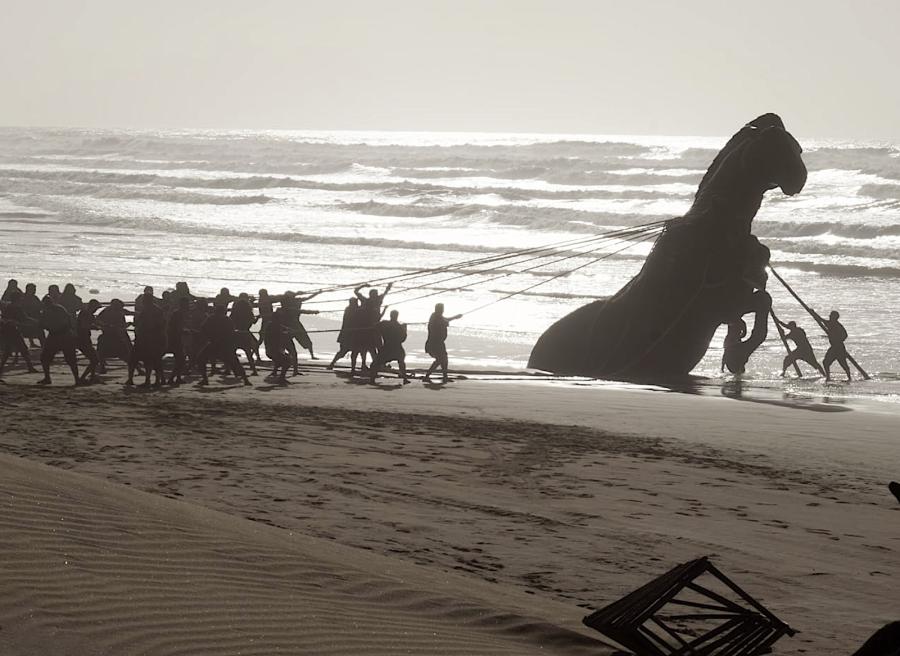
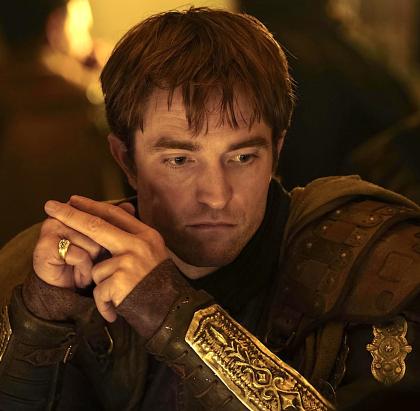
Proceedings open with images of the half-buried Trojan Horse (pictured above), the cunning device whereby Odysseus, King of Ithaca, prised open the defences of the besieged city of Troy. The city was subsequently sacked and its inhabitants slaughtered, but it took Odysseus (Matt Damon) a decade to find his way home. This was in no small measure due to the allure of the sea-nymph Calypso (played here by Charlize Theron). She detained Odysseus for seven years on her island, Ogygya, keeping him doped up on lotus flowers and forgetful of his previous life with his wife Penelope (a long-suffering Anne Hathaway, tormented in Odysseus’s absence by ruthless and manipulative suitors, led by Robert Pattinson’s loathsome Antinous, pictured below).
One way of reading Nolan’s movie would be to regard it as the story of a man struggling with post-traumatic stress and combat fatigue, brought on by his horrific experiences in the Trojan War. It’s near the end of the film that he mentally revisits the sacking of Troy, revealing how he was horrified by the slaughter and destruction. He felt the wooden horse trick exploited the goodwill of the Trojans, and indeed broke the “law of Zeus”, a notion which recurs several times. It sounds a bit like the “rules-based international order”, a post-World War Two concept which politicians like to pay lip service to when it suits them.
Damon, who was superb in Oppenheimer as General Groves, the military man tasked with corralling the mad-genius scientists building American’s atomic bomb, does a typically solid job as Odysseus, even if he sometimes seems more Centrist Dad than mythic hero. He combines an easy relatability with a dogged determination to survive the insane chain of challenges, labours and life-threatening phenomena that litter his trail back to Ithaca.
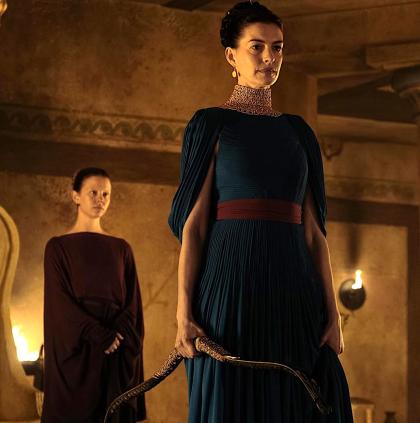
The journey affords us a batch of set-pieces which veer from terrifying to stomach-turning, intensified by composer Ludwig Göransson’s thunderous and intimidating soundtrack. Odysseus and co suffer a hair-raising encounter with Polyphemus the Cyclops, a one-eyed giant who keeps his own herd of sheep but enjoys snacking on the bodies of Odysseus’s men. Odysseus manages to bust his crew out of Polyphemus’s cave by rather unsportingly ramming a blazing log into his one eye (pictured below, Anne Hathaway with Mia Goth as Melantho).
Further terrors ensue when the lads land on yet another bleak desert shore (Nolan deployed a list of locations stretching from Scotland and Iceland to Greece and Sicily), only to find themselves being systematically massacred by a posse of giant metal-clad warriors, as indestructible as an armoured brigade. By contrast, an encounter with the seemingly sympathetic sorceress Circe (Samantha Morton) morphs into an orgy of grotesque gluttony in which the chaps literally pig out. It seems Circe is an embittered hyper-feminist harbouring extremely hostile views about men.
The Odyssey is a long haul, though it has its compensations along the way. Yet somehow I found myself pining instead for a cheesy, old-fashioned epic, like Jason and the Argonauts (with Ray Harryhausen’s inimitable animations) or The 300 Spartans. But what do I know.