Fortune, as a rule, does not favour Part Threes. Hollywood history is replete with sequels that outstrip their predecessors, but second sequels have an altogether patchier track record – for every Return of the King, there are five Spider-Man 3s.
The Hunger Games’s third instalment has a lot of things stacked against it, from the cynical bifurcation of an already slow-paced story into two parts, to the fact that Mockingjay is by far the least loved of Suzanne Collins’ novel trilogy. It’s a prickly, bleak war story with no actual Hunger Games to speak of, its once gutsy heroine Katniss (Jennifer Lawrence) transformed into a passive pawn by political forces beyond her control. So how is it that Mockingjay: Part One emerges as the best Hunger Games film so far by such a wide margin?
 The key lies in new screenwriters Peter Craig and Danny Strong, who understand the value of the unspoken. The romantic angst between Katniss and her two suitors Peeta (Josh Hutcherson) and Gale (Liam Hemsworth) is by far the least compelling aspect of the series, and last year’s Catching Fire became hopelessly bogged down in melodramatic exchanges that did Lawrence a disservice.
Here everyone’s too hollowed-out to do much talking, with a traumatised Katniss adjusting to life in the underground District 13 after her home district was gutted by the despotic President Snow (Donald Sutherland). So instead of one more anguished conversation about why Katniss can’t love Gale, we get her silently laying her head against his shoulder after they hunt, a moment that works because it’s about everything they’re not saying.
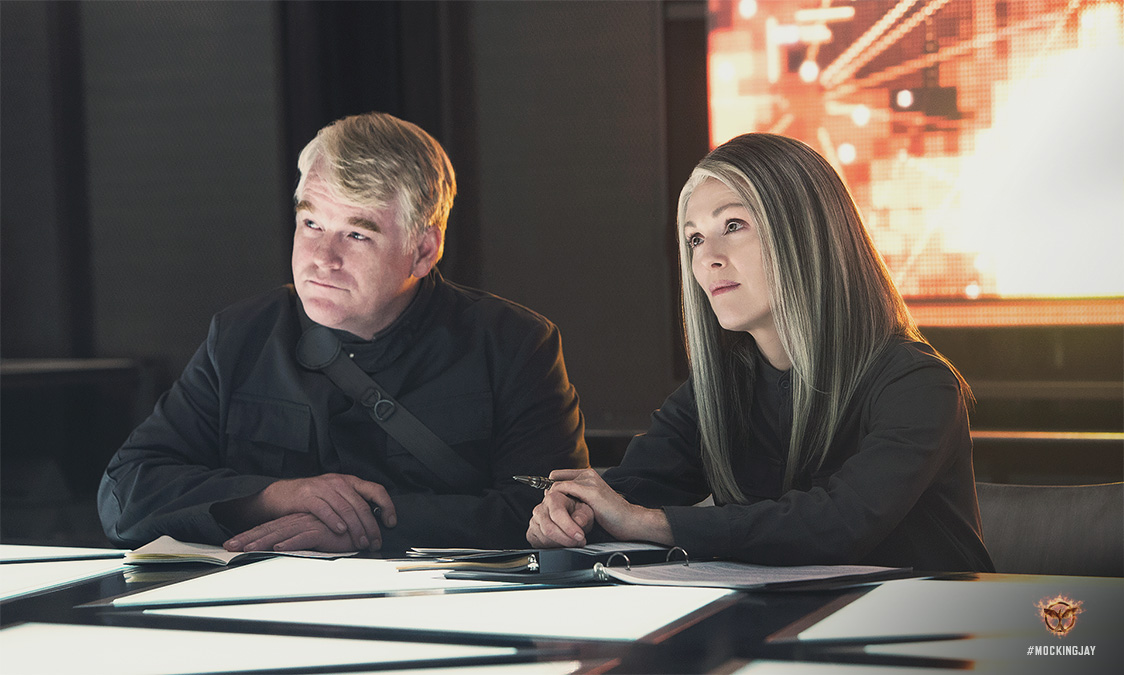
A far more pivotal scene pivots on Katniss singing "The Hanging Tree", a haunting ditty taken straight from Collins’ prose and reimagined by The Lumineers. It’s a breathlessly evocative sequence that is hard to imagine existing in any other young adult franchise, speaking to the sense of doom that pervades Mockingjay. Ostensibly, things are looking up – having spent two films at the mercy of Snow and his dystopian government, Katniss now finds herself within an enclave of rebels led by President Coin (a slippery Julianne Moore) and Plutarch Heavensbee (Philip Seymour Hoffman).
In no other current series are the stakes so high, the pain so immediate, or the characters so lovingly drawn
With her “electrifying” act of defiance at the end of Catching Fire’s Quarter Quell, Katniss has stirred the beginnings of a revolution across Panem, and Coin is keen to channel that influence by filming a series of propaganda clips centred on Katniss delivering inspirational rhetoric. But Katniss is barely stable, prone to swing wildly between hysteria and catatonia, and distressed further by the revelation that Peeta is not dead, but rather is being trotted out as a political puppet on the Capitol’s chat show.
Lawrence has seldom been more compelling as she plumbs both Katniss’s vulnerability and her reluctant strength, and the "propo" device embodies what is both so strange and so strikingly effective about Mockingjay: Part One’s structure. Every significant plot turn and character decision takes place on a screen within a screen, delivered as spin or as subterfuge – Katniss’s "If we burn, you burn with us" speech, a game-changing twist from Peeta, a face-off between Snow and Katniss, some dark exposition for Sam Claflin’s Finnick, even a third act rescue mission. The revolution is very distinctly televised, and on the big screen this idea resonates in ways it never could on the page.
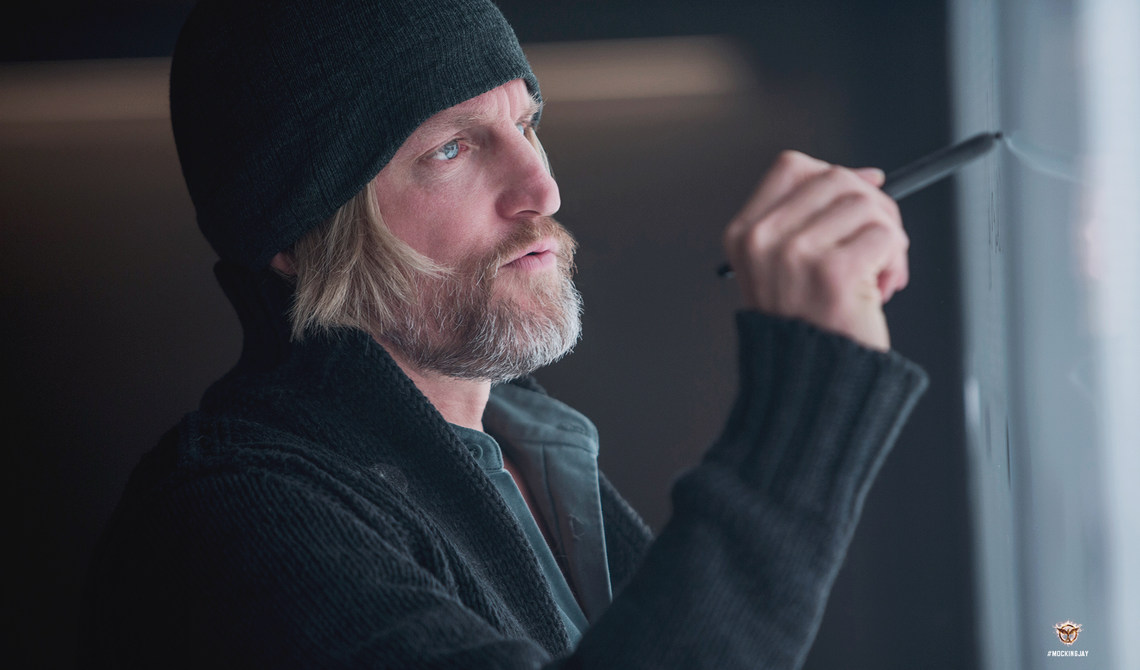 Tempering the bleakness somewhat is Katniss’s relationship with mentor Haymitch (a reliably warm, wry Woody Harrelson), who’s newly sober and a more effective father figure than ever. One shrewd change from the book is the incorporation of Elizabeth Banks’ Effie into the rebellion: formerly a primped Capitol lackey, she’s de-glammed but still elegant here as a quiet source of strength.
Despite being only Part One, this feels like the most complete of the Hunger Games films to date, beginning with clear stakes and ending on a cathartic and compellingly downbeat note. In no other current series are the stakes so high, the pain so immediate, or the characters so lovingly drawn.