Juniper provides, above all, an absolutely unforgettable role for Charlotte Rampling. New Zealander Matthew J Saville, who devised the script and directed the film, based her character, Ruth, on his own feisty and well-travelled grandmother, who had led a full life, and then returned home – where she drank substantial quantities of gin every day.
The other main character, her troubled grandson Sam (excellent newcomer George Ferrier), is also based on real life. In Saville’s own late teenage years, his time at a boarding school in Hamilton was beset by the experience of his contemporaries attempting or committing suicide.
The relationship between the two starts as a take-no-prisoners battle of obdurate wills. As the film progresses, the grandson finds that there are ways to face up to life, whereas the grandmother starts to make her peace with the idea of her death. It is a tale well told, and brings in all kinds of wider reflections. When Sam asks Ruth to sum up what war means, her response is trenchant: “War is just a waste, a senseless bloody waste.”
From a very early stage in the development of the film, Saville knew he wanted Rampling to play the part of the grandmother, and made sure the script was developed into a shape where – if she could get to read it – she would be interested. It is indeed very tautly written. Rampling has the opportunity to be witheringly dismissive of just about every other character, with the most scabrous insults destined to hurt the weedy, the well-meaning, and the religious.
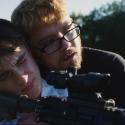
Ruth insists that a jug of minimally watered-down gin should be her constant daily companion, so when an alternative is presented, Rampling gives it industrial-strength mocking contempt: “I don’t really do tea.” Glasses get thrown at people who dare to cross her, and they hit their targets. 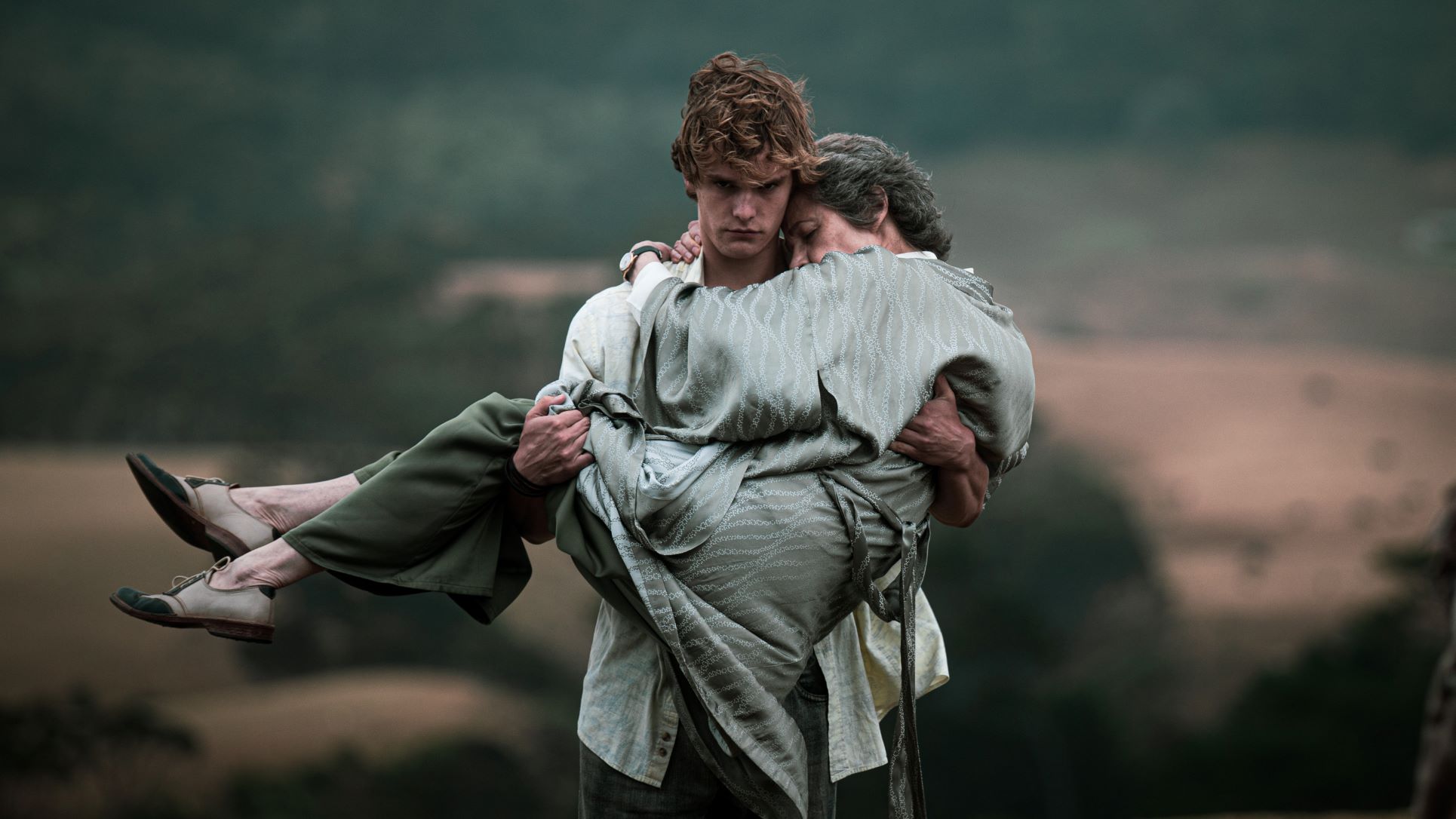 The trickiest role in the movie is the one in the middle of this combustible pair. Sam’s father and Ruth’s son Robert (Marton Csokas) makes himself scarce most of the time, preferring to escape to London. Csokas has mostly played villains, but here what is required from him is to provide a void for Sam and Ruth to bridge. Through weakness, evasiveness, and an inability to communicate, he needs to have visibly failed in his responsibilities as father and his duties as son. It is a hard ask, but Csokas manages it deftly. (Pictured above: George Ferrier and Charlotte Rampling)
The film is set in the 1990s, so communication is a lot trickier than it would be now. The distant relationship between Sam and his father is reinforced by the fact that the only way they can reach one another is on a landline. It is Sam who makes all the attempts to do this
The feeling of isolation is amplified by the wonderful portrayal of the landscape around Auckland, with huge, brightly coloured skies beautifully filmed by Marty Williams. The proximity of nature and the way the characters feel it are a strong feature of the film. A horse that had belonged to Sam’s mother plays a crucial role, and the emotional impact of the scenes with it are carefully contrasted with the lack of feeling between the people. The careful, luminous soundtrack music by Marlon Williams and Mark Perkins also works well.
This is Saville’s first full-length feature film. On a first viewing, I wondered if the scenes in which Ruth’s approaching death becomes the focus weren’t a little too drawn-out, but if there are alternatives to an operatic apotheosis, it is far from obvious what they would be. It is surely Rampling's strongest and best role since she played Sarah Morton in Francois Ozon’s The Swimming Pool (2003).
Those fans who recall she was born under the big skies of the Essex–Suffolk border will be in heaven.