

Jafar Panahi’s It Was Just an Accident is a shattering absurdist anti-caper – a kind of minimalist take on It’s a Mad, Mad, Mad, Mad World inspired by Iran’s ongoing tragedy.
His country's top director and one of the sharpest thorns in the Islamic Republic’s regime, Panahi was promoting his Palme’ d’Or-winner in New York last Monday when Branch 26 of the Tehran Revolutionary Court sentenced him to a year’s imprisonment for “propagandia activities”. He’s also banned from overseas travel for two years and from joining social and political organisations. The Supreme Leader and his judges will surely gnash their teeth should Panahi’s third imprisonment land him the International Feature Film Oscar.
It would be merited not only by the sinuous thriller’s microcosmic depiction of the fallout from the state’s draconian methods of repression, but also for its emotional power and orchestration of the shifts in perspective that follow the arrival of new characters. Twists, shocks, and stabs of gallows humour abound.
The movie's economy of means is a feat in its own right. As often before, Panahi filmed guerrilla-style, in secrecy with a small cast and crew in risky locations. His goal this time was to relay the horrific experiences suffered by – and described to him – by fellow inmates during his two previous incarcerations.
It Was Just an Accident starts noirishly. The front-of-windscreen POV of a car threading through a raven-black night beyond city limits shows a bearded middle-aged man (Ebrahim Azizi) at the wheel, his pregnant wife (Afssaneh Najmabadi) beside him, and their young daughter (Deinaz Najafi) in the back seat – the girl’s innocent prattle guaranteeing that all hell will break loose. After the car strikes and kills a wild dog, it falters, which forces the driver to head to a local garage. The wife's philosophical response to the accident is ironic.
Her husband is offscreen when the rasp of his prosthetic leg startles a mechanic, Vahid (Vahid Mobasseri), who believes it is the sound he heard as a blindfolded prisoner tortured by his interrogator, Eghbal, or “Peg Leg”.
Vahid follows the family home and the next morning bludgeons the man and hauls him into his white van, which becomes the narrative’s vehicle, as did Panahi’s self-driven yellow cab in his docudrama Taxi Tehran.
At a remote desert spot – where a leafless Waiting for Godot-ish tree connotes the self-lacerating nihilism of Vahid’s revenge quest – he begins to bury his captive alive. But his protests that he’s innocent prompt Vahid to get other torture victims to confirm that he is carrying Eghbal. Broken but conscientious, Vahid later helps the man's little daughter and her mother in an emergency.
Speaking to Vahid, one of the torture victims, Salar (Georges Hashemzadeh), says of the persecutors, “There’s no need to dig their graves. They’ve done that for themselves.” But Salar wants no involvement in Vahid's crisis and sends him to Shiva (Mariam Afshari), a tough, defiantly hijab-less photographer.
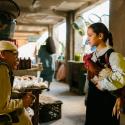
Interrupted snapping a bride and groom, Golrokh (Hadis Pakbaten) and Ali (Majid Panahi), Shiva resentfully agrees to inspect the unconscious man in Vahid’s van. Both women were tortured by Eghbal – Golrokh sexually – while blindfolded like Vahid. Shiva claims to recognize Vahid’s captive by the smell of his sweat, but Golrokh demurs.
When Shiva’s volatile ex-partner Hamid (Mohammad Ali Elyasmehr) is subsequently approached, he touches the scars on the man's leg and says he is Eghbal. None of the “proofs” – sound, smell, touch – are convincing. The issue of the captive’s guilt is never resolved; as a human MacGuffin, he’s there to reveal the degrees of movement on the five travellers' moral compasses, or if they’ve lost them altogether.
As the film becomes a bitter farce, various of the travellers encounter security cops and a hospital nurse who, symptomatic of Iran’s corrupted system, demand bribes. The van’s return to the desert – where Hamid denounces Ali as a politically disengaged rich man’s son and urges the captive’s killing – is a Godot-like repetition that closes the circle of existential futility.
With similar circularity at another location and the sky black again, one of the travellers, perhaps the least expected, demonstrates that brutality begets brutality (as it does in Ken Loach’s Iraq War thriller Route Irish). It Was Just an Accident's devastating final shot is charged with regret, but it's not unhopeful.



Add comment