Now I know why the BBC Symphony Orchestra slunk so easily into Piazzolla tango mode last Friday: they'd danced it under Latin American instruction four years ago. It's all part of their education department's annual Diverse Orchestras week, where performers from another culture come to open the players' fantasy and the onlookers get to learn something into the bargain. And learning has never been more fun than it was last night in the Tabernacle, Notting Hill's vibrant arts centre, where the Fez Andalusian Orchestra under one of the world's great string players, Mohamed Briouel, set a zinging example.
I'll be honest: I went along to hear the authentic sets of Arab-Andalusian music which spread outwards from the courts of Seville (to Tunisia), Cordoba (to Algeria) and Granada (to Morocco). I wasn't placing any high hopes on the fusion experiments with the BBC Symphony Orchestra's Family Orchestra and Chorus at the beginning or with five players from the orchestra at the end (the Turkish experiment two years ago hadn't got beyond a well-intentioned but rather self-conscious melange).
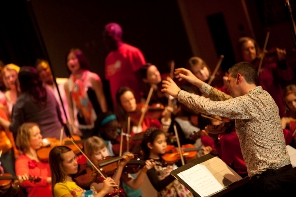 How wrong I was. Each brought something new to put on the table alongside the Fez musicians' poetic sophistication. For a start, you couldn't but be moved and tickled by the way the brightly dressed London group of all ages and colours (the BBCSO Family Orchestra and Chorus under Lincoln Abbotts pictured right), whose credo is simply to "have a go" under expert guidance, stood on stage in eager anticipation alongside professional North African and BBCSO musicians. They started to play, and it was spellbinding, especially to watch the carefully allocated activity of the young string players, the kids watchful under the direction of violinists Hania Gmitruk and Vanessa Hughes and every so often plunging into rhythmic patterns with grinning attack. The best came at the end of the Eastern medley - a 10/8 Andalusian sung poem known and loved all over the Arab-speaking world, "Lamma Bada Yatathanna", so soulfully delivered by all that its Utopian zeal quickly brought tears to the eyes. This, I thought, no doubt more than a trifle sentimentally, is the universal music dreamt about by Pamina and Papageno in Mozart's The Magic Flute.
Fez's Andalusian orchestra, duly attired in the trademark hat and covetable yellow slippers - apparently extremely expensive, owing to the saffron dye - took centre stage for two very different sets. The first had pure musical poetry at its core - introspective music-making of the kind I've only previously heard from an Iranian group at a private gathering in Isfahan, with expressive solos from Otman Alami on the qanun (a kind of North African zither), Berrada Driss on oud and Briouel himself, a true master who'd be recognised as such in any culture, playing the viola upright on his knees Moroccan-style.
Melismatic leads came from the fabulous Aziz Alami Chentoufi, accompanying his ringing tenor altino on a subtly wielded tambourine. It's extraordinary to hear the whole ensemble take up the song in vocal unison, but with differing ornamentations, an effect that might sound chaotic to Western ears but which musicologists would certainly be right to dignifiy with the name of heterophony. On the strings, it sounded like the echoing beauty of Tippett's Fantasia Concertante on a theme of Corelli. But of course it's purely instinctive, as are the phenomenal accelerandos and rhythm switches. The second set had upbeat Moroccan songs familiar to many in the audience, whose sharp rhythmic clapping added to the sense that we were in a casbah version of Ronnie Scott's in its heyday. I have only one criticism: it's always enriching to know what's being sung, and the rest of us were in the dark about the lyrics, as we all too often are on casually produced so-called "world music" CDs that don't provide the texts.
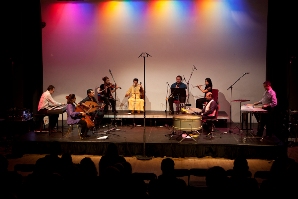 The Moroccans got a standing ovation, of course. I wasn't expecting it for the final fusion piece, led by composer Fraser Trainer (ensemble pictured left). But this was clearly as eye-opening for the BBC players who worked alongside violinist Mustapha Serbout and oud-player Nizar Al-Issa as it was for us, and it climaxed in a stupendous percussion duet between Sherif Zaki and Alex Neal. Its improvisatory brilliance, which gave the O-Duo a run for its money (and in a much more worthwhile context than the new percussion concerto that team had played with the BBCSO at their 80th birthday concert) clearly took the other players as well as the spectators by surprise - so, yes, another standing ovation.
Equally deserved was the little slot of two movements from the delightful Dohnányi Serenade played by three members of the orchestra, the Elgin String Trio, raised to a level of pitch-perfect nuancing that you would have been happy to hear at the best chamber festivals in the world. That kind of music-making was clearly new to some of the listeners last night, but having very vocally admired their little angels in the Family Orchestra, they listened with rapt attention. The Fez players go on to give another open concert at Maida Vale on Friday, this time with the full orchestra - all tickets already gone, I'm told - but it can't surpass the exhilarating atmosphere of last night's event in a venue I blush to say I'd never come across before. More of this at the Tabernacle, please.
- Further details of Friday's sold-out concert on the BBC Symphony Orchestra's webpages
- Read more on theartsdesk about music festivals in Essaouira and Fez
- More about the Tabernacle on its website