It is a very rare thing, as Darius Brubeck reflected, to “inherit a hit.” This gig by the pianist and his quartet marked the exact day of the 60th anniversary of the launch of Time Out by his father Dave Brubeck. Time Out was the first million-selling album in jazz, reaching No 2 in the US pop charts. “It was the gateway drug into jazz for a whole generation,” he mused.
The concept of “inheriting” in monetary terms is unthinkably rare in jazz to say the least, but is quite literally true for Time Out. The story goes that Columbia took against the bizarre idea of an album consisting of tunes in odd time signatures, which Brubeck was imagining without any photographs, just an abstract painting by Neil Fujita. And since the label didn’t want to issue Time Out, Brubeck père and his smart lawyer cut a deal: the pianist would finance the recording, but continue to own the masters. So it was Time Out, as Darius has recently remarked elsewhere, that saw Darius and his five younger siblings through college, and even financed the purchase of a house and 38 rolling acres in Connecticut.
The Darius Brubeck Quartet had drawn a full house to the Jazz Café. The pianist was genuinely surprised, and also touched, by the size, the warmth and the attentiveness of the audience, drawn from several generations. Darius was so piqued by curiosity, he couldn’t help asking for a show of hands as to how many people owned a copy of Time Out; about half of the hands in the room were raised. And that familiarity expressed itself unexpectedly when a loud celebratory cheer suddenly broke out at the arrival of the fifth bar of “Take Five”, the point where the piano and the bass join the drums and set up the 5/4 riff. The first half of the concert consisted of the tunes of Time Out, played by the quartet, with “Take Five” transported from its normal place as third tune on the album to a more apt position in this context, as first half closer.
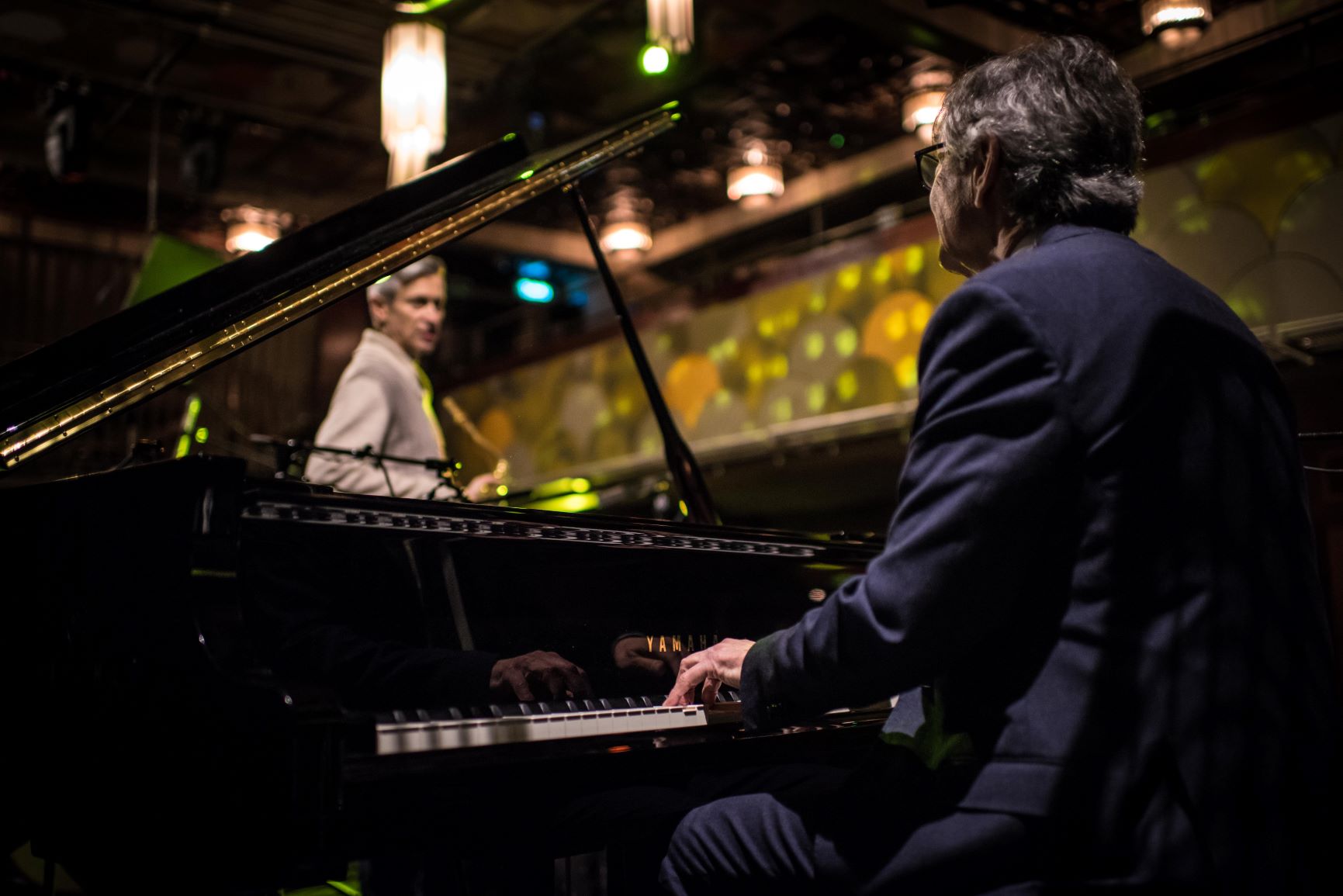
Darius’s quartet are a well-seasoned unit. The drummer Wesley Gibbens is a South African whom Brubeck got to know during the two decades that the pianist lived and taught in Durban, and where he set up the first jazz course at a university on the African continent. The challenge of taking on Joe Morello’s mantle is far from simple, but Gibbens rose to the challenge well. Saxophonist Dave O’Higgins (pictured above with Brubeck by Monika S Jakubowska) is a wonderfully fluent improviser who builds solos and always has a strong sense of where he is headed in his playing. He has been working with Brubeck for more than a decade. Bassist Matt Ridley is a player who never over-complicates, and he anchored all of the odd time signatures with simple authority. And whereas Paul Desmond, the alto saxophonist in the Dave Brubeck Quartet, had a delicate sound – he once said he tried to sound like a dry martini – O’Higgins has tougher tenors as his models: there were echoes of "Lockjaw" Davis in the opener, “Blue Rondo à la Turk”.
This gig was also the launch of a new CD from the Darius Brubeck Quartet, Live in Poland, recorded in Poznan, a first release by the quartet on the increasingly prolific Ubuntu label. Tunes from it formed the substance of the second half of the gig. The album has historical associations with Dave Brubeck's classic quartet with Paul Desmond, Eugene Wright and Joe Morello. Darius as a 10-year-old boy went on the US State Department tour to Europe with them. It was this politically inspired tour, as the recent film Jazz Ambassadors illustrated, which solidified the constitution of Dave Brubeck's long-lasting group, and last year Darius was invited to retrace their steps from six decades ago. The encore brought that home. “Dziekuje” (thank you in Polish) was Dave Brubeck’s response to seeing bombed buildings from the train travelling from Warsaw to Poznan, and also recalls Chopin. It was played with sensitivity, emotion and real atmosphere.
A tune that brought out a very different side of Darius Brubeck’s own and distinct musical legacy was “Nomali”, a South African tune by Caiphus Semenya, made popular by Hugh Masekela. The band settled straight away into a slow, deep and danceable groove, and one could sense the audience starting to sway. That was just one highlight of a special and very affecting evening.