Kathryn Williams has a lot to live up to. The last time I saw the Liverpudlian singer-songwriter play live was a completely unamplified gig in the Tricycle Theatre some nine years ago, and its intimacy and intensity remain seared in my memory as one of the most powerful performances I've ever experienced. So I was feeling some trepidation about seeing her play in my local south London parish church as part of the Sydenham Arts Festival: while her recent Hypoxia album is up there with her best, she can be inconsistent on record, with the occasional drift too far into daytime Radio 2 territory, and there was a nagging worry that she might not live up to these impossibly high standards.
The support act – also Kathryn's pianist – Astrid Williamson was diverting. The Scottish singer is a gutsy vocalist with strong late Sixties overtones, sometimes pushing into Grace Slick territory, and performed with an engaging, sometimes slightly awkward directness. Her between-song chat about the pair's touring experiences – “we're like Thelma and Louse... without Brad Pitt” – was entirely charming, and her songs likewise: for all that lyrics that rhymed “loose change” with “close range” and used phrases like “outta sight” unironically could have a certain gaucheness, the flip side of that was a comforting honesty. It often felt like seeing a friend play above a pub, rather than a grand show, but was none the worse for that.
Her subject matter remains the intensity of the small joys and pains of ordinary lived lives
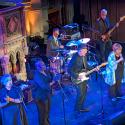
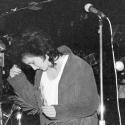
The moment Williams's set begun, though – she alone on guitar, Astrid on piano and occasional backing vocal – the mood was transformed. Although she was just as conversational as Williamson between tracks, and although musically the set started gently, there was a familiar quiet steeliness to everything she did that rendered it all exponentially more serious. And more than anything that seriousness came through in her voice. Lyrics like “I've heard people say that they like me/And then laugh when I fail” – so simple and potentially dry – gained real power when delivered with her rare purity of tone.
As the set went on, the intensity implacably ratcheted up, though you'd be hard pressed to notice that this was happening from moment to moment, because everything she did was about restraint and subtlety. Quips on the mic between songs – “I keep having the feeling of being on a date, I think I should ask you all how your day was”, “my crowd only goes out twice a year”, or joking about her Sylvia Plath-themed Hypoxia songs “not being a summer Ibiza hit” – accumulate to give a sense of profound poetic discomfort. And simple lines in songs – “looking on a beach for a heart-shaped stone”, “loneliness was never a part of us”, or “you turned a corner and I stayed on the bend” – likewise touch simply and gently on their own, but over time became collectively more and more powerful as they chipped away at our own armour.
There are a few reasons Williams is not a bigger star, despite her early Mercury Prize nomination and occasional MOR tendencies on record. Clearly, she possesses little character armour: she writes and talks devastatingly about being a woman in the public glare, and when she says, “You only have to have tonight with me: I have to have all times with me”, after a particularly dark moment from Hypoxia in the later part of the set, it's hard to see the funny side. But as a musician and as a writer she is anything but fragile. The unerring perfection of her voice, and that accumulation of tiny lyrical and musical details to make something far greater than the sum of its considerable parts, mean the set may have been painful to hear, but was also completely irresistible.
There's nothing overtly spiritual about Kathryn Williams: her subject matter remains the intensity of the small joys and pains of ordinary lived lives, the safety net of cosmic significance completely absent. Yet as the set culminated in her expertly looping and harmonising her own voice with effects pedals, the fact she was in a church was not irrelevant. The painful beauty, and almost impossible confidence, of her music of sadness, vulnerability and love, had built into a kind of secular gospel, and the effect was devastating and supra-human. No, it didn't quite live up to my experience at the Tricycle a decade ago, but it came very, very close. There are not many musicians alive today who have this power.