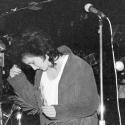
Milton Nascimento is 76. Physically, he is quite frail; he had to be helped carefully onto the stage and then up into a high stool for this London concert by a couple of band members. But that arrival and rather ungainly progress were, as one might expect, given a welcome befitting this hero of the Brazilian musical world. The completely full Barbican Hall was willing him on.
This was one of those nights where the non-Brazilian listener is definitely missing out. One can feel the palpable sense of connection, the sheer warmth and adulation from the besotted audience. People are joining in more or less every line from every song. One can only regret not having a better grasp of the Portuguese, or occasionally the Spanish texts.
The set for this European tour is based around a re-visit of the seminal album Clube Da Esquina from 1972. So a number like “Um Girassol da Cor de Seu Cabelo” (A sunflower with the colour of your hair) starts wistfully and innocently and then gathers momentum and energy. The classic “Cravo e Canela” (Clove and cinnamon) bounces along and rocks out with percussion-driven momentum. And the Violeta Parra song “Casamiento de Negros” (Black wedding) became like a blessing, with Nascimento responding for once to the outstretched hands of the audience and reaching out to them, in the manner of the statue of the Redeemer.
Nascimento’s voice back in the early Seventies had a particular innocent and angelic quality. He was known for occasional ascents into the falsetto register. The voice can now be a bit gravelly, and as the evening went on, there was an increasing tendency to sing flat. That said, he has a fabulous band who keep the show on the road with phenomenal energy and vigour. The guitarist Wilson Lopes, from Nascimento’s native region of Minas Gerais, is a massive and complete musician. He was band-leading the seven-piece unit at the Barbican with superb authority, switching from rock solos on electric guitar to the delicate filigree of nylon string acoustic. Nascimento also places extra singing duties in perfect hands with his protégé/pupil José (known as Zé) Ibarra. A remarkable singer in his own right, he came into his own when Nascimento took a time-out during the set. For the support slot there was a short but highly convincing set from young Italian singer Celeste Caramanna (pictured above). It is a decidedly tough act for an unknown singer to walk onstage cold when everyone is waiting for their hero. And she didn’t have the benefit of any introduction: Gilles Peterson who had been DJ’ing just quietly shut up shop, sloped off and left her to it.
No matter. Caramanna was equal to the occasion. She won over the crowd quickly, notably with songs from two Brazilian female singers, both of whom died tragically young. She sang the Elis Regina song “O que tinha de ser” (What had to be) with a disarming vulnerability, tenderness but at the same time strength, conviction and musicality. That song brought the high-quality idiomatic piano playing of John Crawford to the fore. Then, by way of complete contrast she gave us the swagger and the sass of "Vá morar com o diabo" (Go live with the devil) by Cássia Eller; that gave a chance for the dextrous and persuasive guitar playing of London-based Uruguayan Guille Hill to capture the imagination.