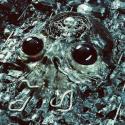
Evil Grave were from Malta. They were a going concern between December 1971 and around May 1977. Despite their longevity, they released no records. However, there were ad hoc recording sessions: at the studio of the island nation’s TV company Rediffusion in March 1973 and, at a home studio, in either April or May 1977. These provide what’s heard on the extraordinary Death From Malta.
The band’s name drew from the Black Sabbath songs “Evil Woman” and “Children of the Grave.” To an extent, this points to where Evil Grave – at least on the evidence of Death From Malta – were coming from. “Optica,” from 1973, is a form of chugging hard rock with whizz-bang maelstrom-esque sections. It is dark, heavy, ominous. This despite the (appropriately) slightly murky sound quality. Similarly, the next 1973 track, the epic “Screaming Streaks of Light” is – had it been released – potentially shelvable alongside records by The Edgar Broughton Band, Deep Purple, Sir Lord Baltimore, the early UFO and, of course, Sabbath. Heavy freak rock with a prog edge, rather than metal as such. A cut from the same year titled “Jam Session” features a brief musical quote from the Sab’s “Electric Funeral.” The final 1973 offering is the crepuscular, moody, sepulchral “Satan’s Death.” Gripping stuff.
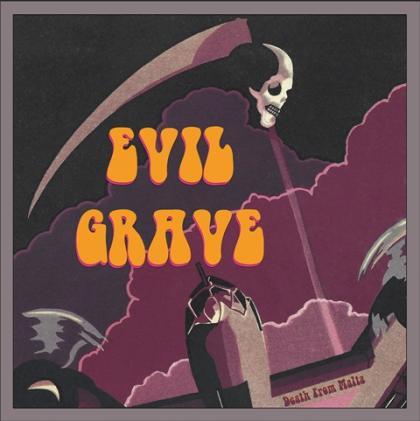
The only track which survives from 1977 is something else. The just-over 15-minute “Machinery” – taking-up the whole of Death From Malta’s Side One – is rock, but not a rock drawing from an immediately comprehensible perspective. The band had clearly moved on from 1973. There had been line-up changes.
“Machinery” begins with a treated voice, more Speak & Spell machine than that of Black Sabbath’s “Iron Man,” and then finds its way with driving, verging on funky, guitar. As the band gels, the whole thing races forward to an initial crescendo during which a synthesiser bloops. The treated voice reappears soon after the two-minute point – machinery, indeed. As this epic continues unfolding there are discrete musical sections, some jazz-fusion guitar at four-or-so minutes in, a dive into a brief free-form freak-out, jittery spaciness, chanted untreated voices and, well, more weirdness. If the 1976 Devo had been prog-inclined hard rockers, they may have come up with something like this. It is astonishing.
Obviously, Evil Grave were unknown outside Malta before this album. It also seems that within their home country they were barely known. The belated propagator of this off-the-wall band is Lee Dorrian, formerly of Napalm Death and Cathedral. He is also the proprietor of the Rise Above label, which has issued Death From Malta (the imprint also released last year’s top-banana comp Yeah Man, It's Bloody Heavy). Dorrian was on holiday in Malta a few years ago and started asking music people about local bands he might be interested in. He met Noel Mifsud, who lives in Birkikara, eastern Malta. Talk turned to Evil Grave. The digging began.
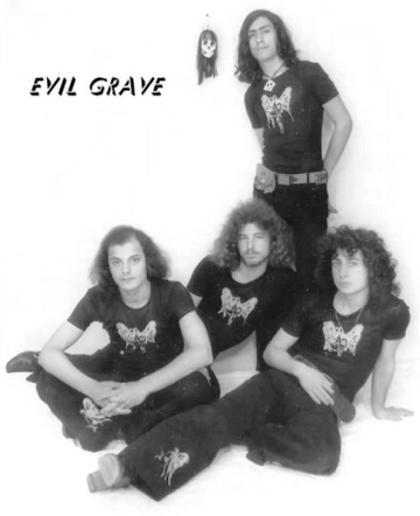
The story subsequently emerging appears to have little local context. Maltese folk music is known about, as is the song festival which was founded in 1960. Malta is familiar from its regular Eurovision presence. Evil Grave were nothing to do with any of these. Furthermore, David Bowie's 1969 appearance at the Malta International Song Festival does not seem to have inspired any local musicians. But there was something going on, as shown by Evil Grave having drawn its membership from earlier bands: a blues-psychedelic group named The Stampede and a rock outfit first known as The Beatmoors and then as Orpheus Balzan. There was swift interest in Evil Grave. For the first half of 1972, they had a residency at the Pharaoh’s Den night club in the Salina Bay Hotel. Then, they played and rehearsed at The Palm Beach Club in the north of Malta.
They attracted newspaper coverage and were picked up by a management company. A proposed tour of Sweden fell through and when offered an appearance on Swedish TV as compensation they refused as it was too commercial for their sensibility. How this decision squared with regularly playing a hotel nightspot is impossible to determine.
After this, there were line-up changes. It all ground to a halt in 1977. Two of the band’s members then went on to play in a cabaret band on a Greek cruise ship. Evil Grave became a memory, albeit one held on to by few people
Now, despite their former manager having more tapes which could not be accessed, band member John E. Zammit-Pace (guitar, vocals) has disinterred what he has. The formidable Death From Malta is the result. A must-hear.
- Next week: Jon Lucien - Search For The Inner Self. Striking 1969 soul album is issued for the first time
- More reissue reviews on theartsdesk
- Kieron Tyler’s website