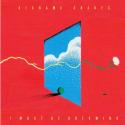
“Jazz,” exclaims an audience member just after Plantoid launch into “Ultivatum Cultivation,” tonight’s second song – also the second song on the band’s recent second LP Flare.
He’s got a point. What’s emanating from the stage at East London’s Moth Club is more a candidate for a description as jazz rather than the math rock – or even the prog rock – tags often cropping up when trying to pin down Plantoid. Jazz: in this case a take on the genre fusing a Miles Davis Bitches Brew sensibility with, in contrast, softer things; things suggesting a familiarity with Gary McFarland’s Sixties deconstructions of bossa nova or the space-age sensibilities of the Sun Ra Arkestra at their more linear and sinuous. But imbued with the hard edge of rock and angular heavy metal riffing.
A difficulty with pinning down Plantoid is, quite possibly, a trait the band is happy with. They are, clearly, doing their own thing. Much of their set is more overtly jazz-inclined than what’s heard on Flare and its predecessor album Terrapath. Although everything played is drawn from their two albums, this is no by-rote facsimile of what’s in the grooves.
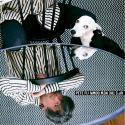
That much is immediately telegraphed by the grouping gathered on stage. The core members of the Brighton-based band are Louis Bradshaw (drums), Tom Coyne (lead guitar) and Chloe Spence (guitar, vocals). Here, the line-up swells to a five-piece with the addition of Callum McMurchie (backing vocals, guitar, keyboards, synthesiser) and Matthew Todd (bass guitar). Even though Todd is also on the front line, Coyne and Spence draw most attention. The latter as she sings all the songs, the former as his guitar is foregrounded, often taking flight. There’s the odd concise drum solo and the bass guitar persistently pulsates, while McMurchie fills in and supplements. But ears and eyes are drawn to Coyne and Spence.
This is no mean feat as the sound – as is typical at the Moth Club – is not ideal. Despite a slight mushiness, Spence’s voice comes across loud and clear but her guitar is often inaudible. Coyne cuts through though. There’s an emphasis overall on the bottom end. Much of Bradshaw’s drums are reduced to a vibration, one felt rather than heard clearly. Todd’s bass is more distinct but is also marooned in the lower register. Everything McMurchie does is part of the whole but when, say, he plays lines on his synth they don’t stand out. Based on previous experiences with the Moth Club, this is not to do with the band but a result of the venue itself: its nature, its acoustic.
The Plantoid experience feels unique
Irrespective of any sound issues, Plantoid’s music can be difficult. One song can incorporate sudden tempo shifts, the use of multiple tricky time signatures, abrupt lurches from the pell-mell to the pacific. None of this is a concern. Plantoid go down great at this sold-out show.
A lengthy “Insomniac (Don't Worry)” – lengthier than on Terrapath – is a case in point. The bed is an insistent, verging on atonal, riffing guitar counterpointing Coyne’s ladder-climbing, extremely brittle, solos. The structural base is to be built from. Contrast this with the filigreed “Good for You.” Its fragility is interspersed with blasts of pure noise and a quick diversion into what sounds like a salute to Black Sabbath’s “Iron Man.” Or “Splatter,” which in Plantoid-world counts as a direct pop song: live, its angularity oddly evokes The B52’s.
In this setting, what’s on record is stretched out, taken to what might be its limit. Most striking is Spence’s voice. There’s a greater force than what’s captured in the studio. Her penchant for a sweet melody is still more-than apparent, but it’s clear she’s reaching further, digging deeper. All that comes to mind as an equivalent is the mid-period Sugarcubes Björk, when she was reining-in her quirkiest tendencies.
Plantoid are hugely impactful. Each member of the band is a tremendously accomplished musician. Together, their chosen path is distinctive. While there are familial parallels with Nordic jazz and rock synthesisers such as Elephant9 or Supersilent, the Plantoid experience feels unique – an attribute which shows no sign of impeding their progress.
Afterwards, a couple of other audience members mull over what they’ve just seen. Plantoid are, it is agreed, a “good ensemble.” Maybe an offbeat description, but in view of the band’s musical chops it makes sense. “Saw them at the [Brixton] Windmill, [now] the Moth Club,” continues one of the pair. “Where next? Brixton Academy?” It might take a while, but based on this show that appraisal doesn’t seem so far fetched.