Would-be axe murderers of the BBC often propose to lop off (among other things) TV channels Three and Four, but Four’s music coverage is vastly better value for viewers’ money than the executive pension fund. Synth Britannia stuck firmly to Four’s “Britannia” formula, being a bunch of talking heads and clumps of archive footage interwoven with synth-pop classics from the late Seventies and early Eighties. But that’s OK as long as the raw material is strong, and this saga of post-punk, pre-New Romantic gadget-pop was often fascinating and sometimes even thought-provoking.
Not that they didn’t try to screw it up with a voice-over so lame that it deserved to be hauled outside and shot by the Dead Horse Committee, after it had flogged itself across the start line with the jaw-droppingly limp “A long time ago in a galaxy far far away…” But otherwise, Synth Britannia stuck to first principles, most reassuringly by rounding up a well-stocked list of the appropriate participants. Daniel Miller, who recorded the much-mimicked "T.V.O.D." and "Warm Leatherette" in his living room as The Normal before forming Mute Records, used to be something of a recluse, but here he was positively gregarious. There was “something very un-British about electronic music”, he mused (because everybody started off copying Kraftwerk, perhaps?), and he wasn’t the only contributor to recall, with the thousand-yard stare of a Marine who’d just fought his way across Iwo Jima, the spleen and vindictiveness with which the music press assaulted the unsuspecting synth-poppers.
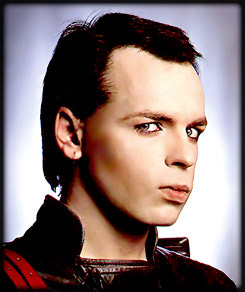 Mind you, while the sneering hacks may have disembowelled the early Depeche Mode or Gary Numan (pictured right), the experimental pioneers of the movement enjoyed kudos from the more cerebrally-inclined scribes. The former were on parade here in the shape of Richard Kirk from Cabaret Voltaire and Chris Carter and Cosey Fanni Tutti from Throbbing Gristle, while Martyn Ware described his journey from the original Human League to the post-modern, politicised pop of Heaven 17 with professorial earnestness.
The musicians’ commitment to their cause was, in retrospect, awesome. Bernard Sumner, then of Joy Division, described how he’d spent two months building a primitive synthesizer from plans in an electronics magazine, which he then used to record "Atmosphere". In Sheffield (“a city torn between the past and the future!”), Cabaret Voltaire were dreaming up weird electronic effects and making their voices sound like robots. But “things were also stirring down south!” where we encountered John Foxx, Gary Numan and Basildon’s home-grown futurists Depeche Mode. The ‘Mode’s Vince Clarke remembered how they’d all travelled up to Fenchurch Street on the train, each carrying his own synth, to appear on Top Of The Pops.
Depeche Mode went on to become international stadium-fillers, but the Human League’s mighty Dare album remains the most enduring symbol of synth-pop’s commercial flowering. The League’s Phil Oakey seems to have acquired an almost music hall jollity in his middle age, perhaps because his band have become a much-loved staple of the Yuletide nostalgia circuit, but better still was the account by the Human League girls, Joanne and Susanne, of how they’d originally been recruited to give the glum electro-dronesters a bit of pop glamour. Oakey dutifully visited their parents to convince them of his honourable intentions, while their head teacher thought a six-week European tour with a pop group would be very educational and would give the girls the chance to visit art galleries.
Synth Britannia abruptly banged the shutters down around the point where monstrosities like Howard Jones and the Thompson Twins began to appear. It was amusing to see that not even visionary synth pioneers are immune from grouchy “in my day”-ism. Martyn Ware deplored the way music had become bland and homogenised, while OMD’s Andy McCluskey protested that all their electronic efforts had been undone by the return of hoary rock’n’roll stereotypes, personified by Oasis. Come on chaps, at least your fans used to go to the shops and actually buy your records.
Synth Britannia repeats on BBC Four at 11.40pm Sunday October 18, and at 1.10am and 3.10am on Monday October 19