

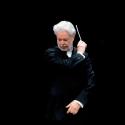
Why, a modish reader might ask, did I go to hear a rum-looking cove conducting a classical lollipop at the Festival Hall when I might have tasted the latest fruits of a controversial prodigy over at the Barbican? First, because there's plenty of time to wait and see whether bumptious wunderkind Alex Prior will get beyond the derivative, lurid monsterworks he's currently producing. Second, because the immensely likeable cove, French-born Stéphane Denève, is so busy transfiguring his Royal Scottish National Orchestra that we Londoners all too rarely get to see him. And last, because you can't beat the impact of Rimsky-Korsakov's Scheherazade when it's firing on all cylinders and seducing with every gorgeous solo. Philharmonia players and a peculiar audience seemed overwhelmingly convinced about that last night.
Not that the concert was all staple Classic FM fare. Denève might have started with the only piece by Paul Dukas widely played today, The Sorcerer's Apprentice; he chose instead the slightly prolix enchantment of Dukas's balletic yarn about a death-announcing Persian fairy, La Péri, preceded by the harmonically resplendent fanfare the composer added later. It was a gift to the opulent Philharmonia brass, of course, but even here Denève established his trademark lift and inflection of broad phrases. The ballet music proper swoons and coruscates like a windbaggy Salome's Dance, though its melodies are strong and I found it easier to succumb to its glitter than to understand the mysteries of Debussy's near-contemporary Jeux, over which so much more critical ink has been spilled. Denève certainly brought a subtle Debussyan poise between darkness and light, and the last muted brass chord notched up one of the most startling conclusions in late-romantic music.
Between the two exotics, Mozart's best-loved A major Piano Concerto could have brought a dash of sprightly high spirits. Not, however, in the careful hands of deadly-serious Lars Vogt, whose sometimes bizarre introspection Denève and the Philharmonia were wise not to contradict. The payoff to a pale first movement came in the Adagio. There are certainly painful depths to plumb here, and Vogt - hunched over the keyboard in a way that surely can't be good for his physical well-being - duly cast his spell. Only in the last, exuberant bars of the final rondo, though, did he snap out of his self-hypnosis and rejoin the daylight world.
The dreams and visions cast by storyteller Scheherazade, on the other hand, can seem brighter than the real thing. Here we had a master narrator in the wonderfully alert, corner-turning Philharmonia leader, Zsolt-Tihamér Visontay, who rightly took the first wild cheers at the end of the performance. No doubt about it, though: Denève was the great co-ordinator, persuading us that for all its vague Arabian Nights programme, Rimsky-Korsakov's orchestral treasury is a true symphony shot through with colossal tension and release, the only 19th-century Russian specimen of its kind worthy to stand alongside Tchaikovsky 4, 5 and 6.
Deeper than the picture-book sea on which Sinbad's ship dips and soars, the first movement had none of the usual pressing-forward, but nor did it ever coast, thanks to this conductor's perfect blend of relaxation and attention to detail. Denève made us marvel at what care Rimsky-Korsakov gives to the subtle divided-string support of every solo (and what tremolos in the work's central doomsday). There's a whole clutch of them in the second-movement tale of the Kalender Prince, rightly given free rein. But in this performance the solo woodwind kept on weaving miracles in the tender portrait of the young prince and princess, a much needed symphonic respite after its high-anxiety predecessor - sea-breeze flute and susurrating, sashaying clarinet wove a magic I've never heard here before.
And when did tears last come to the eyes at the sound of fortissimo unison trombones? Their magnificent contribution rightly crowned the quick-change excitement of the finale, as Scheherazade flicks from tale to tale to keep her head; Denève went well beyond the call of duty in his masterly tempo adjustments. I'm sorry not to have seen Alan Bennett in the audience; he might well have reclaimed Scheherazade from his pile of anti-Desert Island, never-want-to-hear-again discs had he been swept up by this brilliant realisation of the orchestra's full expressive potential.
Between the two exotics, Mozart's best-loved A major Piano Concerto could have brought a dash of sprightly high spirits. Not, however, in the careful hands of deadly-serious Lars Vogt, whose sometimes bizarre introspection Denève and the Philharmonia were wise not to contradict. The payoff to a pale first movement came in the Adagio. There are certainly painful depths to plumb here, and Vogt - hunched over the keyboard in a way that surely can't be good for his physical well-being - duly cast his spell. Only in the last, exuberant bars of the final rondo, though, did he snap out of his self-hypnosis and rejoin the daylight world.
The dreams and visions cast by storyteller Scheherazade, on the other hand, can seem brighter than the real thing. Here we had a master narrator in the wonderfully alert, corner-turning Philharmonia leader, Zsolt-Tihamér Visontay, who rightly took the first wild cheers at the end of the performance. No doubt about it, though: Denève was the great co-ordinator, persuading us that for all its vague Arabian Nights programme, Rimsky-Korsakov's orchestral treasury is a true symphony shot through with colossal tension and release, the only 19th-century Russian specimen of its kind worthy to stand alongside Tchaikovsky 4, 5 and 6.
Deeper than the picture-book sea on which Sinbad's ship dips and soars, the first movement had none of the usual pressing-forward, but nor did it ever coast, thanks to this conductor's perfect blend of relaxation and attention to detail. Denève made us marvel at what care Rimsky-Korsakov gives to the subtle divided-string support of every solo (and what tremolos in the work's central doomsday). There's a whole clutch of them in the second-movement tale of the Kalender Prince, rightly given free rein. But in this performance the solo woodwind kept on weaving miracles in the tender portrait of the young prince and princess, a much needed symphonic respite after its high-anxiety predecessor - sea-breeze flute and susurrating, sashaying clarinet wove a magic I've never heard here before.
And when did tears last come to the eyes at the sound of fortissimo unison trombones? Their magnificent contribution rightly crowned the quick-change excitement of the finale, as Scheherazade flicks from tale to tale to keep her head; Denève went well beyond the call of duty in his masterly tempo adjustments. I'm sorry not to have seen Alan Bennett in the audience; he might well have reclaimed Scheherazade from his pile of anti-Desert Island, never-want-to-hear-again discs had he been swept up by this brilliant realisation of the orchestra's full expressive potential.
- Details of next Philharmonia concerts and details of its 2010-11 season on the orchestra's website
- Check out what's on at the Southbank Centre




Add comment