
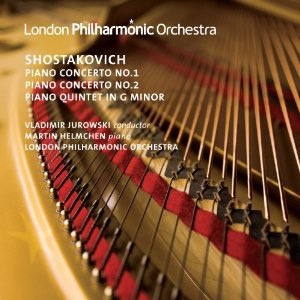
 Shostakovich, Piano Concertos, Piano Quintet, Martin Helmchen (piano), London Philharmonic Orchestra/Vladimir Jurowski (LPO)
Start with the coupling, a studio recording of Shostakovich’s 1940 Piano Quintet, a perfectly balanced blend of wit, poise and profundity. From the opening neo-classical flourish to its haunting, drily ironic close, this performance impresses. Martin Helmchen takes the work seriously and urges us to do the same. He’s beautifully accompanied by the LPO’s principal string players – I’d urge you to listen to Pieter Schoeman’s immaculate slow violin solo in the Intermezzo. The intonation is perfect, the effect shattering.
Helmchen’s live readings of the two contrasting concertos are similarly deadpan. The neoclassical writing in the 1933 Piano Concerto no.1 is dispatched with an appealing dryness and lack of irony. Paul Beniston’s crucial obbligato trumpet solos can be heartbreaking in their poignancy, particularly near the close of the Lento. And I’ve never heard the slapstick close sound this cheerless.
The 1957 Second Concerto, dismissed by its composer as musically worthless, sounds far more serious than usual in Helmchen and Jurowski’s hands. Piccolo and side drum are more prominent, insistent ostinati more nagging. The lovely, nostalgic Andante is as attractive as ever, but the last movement’s 7/8 rhythms have a threatening menace. Intelligent performances of fascinating, accessible works.
 Find this Shostakovich recording on Amazon
Watch Jurowski and Helmchen play Shostakovich on youtube
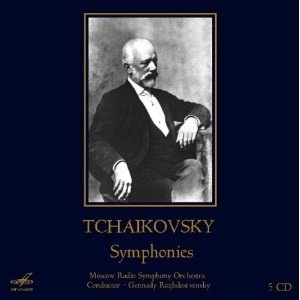 Tchaikovsky, Symphonies 1-6, Moscow Radio Symphony Orchestra, Gennady Rozhedestvensky (Melodiya)
Another slab of thrilling Cold-War era music making reissued by the Russian label Melodiya. Even the packaging is old-school, with ripely translated sleeve notes and a cardboard box already showing signs of strain. This is still an amazing bargain; these performances were recorded in the early 1970s and capture a truly authentic Russian playing style – weighty, dark strings, eloquent earthy winds and brass playing of raw power. Start with the Pathétique’s first movement, and the terrifying, primeval roar emitted by Rozhedestvensky’s trombones before the second theme’s reprise. It’s only matched by Mravinsky’s famous 1960s version, now on DG. The vibrato-heavy horn solo in the Fifth won’t be to everyone’s taste, but it’s a sound that Tchaikovsky must have known. The pizzicato strings in the scherzo of the Fourth are a delight, and the passage in the last movement when the doomy brass fanfares return is magnificently managed, allowing us a properly affirmative conclusion.
The early symphonies aren’t played as lightweights. Rozhdestvensky has taught me to love the Third in particular, with its three balletic inner movements framed by unbuttoned major-key outer ones. The First allows some idiomatic-sounding Soviet winds to shine, with bassoon solos to die for. You’ll like this set. And then you’ll be tempted to splash out on this team’s 1960s cycle of the complete Prokofiev symphonies – in cruder sound, but equally involving.
Watch Rozhdestvensky and the Leningrad Philharmonic play Tchaikovsky
 Adam Woolf (sackbut): Songs Without Words (SFZ Music)
Adam Woolf is a long-serving member of His Majesty’s Sackbuts & Cornetts, and this solo recital consists of transcriptions of 16th- and 17th-century vocal music. The sackbut follows the vocal line exactly, or adds ornamentation to create virtuoso display pieces. The results are unexpectedly mellifluous and I was unprepared for the panache of Woolf’s playing. It’s like a softer, mellower trombone sound, and the sleeve note quotes period sources praising 17th-century sackbut players who could match the agility and range of singers. Woolf’s technique never draws attention away from the music he’s chosen, or the idiomatic accompaniments on organ, theorbo, harpsichord or viola da gamba.
The slower pieces are especially successful. Schütz’s O Jesu nomen dulce with its lilting harp and theorbo backing, or Van Eyck’s mournful Dowland-influenced Pavane Lachrymae, the only work on the disc played without accompaniment.





Add comment