At first the machines are in control. A crane drags the inert body of a woman across the floor, lifts her up and leaves her dangling from the waist. A man follows, dragged by one foot and suspended upside down. The two bodies rise and fall or swing round in a duet horribly reminiscent of carcasses hanging in an abattoir.
French choreographer, Boris Charmatz is obviously not out to please us with a light hearted evening of frivolity. The mood lightens a bit, though, when the crane lowers its cargo onto a giant conveyor belt that gives the dancers a bumpy ride as it bounces up and down with increasing vigour. Watching them negotiating these difficult circumstances, one scarcely notices other dancers slinking in, dragging or carrying small bundles.
One begins to fear for the safety of the little ones
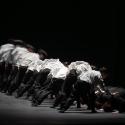
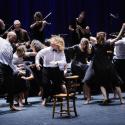
Everyone is dressed in black and, with the lighting low, it takes a while to realise that they are bringing young children onto the stage. The kids appear to be asleep or drugged – like Madeleine McCann abducted in the night – for they allow the grown-ups to manipulate them as though they were puppets. Some are dragged, carried, swung, dangled, twirled or rolled; others remain floppy while their arms and legs wave, their feet tread, their hands shake and their heads nod at the behest of an adult who pulls the strings, as it were.
Despite the inequality of the situation, these interactions seem fairly benign; its when the adults begin to liase with one another – clustering in a circle and passing the comatose children round – that one begins to fear for the safety of the little ones and becomes horribly aware of their vulnerability.
But the circle soon breaks up and the adults wander around uttering strange cries as though desperately lost. It reminds me of Tadeusz Kantor’s Dead Class, which I saw back in 1975; I’ll never forget the class of deadbeats invented by the Polish director with puppets of their younger selves clinging to their backs. My view of the children shifts; now they seem more like reflections of the adults encumbered by them than independent beings.
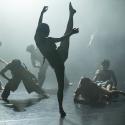
The ambiguity of Enfant makes it endlessly fascinating. At a time when adults have become too scared to handle children in case they are accused of inappropriate behaviour, witnessing so much hands-on manipulation is refreshing as well as troubling. Things are about to change, though. The children lie on the floor as though dead while the adults roll about making nervous, jerky movements that get more and more frenetic. Encouraged, perhaps, by the siren call of a piper, the children begin to sing.
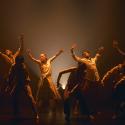
Suddenly one child starts to run and others follow; soon chaos reigns as the bagpipes play at full blast and the children run, prance, leap and dance around the space and the adults join in. It's Bedlam; no one is in charge in what Charmatz describes as a "fragile performative moment, because you can’t direct the children". "Dance should be dangerous," he says. "I like chaos in the frame."
A motley procession trails along behind the piper; it puts me in mind of Pieter Bruegels’ painting The Blind Leading the Blind (1568) showing a line of hapless beggars falling into a ditch. Once the adults fall, power relations are reversed. The children join forces to get their own back on the grown-ups, while an enterprising girl hooks the piper up to the crane and he is hoisted heavenward still playing his plaintive tune.
- Enfant is at Sadler’s Wells tonight
Overleaf: watch Boris Charmatz discuss Enfant