

In each of its incarnations – books, television series and theatre shows – covering more than 80 titles, Horrible Histories, created by Terry Deary, has been a hit. Children love the stories' anarchic humour and gory details, while parents and teachers know that their charges are retaining some information while having fun.
And now Horrible Histories' latest incarnation, Barmy Britain, presented by Birmingham Stage Company and written by Deary and Neal Foster, is touring drive-in venues around the country.
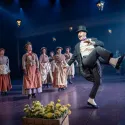
Performed by Foster and Morgan Philpott, who play multiple roles with lots of on-stage costume changes, Barmy Britain has Horrible Histories' winning mix of slapstick, silly songs, daft sound effects and even occasional (very funny) puppetry. It also has the thing young children love most – lots of bum and fart gags.
Foster and Philpott take us through 2,000 years of British history, starting with the Romans and ending with Queen Victoria, who does a rap (“I'm Vic the Queen/ I'm old and mean"), which was given a perfectly timed percussion accompaniment courtesy of the audience's car horns. Richard III, meanwhile, whose body was found buried in a car park – and therefore surely an apt subject at a drive-in show – gets a mention too.
The duo vary the pace with an occasional song, or by presenting a skit as if it was a stand-up sketch, or even an episode of Who Wants to Be a Millionaire?, as Guy Fawkes is questioned by Chris Tarrant. It has be Tarrant as the actor winningly confesses he “can't do Jeremy Clarkson”.
Horrible Histories' great strength is being entertaining and funny while slipping in memorable facts – I didn't know King John of Magna Carta fame was illiterate, for instance. And some of the content (Barmy Britain was first devised in 2015) has strangely become bang up to date; in the section on the bubonic plague, Philpott says with a side-eye to the audience: “Thank goodness things like that don't happen nowadays.”
It isn't just royals in the show; Dick Turpin appears and, in one of its best sections, Foster and Philpott run through the gruesome story of the murders committed in early 19th-century Edinburgh by Burke and Hare, supplying fresh corpses to anatomist Dr Robert Knox.
I must say Northampton Saints' car park wasn't an ideal venue (one big screen was not enough for such a large space as those at the back would have struggled to see any detail on the stage), but Foster (who also directs) and Philpott give typically committed performances in an hour that moves swiftly. And, judging by the reactions of the youngsters around me, it was a hit for its target audience.





Add comment