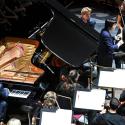
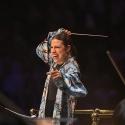
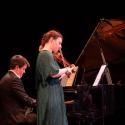
Pavel Kolesnikov returned to the Hallé last night with a bobby-dazzler of a concerto. He’s a laid-back dude in appearance, with no tie, flapping jacket and cool appearance – quite a contrast with the full evening dress worn by the orchestra members – but the music says it all for him.
Saint-Saëns’ Second Piano Concerto (three movements, getting faster each time) is a vehicle of naked, virtuoso pianism in a hotch-potch of styles ranging from the imitation Bach organ toccata at the start to a comic episode in the central movement that could be illustrative of one of the species that missed making it to The Carnival of the Animals (pandas at play, perhaps?). It demands ferociously brilliant technique from its soloist, which Kolesnikov has in almost uncanny intensity, but also gives the opportunity for glorious cantabile in its sweet tunes and a few ethereally gentle moments. Not as much as the Rachmaninov he played last time, perhaps, but as a seasonal display of pianistic fireworks it was hugely successful.
The scherzando middle movement was suitably good fun and very neatly phrased and articulated (with a beautiful horn solo from the Hallé’s Laurence Rogers), and the hyperspeed saltarella of the finale kept in admirable synchronicity between solo and orchestra.
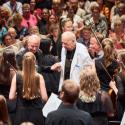
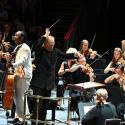
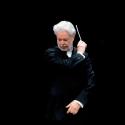
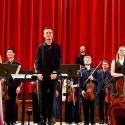
The concert was conducted by Olari Elts [pictured below], taking the place of Nodoka Okisawa; the programme being basically one of 20th century fun French music to form a foil to the Saint-Saëns, plus Three Film Scores for String Orchestra, a late piece of editing from screen soundtrack music by Takemitsu (whose music has its French influences, allegedly). 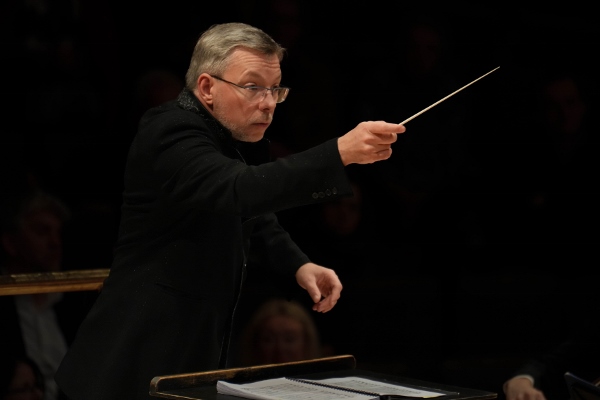 Ravel’s Le Tombeau de Couperin is a popular orchestral piece today, its four-movement “French suite” providing light and airy textures allied to Ravel’s nostalgically dreamy harmony and winsome melodies. The Hallé orchestral sound, led by Roberto Ruisi, was clean, with 40 strings mustered (that applied throughout the evening), and Elts’ approach, business-like and economic of gesture, even small finger movements commanding attention, yielded dividends in this music (such as the lovely diminuendo at the close of the Prélude). The Menuet became the piece’s highspot, a plaintive evocation of a gracious former age, and the Rigaudon was despatched with efficiency and a generous helping of fun, sentiment and flexibility in the tempo. Hallé principals Stéphane Rancourt (oboe), Amy Yule (flute) and Thomas Davey (cor anglais) shone brightly.
After his concerto, Kolesnikov entertained an appreciative audience with a (possibly tongue-in-cheek?) version of Rameau’s L’égyptienne – not quite Couperin-as-seen-by-Ravel, but in rather similar vein the way he played it.
The short Takemitsu pieces were light relief in a programme that was none too weighty anyway, their variants of popular vernacular styles providing tuneful and easy on the ear: the Funeral Music from Black Rain poignant and almost anguished in Elts’ hands, and the Waltz from Face of Another warmly ironic.
Poulenc’s Sinfonietta of 1948 has its own sense of being almost a set of send-ups, opening with bold phrasing and juicy harmonies reminiscent of the Organ Concerto, and proceeding into syrupy, almost decadent, territory, and the second section has a rollicking, perpetuum-mobile sort of theme, with its own nostalgic foil. The slow movement provided luminous, luxuriant sounds, and the finale’s short, snappy phrases with both a jolly episode and some sentiment laid on thick as well, were played with generally enviable precision.
THE concert followed an impressive piano recital earlier in the day at the Bridgewater Hall promoted by the Manchester Mid-day Concerts Society. Edward Leung, a graduate of Princeton University and the Royal Birmingham Conservatoire, gave a genuinely exciting account of Liszt’s Polonaise mélancolique no. 1, highly expressive, with a sense of the unexpected always around the next corner, some lovely high ringing tone, and an explosive conclusion, and went on (with brief Meredith Monk, Bach and Shostakovich fugal writing thrown in) to Franck’s Prélude, chorale et fugue, played with ruminative depth, thunderous fury, melodic resignation, and with clarity, determination and passionate commitment. His music is never dull and completely mesmerizing.
- · Repeated on Sunday 10 November
- · More classical reviews on theartsdesk