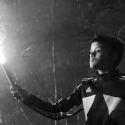
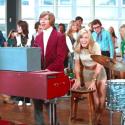
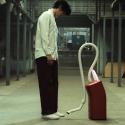
It’s hard to describe this hot mess of a film without divulging the entire plot. And even if you did, you’d struggle to convey the scabrous psychosexual atmosphere, or summarise the thematic currents that swirl beneath the surface. As director Peter Medak says in one of the interviews on this typically well-stocked BFI disc, “It's too complicated to explain."
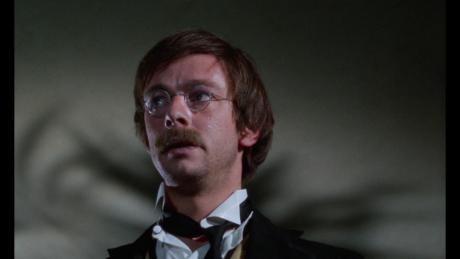
The basic setup is simple, though: Theo (Peter McEnery, pictured below right) and Vivien (Glenda Jackson) live above Theo’s father’s antiques shop in a down-at-heel corner of West London. They pass the time by indulging in what today would be labelled “cosplay”, although even seasoned S&M enthusiasts might blanch at the macabre roles they assume: Theo dons wireframe spectacles and formal Edwardian attire in an attempt to channel Dr Hawley Crippen, the notorious wife murderer, while Vivien plays both Crippen’s wife, Cora, and his mistress, Ethel Le Neve.
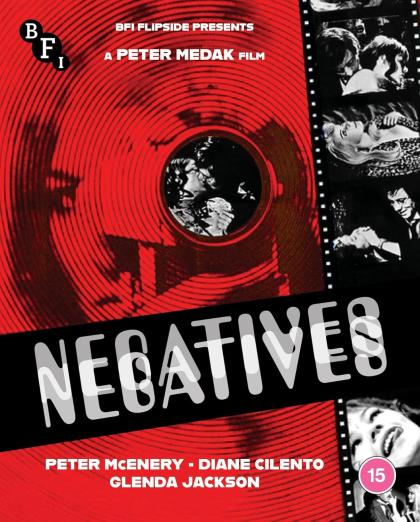
Theo and Vivien’s commitment to their roles is more akin to method acting than fantasy role play, and it’s hard to tell whether they’re "in character" or not during a given scene. In or out of costume, Theo is morose, dejected, pathetic. Vivien is haughty, needling, domineering, and cruel. Both actors deliver fascinating, combustible performances.
McEnery allows what could have been a thankless role to subsume him, and in so doing creates a character whose screen presence belies his weakness and submission. Glenda Jackson, resplendent beneath elaborate wide-brimmed hat and veil, cheek punctured with a heavily pencilled beauty spot, utterly convinces as a woman who genuinely enjoys psychologically torturing and emasculating her downtrodden male partner.
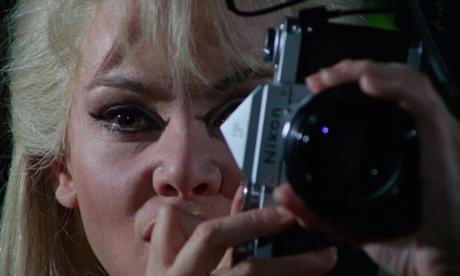
This bizarre ménage is complicated by the introduction of Reingard (Diane Cilento, pictured below left), a glamorous, voyeuristic German photographer who befriends first Theo and then Vivien, moves in with them, and adds another kink to their already complicated domestic setup. The viewer might make certain predictions about the result of introducing another dominant, manipulative female into a situation wherein a woman already has the whip hand over a man. But this isn’t a film that plays to expectations.
Reingard’s Nikon camera becomes the dramatic device which proves the adage that observation alters its subject. It may not steal souls, but here the camera certainly doesn’t seem to do anyone any good. The title Negatives connotes not just the obvious photographic aspects, but the sense that, in adopting personas, the characters are merely manifesting their dark sides.
“Some people refuse to be themselves, they only want to be someone else,” Theo tells Massinger (Billy Russel), the upholsterer at his antiques shop. But why choose Crippen? The only reasonable explanation is because the famous femicide represents such a powerful nexus of sex, death, and misogyny.
When Theo and Reingard visit Madame Tussaud’s and view Crippen’s wax figure, she scoffs at how unremarkable he looks. Her derision parallels Vivien’s taunting of Theo, itself an echo of Cora’s alleged henpecking of Dr Crippen. Margaret Atwood’s famous maxim – “Men are afraid that women will laugh at them. Women are afraid that men will kill them” – springs to mind. I was also reminded at times of Hitchcock’s Frenzy. In her booklet essay, Josephine Botting remarks, with wry understatement, “It’s tempting to conclude” that Peter Everett, author of the source novel, “was not a fan of the female of the species.”
Theo appears to get a sexual kick out of being humiliated, but some S&M aficionados will tell you that the "sub" is often more in control than appearances might suggest. Conversely, it’s not impossible that Vivien drives Theo so hard out of a masochistic desire to provoke violence.
The daring cinematography makes much play with mirrors and frames. Clocks tick, the camera shutter clicks, and the word "decadence" assumes a dual meaning. While Theo’s father lies dying in hospital, his shop is gradually crossing the line between "antiques" and "bric-a-brac". “I wish I had something better to leave you,” the old man tells his son. Nostalgia hangs heavy, as does the sense of English empirical decline.
Costumes and production design combine to offer a visual banquet: a gaudy mix of seedy and sumptuous. Nobody steals this film, but Glenda Jackson is served arguably the meatiest role and sinks her teeth right into it. A lot of actresses in an erotic thriller might have felt upstaged by Cilento, who looks (to borrow a phrase from Bob Dylan) “like she stepped out of La Dolce Vita”. Not Jackson. Her sullen, heavy-lidded sensuality pulls viewer focus and charges almost every scene she’s in.
The later stages of the plot are hard to interpret. You might posit a metaphorical or symbolic parallel between Theo’s behaviour and the impact of "sex crimes" on society. Or you might simply think the film is going off the rails. Is it fun? Sometimes. Is it boring? Never. Is it erotic? That’s a matter of taste.
Theo might have done well to heed Kurt Vonnegut’s warning (in Mother Night) that "We are what we pretend to be, so we must be careful about what we pretend to be." The mask doesn’t stop at the face, but eats right through to the soul. Again and again, we circle back to the curious but long-acknowledged link between sex and death, here made manifest by a couple who perhaps indulge in baroque perversions as a means of avoiding facing up to a reality that inevitably involves dysfunction, decline, and death. The irony is that their sex games only hasten that process. La petite mort, indeed.