In a notable case of nominative determinism, the 2025 film about a kabuki star, Kokuho – meaning “national treasure” – became just that in Japan, a box-office smash. The keening voices and ultra-stylised mannerisms of the genre are not staples of Western entertainment, so a three-hour feature film about a kabuki actor sounds like a tough proposition here. But the time is well spent and flies past.
Kokuho’s storyline is the familiar one of the isolating life that supremely gifted artists face and the people they sacrifice along the way in their pursuit of perfection. Think virtually any biopic of a performer, or all the fictive descendants of Dr Faustus. Kokuho even has its main character, Kikuo (Ryo Yoshizawa), make a Faustian pact at a temple, where he prays to the Devil to make him the greatest kabuki actor in 20th century Japan.
In typical artist biopics, how the performer harnesses the basics of his profession to become a star is the focus. Here, though, Kikuo has more than the angle of his arm or the intonation of his swooping falsetto to master. He is an orphan, adopted by a yakuza boss after his parents died in Nagasaki of radiation poisoning. The kabuki life runs oddly parallel to the yakuza’s at times; it is dynastic and structured around families, who hand down the revered name of their head man to the next generation. Once reviled as deviant influences by the shogunate, in the 20th century we find kabuki stars have corporate sponsors who build theatres for them and squealing female fans a K-pop band would recognise.
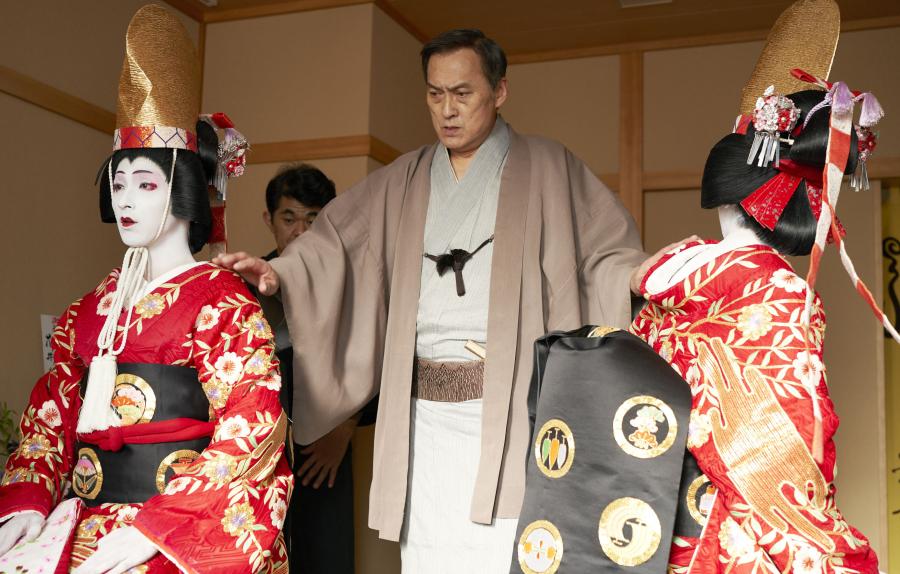
One such kabuki patriarch, Hanai Hanjiro II (Ken Watanabe, pictured above, centre, with Ryo Yoshikaza, left), spots the teenaged Kikuo’s talent and takes him on as an apprentice when his adoptive father is killed by a rival gang. For Hanjiro, he is a natural onnagata, a male actor who specialises in female characters; for Hanjiro’s own son, Shunsuke (Ryusei Yokohama, pictured above, right), who is set to inherit his father’s title, he is a disconcerting presence. The plotline weaves its way from 1964 to 2014, as the two embark on their careers, and the bond between them is regularly tested. Kikuo has the talent, but Shunsuke has the bloodline. Both will suffer reversals, like Shakespeare's Bolingbroke and Richard II, as their buckets rise and fall.
The film is fairly conventional in style, its storytelling straightforward, its sexual stance decidedly hetero. Women may be coaches, but most of them here are essentially handmaidens (and sexual partners) to the actors. And the potential bromance between the two leads remains an often grudging affection. The storyline spans its half-century with steady pacing and a few flashbacks, aided by captions showing both the dateline and information about the kabuki pieces being performed, typically tales of thwarted passion and betrayal, ending in death.
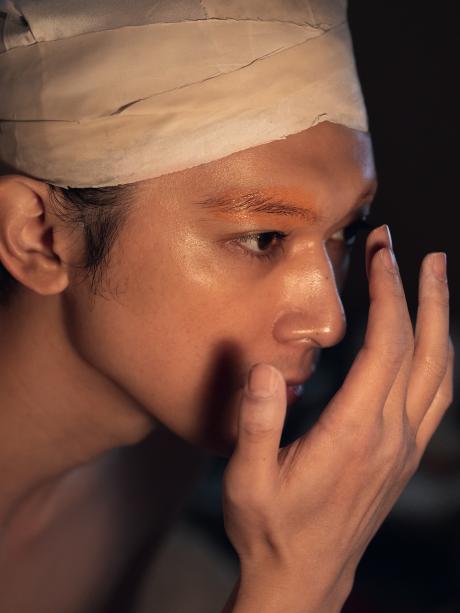
Visually, it’s a treat. The camera moves alongside the dancers, watching them apply their makeup, accompanying them backstage through all the production’s paraphernalia and onto the platforms below the stage that raise them up to the playing level. We whirl around them and stare close up at their amazing white-faced makeup, with its hints of vermilion at the corner of the eyes. One shot, in the piece called Snow Maiden, is breathtaking in its beauty.
Lee Sang-il, a South Korean director known for action films and the TV series Pachinko, keeps things simple, creating scenes of intense emotional power, mostly accompanied by just the traditional vocals and instruments of the genre, the Japanese flute and the shamisen (a three-stringed instrument), and leaving the swelling strings of Western orchestral music for the finale. For key scenes, including the very last, all background noise is totally silenced. Lee's biggest nod to artiness is a repeated motif of swirling points of light, which could be snowflakes or blossoms, or even fireflies.
But the comparative simplicity of this approach leaves the fascinating kabuki life, its gorgeous costuming and refined gestures, firmly centre stage. The two leads rise to the challenge of embodying these actors impressively. Neither of them is a kabuki specialist, but they trained for 18 months in the techniques (their teacher, a woman, makes a brief appearance in one scene, as a photographer). It’s impossible for an outsider like me to judge how authentically they are performing, but they are riveting and poignant to watch, especially as they age.
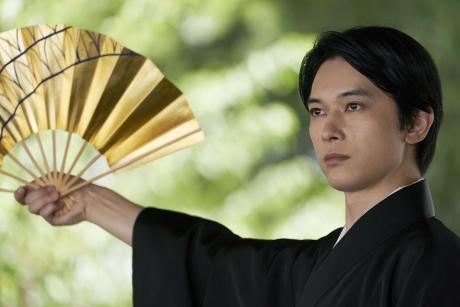
Just as extraordinary are the actors playing the older kabuki stars. Watanabe, so often cast as a tragic warrior, is mesmerising, especially in magisterial full slap in his final scene. As is the 80-year-old actor Min Tanaka playing the onnagata Mangiku, an ascetic who warns Kikuo not to be seduced by his own beauty so that it consumes his art, and who finally retires in his late eighties to an empty cell. Tanaka, a ballet dancer turned actor, has a severe lined face that serves as a road map to the stringent demands of the kabuki life.
What isn’t so easy to depict is the kabuki mindset, which it is just as important to master as the physical techniques. It’s left to the increasingly inward-looking Kikuo to exemplify the kabuki way. The photographer says to him, when she encounters him in his sixties, that when she had watched him perform, the experience was transformative, as if he was inviting her somewhere she had never been. The film does the same.