It is a nightmare scenario: you have an accident that leaves you comatose. You are out of action in hospital for three weeks and then, when you wake up, you gradually realise that you don’t remember anything of the past 10 years. Not three weeks, but 10 years! So what has happened to your life? This is the basic premise of Olivier- and Tony-award-nominee Peter Quilter’s new drama, 4000 Days, whose title aptly describes the gap in the experience of its protagonist, played by the ever-watchable Alistair McGowan.
Set entirely in a hospital room, the story explores the situation of Michael (McGowan), who works for an insurance company, and ends up in A&E when he collapses due to a blood clot on the brain. Although the doctors are puzzled by his memory loss, which spans the previous decade of his life, the most traumatised person is Paul, Michael’s partner for most of that time. He discovers that Michael cannot remember a single thing about their relationship.
It is quite refreshing to see a gay relationship concerned more with love than sex
To up the stakes, Quilter adds Michael’s mother, the thrice-married and widowed Carol, to the emotional mix. She has never really liked Paul, and so she is glad that Michael doesn’t remember him. In fact, she reminds her son that he used to be a much more creative person before he met his lover, that he used to love painting. She thinks that Paul made Michael boring. At one point she turns on Paul and says: “You painted him beige.” So as Michael tries to reconnect with his previous personality by painting a mural on the wall of his room (how tolerant is our NHS), Carol tries to persuade him to leave his partner and move in with her again.
The tug of love between Carol and Paul brings up a number of interesting issues, which include the notion of getting a second chance in life, the nature of memory, and the conflict between a mother and her son’s lover. But although it is quite refreshing to see a gay relationship which is concerned more with love than sex, some of the writing here is bland and thin.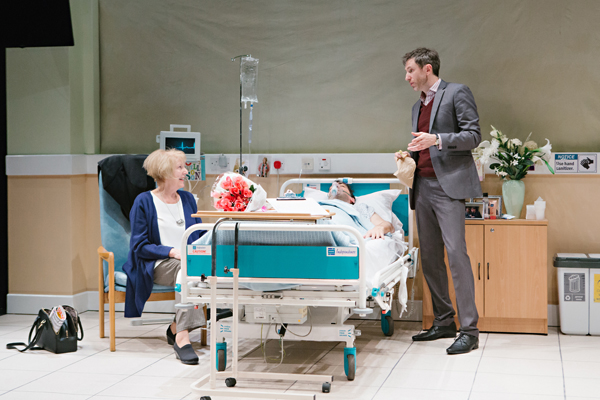 As played by the redoubtable Maggie Ollerenshaw, Carol is the spiteful mother-in-law from hell, a vicious monster who seizes the chance to cling to her son, emasculating him while at the same time proclaiming that “there is no greater love than a mother for her son”. The rather gentle and sensitive Paul has a real struggle to stand up to this maternal machine of total surveillance and control. And for most of the play he has little hope of success. Meanwhile, as Michael rediscovers his previous identity as an artist, he also begins to recover some fragments of memory. But, throughout the play, it’s the ideas rather than the characters that engage the interest, and much of the storytelling is pedestrian and lacking in dramatic power.
Matt Aston’s production is neatly designed by Rebecca Brower, and wends its way through the rather banal twists of the plot while giving plenty of room for McGowan to express Michael’s pent-up frustration and sarcasm, while Ollerenshaw’s Carol has a similar amount of opportunity to pour bitter bile over her son’s relationship. By contrast, Daniel Weyman’s Paul (pictured above with Ollerenshaw) is less demonstrative and more gentle, more feeling, more deep perhaps. If not enough is made of his creative side (being in marketing is surely not the most boring job in the world), it has to be said that the conflict between art and money deserves a deeper exploration than it gets in this rather underwritten and underwhelming play.