The Catalan capital has given its name to a famous number in the Stephen Sondheim musical, Company. And here it is lending geographical specificity to the second two-hander, following the far-superior Camp Siegfried, from American writer Bess Wohl to reach London in recent years.
The star presence of TV name Lily Collins in a demanding stage debut will pique curiosity, for sure, but the play feels as if it wants to be weightier than it is and can't decide whether to surrender to cliche, or subvert it.
Collins plays Irene, a glammed-up American abroad whom we first see in a lustful embrace with a Spaniard, Manuel (Alvaro Morte), whom she has met in a club and whom for some reason she insists on calling Manolo: perhaps she has mistaken him for a shoe?
In any case, and is often the way of these things, the two strangers get to know one another's bodies first, and who they actually are somewhat later. In Manuel's case, he would seem to be a Madrileno who knows a thing or two about flats with poor plumbing and who can hold forth eloquently about the terrorist attacks that brought destruction to the Madrid train network in 2004.
She, in turn, is engaged to an unseen American called Todd who may not perhaps be the best choice for a life partner: pain is soon revealed beneath her determinedly perky facade. Indeed, Irene is so relentlessly "on" (she bangs on about the notion of the American pioneer) that her ramped-up emotional state becomes rather wearing, a problem not solved by her own awareness of how annoying she can be: self-knowledge is not always the solution. 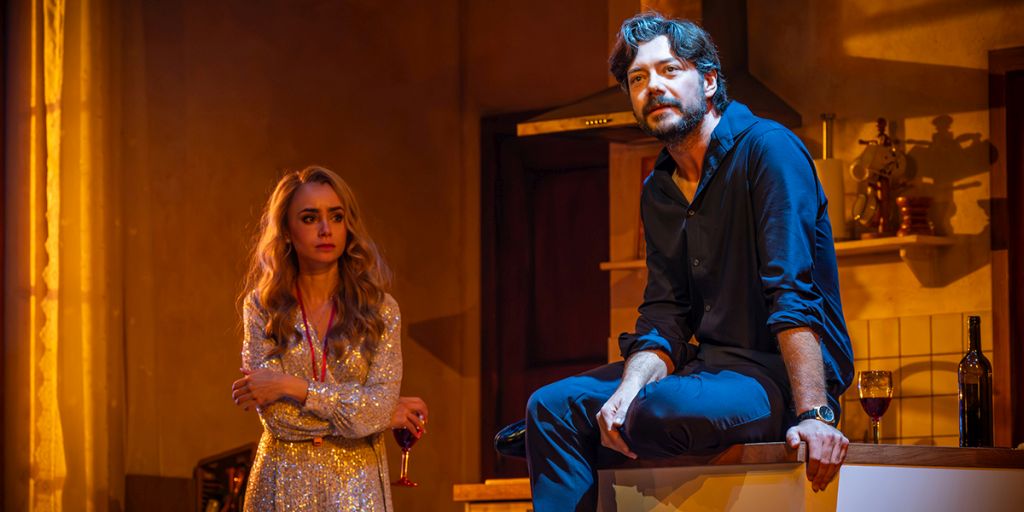 The pair fumble their way through a night that turns out to involve a dual reckoning of the soul. He confronts an ongoing burden of loss that no degree of drink-soaked foreplay can allay; she faces up to anxieties that have made for a confounding sense of dissatisfaction at the ripe young age of 35. Along the way, the locale is pressed into service where metaphorically convenient. The Sagrada Familia comes to represent "a monument to perseverance" from which Irene and Manuel might both draw strength, whilst the wrecking ball soon to demolish the apartment in which they are cavorting could as well signify fragile psyches under attack that not even the soundtrack to A Room with a View (itself played on cue) can salve.
The narrative, set during the Obama era, depends on shifts in mood and tone that align this play with the previous occupant at this same theatre, the wonderful British play Shifters, itself also directed by the fast-rising Lynette Linton, who departs her post running west London's Bush Theatre next year. But whereas Benedict Lombe's two-hander deepens across a deliberately fractured narrative, Wohl has to push revelations towards the realm of contrivance merely to sustain momentum across 90 minutes, no interval. (Camp Siegfried made for an infinitely more organic whole.)
The physical production could not be bettered. Frankie Bradshaw, a collaborator on Linton's National Theatre debut on Blues for an Alabama Sky several seasons ago, makes the setting a place of literal and emotional upheaval: a site of entrapment on the one hand, enlightenment on the other. Jai Morjaria's lighting morphs expressively to amplify heightened states of being toward which one or the other character is drawn before snapping back into an often-grim reality.
Both performers acquit themselves well in an environment new to them, though Morte has plenty of theatre credits back home. As springy of intellect as he is physically wiry, the actor suggests Manuel's potential as a saviour of sorts to the distraught Irene, even if he, too, contains within him deep distress. Collins manages to run headlong towards a rather bristling portrait of the ugly American. Her courage, if that is the word, in embracing cliche is made palatable by the actress's own, indisputable style and by our realisation that you can seek escape from the world in booze and sex but at some point have to wake up to the one constant in life: your conflicted self.