“All discord without this circumference,” the Duchess of Malfi tells the good man she’s just asked to be her husband, “is only to be pitied and not feared”. Perhaps the villains should be more feared and less pitied in the imbalanced casting of Rachel Bagshaw’s clear and yet still atmospheric new production of Webster’s supposed shocker.
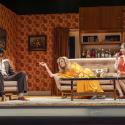
It’s to Bagshaw’s credit and the riveting performances of Francesca Mills as the Duchess, Oliver Huband as her beloved Antonio and Shazia Nicholls as her faithful Cariola that good resonates more powerfully than evil here, even if two of them end up strangled and the third stabbed by mistake. Still, the other key actors surely go too easy on the psychotics. It’s vital to avoid Hammer House of Horror overkill on the Duchess’s two malign brothers, but you feel that Oliver Johnstone’s Ferdinand is too normal and low-key for the crazed monstrosities he inflicts on his twin sibling simply for marrying again, while Jamie Ballard’s Cardinal needs more of a powerful presence. Webster makes it difficult for anyone to make sense of Bosola, the hired assassin with too persistent a conscience, but Arthur Hughes (pictured below on the left with Johnstone) seems to pose too little a threat. 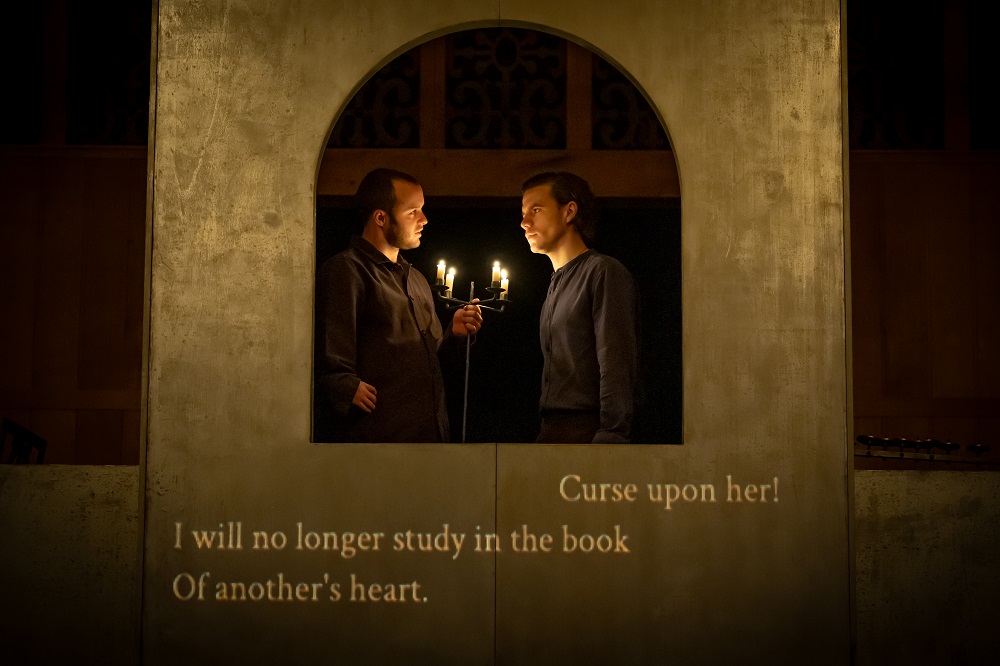 Those are the only reservations about this strong staging, though they’re problematic in the last long stretch of the drama after the Duchess’s murder when concentration flails a little and you wish the malefactors to rush more swiftly to their doom. The Sam Wanamaker Playhouse is surely as effective as the original Jacobean Blackfriars Theatre in exploiting candlelight and shadow for the unbearably claustrophobic later stages of the Duchess’s trials. From harmless beginnings, rife with interpolated lines and song to inject humour (and further misogyny), the tension escalates after the interval to the scene where Ferdinand asks his sister to take his hand and passes on to her a severed limb, carried out in near-total darkness.
The chaos in which he unleashes madmen upon her sees the text projected on the back walls splinter and swirl, a brilliant development in a device which makes us “hear” the earthy language and animal similes of Webster’s very distinctive poetry and prose all the better. The production also has one of the best scores I've heard in a play over recent years, a quartet scored by Anna Clock with prominent roles for double bass and bass clarinet. 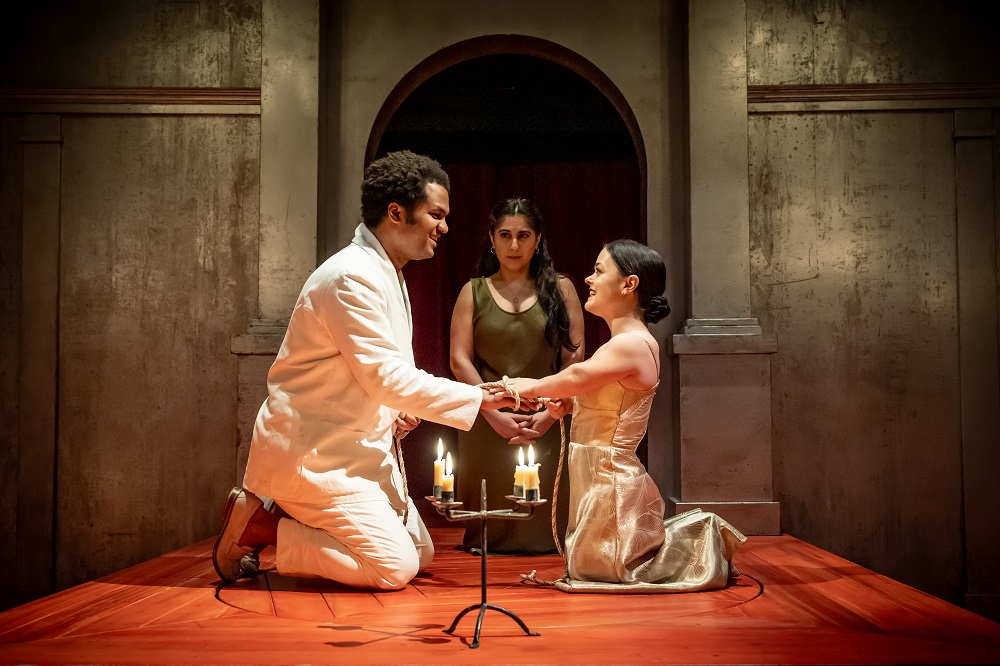 The meaning is exceptionally well delivered by the entire cast. Mills’s Duchess (pictured above with Huband and Nicholls) stands very much at its moral centre: vivacious in her reactions at court and in her playfulness with the man she courts, immensely courageous in facing her trials – all the more powerful for the presence of fear in her resolution (I was reminded of Evgenia Kara-Murza’s speech about fearfulness as not being absent but overcome in the resolutions of her husband’s and Navalny’s returns to certain imprisonment in Putin’s Russia). For all the weakness in characterisation when it comes to the bad men here, it’s good to find ethics playing so strong a role in Webster’s theatre of cruelty.