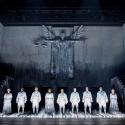
The plays of David Ireland have a tendency to build to an explosion, after long stretches of caustic dialogue and very funny banter. The Fifth Step, though, is a gentler beast whose humour ends with a simple visual gag. Maybe because this is more personally sensitive territory?
Ireland sets the piece in an AA meeting place, somewhere he got to know well in his early twenties in Glasgow. As props, there are just a few folding chairs and a refreshments table with paper cups. The sides of the performing space are raised, turning it into a kind of arena. There, a succession of bouts takes place between James (Martin Freeman) and Luka (Jack Lowden) as they go through the 12-step AA programme.
James, who describes himself as a “recovering Catholic”, is several decades dry, an elder statesman of sobriety; he has given up porn as well, and sex with his wife is a four-times-a-year rarity. He’s a reverse Falstaff, with Luka as his Prince Hal, something of a hothead, an unhappy, lonely man in his thirties who can’t sit without jiggling a foot. Aside from his gargantuan appetite for porn, 20 sessions a day, it’s primarily drinking, he admits to James, that helps cocoon him.
Freeman, as he often does, projects his character as a man cockily sure of himself and the advice he passes on to Luka. Which is, primarily, don’t imagine women are the answer: all emotional attachments are toxic for alcoholics, sweat it out alone. What Luka needs is to become the father to himself that he needed growing up. Avoid all “wet” places with mates who don’t get what you are going through. And a spiritual awakening helps too, or it did for him. James impresses Luka with his experience and agrees to be his sponsor.
 Luka is doubly frustrated. He is horny as hell, though as a “ginger” finds women aren’t attracted to him. James’s no-sex advice is wormwood and gall for him. Then, when he has a strange encounter at his gym and becomes a churchgoing, bible-reading Christian, he has to tolerate James’s stern lectures about the abuses of religious institutions, the paedophilia and cruelty, the links with slavery.
On paper, this setup sounds as if it will become a grim tour of the alcoholic’s mindset, a savage one-sided scrap in which Luka is pummelled into shape. But Ireland evens up the contest and gives him enough energy and savvy to challenge James at every turn. “Why?” is his constant response, like a toddler. Why is his interest in church not a proper spiritual awakening, as James is arguing? As the dialogue becomes a comic rat-a-tat to-and-fro, the balance of power starts to shift and the scales level up. Is James the success story he claims? Is the unseen character known as “Irish Frank” (he’s from Dunfermline, Luka sneers) correct in the tales he is telling, first about Luka, then about James?
This shift is signalled by a spotlit disco-dance of triumph Luka does around the raised edge of the space. He has started to sense there are boundaries he won’t let James cross, cemented by the next, extremely funny scene where he tells James about a dream he has had, featuring James as a white rabbit. Talk of their childhoods stirs up James’s anger towards his rap-loving, increasingly estranged son, his anger towards many things. As they move towards the Fifth Step, the confessional stage in the AA programme, the cracks in his self-defined armour are beginning to show and fists, literally and metaphorically, start to fly. Lowden, as is usual with this exceptional actor, totally inhabits this wired character, for once talking in his native Scots accent (except for a brilliant impersonation of De Niro in Raging Bull, with full facial contortions too). There are times when, as per other Ireland characters, Luka sounds a bit too much like the playwright, too eloquent and gifted at comedy, but the results are extremely satisfying. And the ending is a sweet surprise.
The whole production has a lightly ironic tone, set by the Johnny Cash track that opens it, “I’m Just an Old Chunk of Coal”, with its line about transforming into a diamond one day. The track is reprised, but this time distorted as the two men’s wrangling intensifies; industrial noise fills the scene changes, hinting at the turmoil in the men’s minds. My only quibble with Finn Den Hertog’s direction is that Soho Place’s generous in-the-round space needs careful blocking and volume control. Despite making his actors move around the space judiciously, to give each of its four sides a full-frontal share of the action, key lines sometimes didn’t make it to the rear of the stalls if the speaker’s back was turned. Turn it up to 11, please!