David Ireland’s Edinburgh Fringe hit Ulster American is essentially a play about a play that a Hollywood big name has been cast in by a leading English theatre director. Appropriately, it stars two actual Hollywood “big names”, Woody Harrelson and Andy Serkis, the latter seen here for once without motion-capture tags or prosthetics. Welcome back.
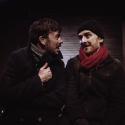
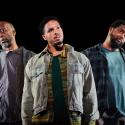
The setting is a typical middle-class period house In London, gutted and expensively decorated, where Leigh (Serkis, pictured below left) is preparing for a meeting with the Oscar-winning star of his latest production, Jay Conway (Harrelson, pictured bottom). It’s the eve of their first rehearsal. Arriving later will be Ruth (Derry Girls' Louisa Harland), the young playwright whose debut drama set in Northern Ireland Jay has signed up for. Between the two of them, the men will show they have mastered every contemporary cliche to describe their work and its vital importance, though their lexicons are rather different.
Before any dialogue is spoken, we see Jay alone onstage, limbering up for the meeting by inspecting his face in an invisible fourth-wall mirror. He has the stylings of a hipster hobo – voluminous floral-print pants, an unattractive thick oatmeal-coloured cardigan with a mountain scene on the back, and orange socks. That he is a loose cannon is underlined by his first line, in which he asks Leigh whether he has ever used the N-word. That, and his habit of doing a deep plié as he talks.
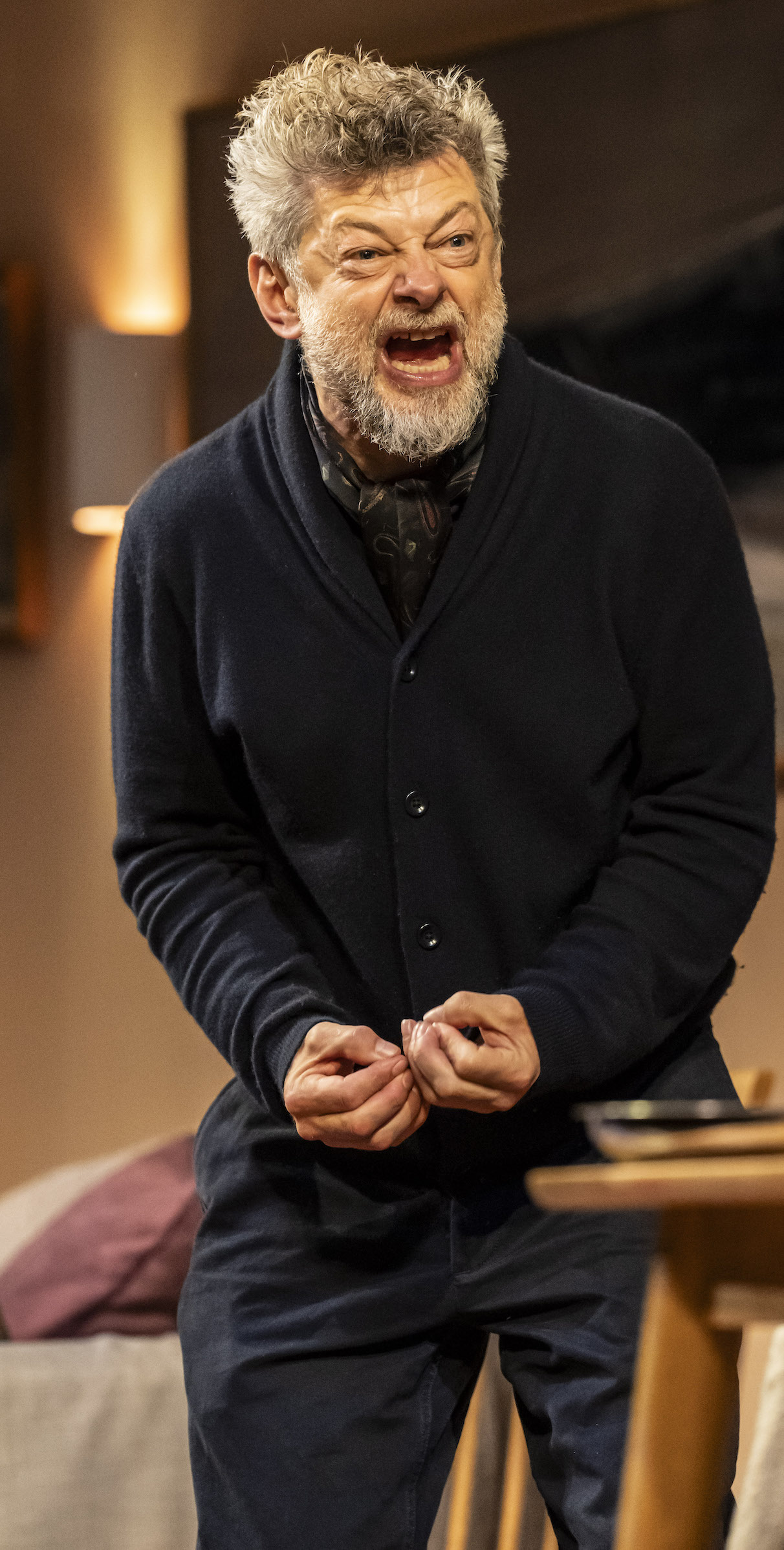 This question will trigger a string of remarks that leads ever deeper into the dark wood of modern identity politics, feminism and racism. But not before the men have established for us how little each knows about the other’s history and culture. A hilarious conversation revolving around James Baldwin is a sign that Leigh is actually out of his depth in Jay’s world (ditto his ignorance of Jay’s mate “Cube”, the rapper, or his thinking Jay’s concern about his “journey” comes down to which Tube he should catch to get to rehearsals).
Then the topic moves to the “Bechdel Theory”, which Leigh does actually know something about, eg that it’s known as the Bechdel Test and doesn’t require male characters simply to talk about feminism. But Jay knows only what “a woman told me” about it, so it must be true.
At every turn, the men fluff each other’s egos, while trying to stake their claim to being the better feminist. Jay ponderously announces men must step aside and leave the field for women, though he claims to have "an intersectional exemption" because he is a Catholic with many siblings and a recovering alcoholic. A subject he has apparently droned on about every time he and Leigh meet, in his attempt to “be a better person, to honour my Truth”. He has signed up for Ruth’s play because of its “unremitting violence”. Only an Irish woman could have created it, he opines, because the Brits are so repressed.
Somehow this line of conversation leads to Jay’s next zinger, and the start of the meeting’s downward spiral: who, if he had a gun at his head and had to choose somebody to rape to prevent a terrorist blowing up a big city – a scenario Jay had faced in a film he made with Rutger Hauer (“such a sweet man”), later cut – who would Leigh choose?
Enter an actual woman, a smart, opinionated, uncompromising one. The web of mutual back-scratching, virtue-signalling and general blethering the men have woven around themselves is now systematically untangled as Ruth unapologetically sets them straight. She isn’t Irish, for starters. This triggers a double explosion. From Jay, who hadn’t understood this, or anything else, about Ulster and who didn’t realise “Fenian bastards” were he and his fellow Catholics, before he agreed to do the role. “That’s hate speech,” he whines. And from Leigh, desperate to keep his big name on board, who repeatedly insists to Jay that Ruth is Irish, though maybe not as Irish as the ones in the Republic.
When Ruth finds out what they have been talking about, there is a third explosion, naturally, and the gloves are off. The fisticuffs, verbal and otherwise, would be worthy of Tarantino if he wrote stage plays about stage plays. And the black humour of the play’s own unremitting violence is in the Martin McDonagh league. To Chekhov’s gun must now be added David Ireland’s eyepatch – which Jay wants to wear as a universal sign of his character’s moral decay.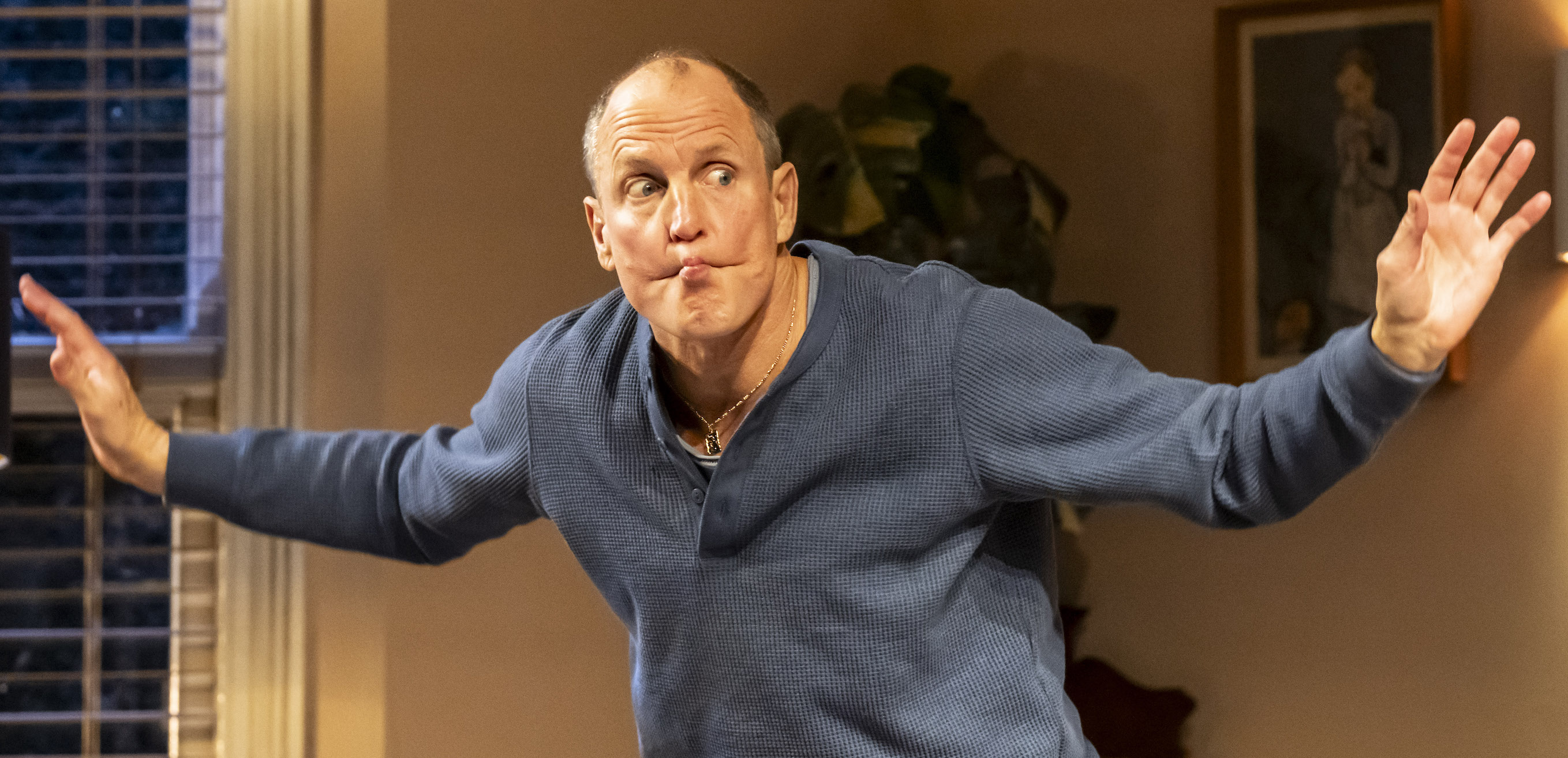 Harrelson is a revelation: a great physical comedian, doing headstands, windmilling his arms, swirling his lumpy cardigan like a matador’s cape, looking on occasion as if he’s about to break into some interpretive dance. He can also slip into Brando impressions and deliver the worst Irish accent any actor ever attempted (“A Belfast Dick Van Dyke – Dick Van Morrison!” Ruth suggests). His Jay is a monstrous idiot, but then so in his own way is Leigh, a walking bad example of entitled liberalism who has no real moral references beyond the evils of Brexit, Thatcher and the Tory party. Serkis gives him a wooliness that parts to reveal the self-important predator underneath.
Press night’s starry audience had great fun gasping noisily at each transgressive statement and expletive the men blundered into, especially Serkis’s demolition of actors (“He’s not an adult, he’s an actor”) and critics (“The only thing I want to read from a critic is a suicide note”). Yes, the script loads the dice and exaggerates the men’s awfulness: it’s a satire. But his script constitutes a masterclass in what not to say and think about the Irish. And the British. And women.