It’s always a risk when a production changes venue. In the curious alchemy of live performance, no-one can be sure whether a shift in surroundings might rob a show of the glitter and allure it once had.
For Jordan Fein’s impassioned, magical Fiddler on the Roof that must have been doubly the case after critics raved about the ingenious way he had worked with Regent’s Park Open Air Theatre’s capricious outdoor setting. The timing of the song "Sunrise, Sunset" – marking the wedding of Tevye’s daughter Tzeitel – to fall shortly after dark was a particular cause for delight.
So it’s a pleasure to be able to report that this transfer to the Barbican has not robbed the show of its magic. We are gripped from the opening coup de theatre, in which Raphael Papo’s astonishing fiddler – whose violin seems to conjure lightning from the air – appears in a wheat field in early morning mist that rises up to become a “roof” (courtesy of Barbican engineering). The dynamic delivery of the show’s infamous opening song "Tradition" by the full cast – who seem to breathe fire into the air alongside the music – stokes the sense of infectious energy. This is a Fiddler that’s going to take us along at a gallop.
The musical adaptation of Sholem Aleichem’s tales of Tevye the Dairyman has come in for criticism in its time. Some early critics described it as “shtetl kitsch” for its playing down of the challenges faced by Jews living in the rural outposts of Imperial Russia. Yet Fein’s production maintains the sense of exuberance in day-to-day life at the same time as sharply delineating the political threats that loom like thunderclouds. At a time when Ukraine is being ravaged by a tsarist Russian president, and the surge of the populist right across America and Europe is enabling the persecution of minorities, it’s not difficult to feel the shivers of lurking oppression.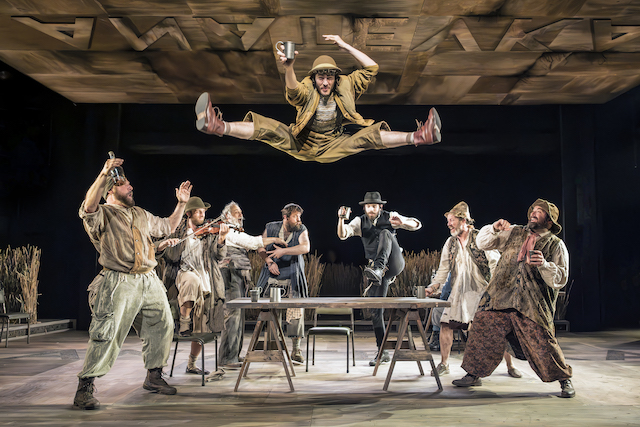 The brisk pace of the production is underscored by a lean, muscular delivery from the ensemble cast which ensures that every song takes flight and that every joke (no matter how cheesy) has bite. Adam Dannheisser’s Tevye is a big bear of a man whose wry dialogues with God are underpinned by profound compassion for his five daughters. His wife Golde – played with wiry determination by Laura Pulver – is more understated, yet clearly cracks the whip in their fraught attempts to map their children’s future.
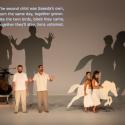
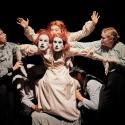
While the emotional authenticity of the performances gives heft to the production’s humour, the show proves adept at flights of fancy too. In the sequence where Tevye fakes a nightmare – in which Golde’s grandmother “returns” to warn that Tzeitel should not marry Lazar Wolf the butcher – the entire cast, dressed in white nightclothes, gleefully conjures up a sense of the supernatural. In stark contrast to the cobwebbed eloquence of the society inhabited by Chekhov’s three sisters (set just a few years before this), here we have a community infused with vigour and fun. Julia Cheng’s occasionally gravity defying choreography (a scene where the men swirl and dance with bottles on their heads gets whoops) adds to the sense of exuberance.
Though Tevye’s the patriarch, there’s little doubt that his daughters run his life. It’s through them that he experiences the changing world, whether it’s Natasha Jules Bernard’s lively Tzeitel, Hannah Bristow’s sparkily intelligent Hodel, or Georgia Bruce’s bookish, impatient Chava. While each experience of change is precipitated by love, in both Hodel and Chava’s case it connects the family to the 20th century’s oncoming tragedies. When the Russians finally expel them from their village, we all know that while Tevye and Golde and their two youngest daughters have a chance of a secure future escaping to America, the family members escaping to Krakow (near Auschwitz) face greater perils.
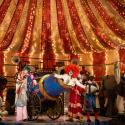
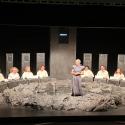
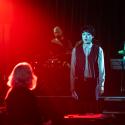
Mark Aspinall’s superlative music direction bolsters the sense of a story told with grit and liveliness rather than regret and sentimentality. Tom Scutt’s glorious set keeps our sensibilities firmly anchored in Russian wheat fields. Aideen Malone’s lighting design subtly augments the production’s shifting moods, whether in the misty, haunting setting of the fiddler on the roof or the gorgeous gold-hued tones that bring warmth to the performance of "Sabbath Prayer". An utter delight.