Adapting of 19th-century novels is sometimes looked down on as a kind of “heritage drama”. The assumption is that it is all about the externals, about the costumes and the coach wheels turning. It is certainly not what drew me to George Eliot. It is the quality of her mind: her wit, her intelligence and her compassionate insight. Middlemarch is a “classic” because it still has resonance today, and a classic should survive all kinds of different interpretations and still remains relevant.
But only conscious interpretation here is in the translation from the novel form into the dramatic. Drama is the development of character under stress of action. When I adapted Eliot’s Adam Bede many years ago, it was an obviously “dramatic” story – seduction, child-murder and a trial scene. But I was always fascinated by the challenge of adapting Middlemarch, a much more subtle drama of developing human lives, and to discover whether it could work on stage. The characters are so rich and their problems so close to our own in spite of the time difference – misguided relationships and money worries, future expectations raised and dashed, and it seemed to me to carry a detail of original observation not often portrayed in theatre.
At the time when the book was written, it was a period of great novel-writing and rather poor theatre
I was also inspired by the thought of bringing her language alive for a live audience. On the page, one’s eye can glide over the sentences, and sometimes miss her subtlety and above all her humour. People sometimes confess to giving up on reading George Eliot because they find it “heavy”. But, like Shakespeare, her dialogue reveals so much more when spoken aloud and shared, her language dense, but very speakable. And I wanted to include her own distinctive voice, shared by the cast, and her ironic comments on the action as it unfolds. I’ve tried to use only her words throughout.
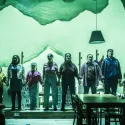
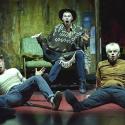
I’ve always loved the challenge of huge themes in small spaces, where the principle must be not “what can we do with this?” but “what can we do without?” How can we tell this story, as simply as possible, so the story will shine through? I wanted to use only her words, the actors and a minimum of setting and leave as much as possible to the audience’s imagination. I also believe audiences enjoy the versatility of actors. I relish doubling characters that have dramatic similarities but were in fact very different – the indulgent Vincy parents double with the stricter Garths, the introverted Mr Casaubon with the extrovert Featherstone, the vague Brooke with the focused Bulstrode, Will who has so much pride with Fred who has so little. (Pictured below, Geoffrey Beevers in rehearsal)
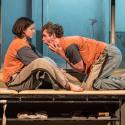
 The shape of the trilogy emerged as I wrote. I took the three main strands from the book: Dorothea’s Story, The Doctor’s Story and the story of Fred and Mary to make three self-contained plays, each in its own social sphere, with differing attitudes to status and money. I knew I should need certain scenes repeated from one play to the next, as the stories overlapped, but enjoyed the fact that these scenes could be angled differently to meet a different perspective. I also became interested in the structural similarities between the stories. It’s obvious that each is based on a marriage, or a potential marriage, and at least the hint of an “eternal triangle”, but each play also has, at its centre, an onstage death which has unexpected repercussions for everything that follows and it became clear that the third play (a strand sometimes considered more of a lighter sub-plot in the novel) answers the first two plays, and provides solutions to the problem the protagonists face. Dorothea impulsively leaps into her first marriage, Lydgate drifts into his, both with disastrous results. Each expects something from their partners that they are unable to give, because they have opposite ways of thinking. But Mary waits for Fred until he has found his feet, and they both know each other well enough so they can truly share the same values.
It is of course an immensely complex novel and I cannot hope to cover it in every detail. But every examination of a classic should throw up something of interest, if it is attempted honestly. My aim is to reach, as simply and directly as possible, the dramatic heart of the book where the characters are tested by their actions.
At the time when the book was written, it was a period of great novel-writing and rather poor theatre. But nevertheless all the great novelists were interested in the theatre, and many encouraged adaptations of their works. Then why should we look down on it? Of course it’s no substitute for reading the book. But I believe it won’t spoil that pleasure. And I hope it will even encourage more people to love George Eliot’s incomparable mind.