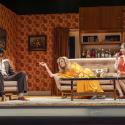
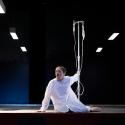
N F Simpson is a legendary absurdist playwright of 1950s and 1960s vintage. But while his 1957 debut, A Resounding Tinkle, got a revival some three years ago at the Donmar, he was widely believed to have given up writing more than 30 years ago. After all, he has a back catalogue of comic classics, and he celebrated his 91st birthday in January this year! But, true to form, the veteran humorist has surprised us once more. Last night, the Jermyn Street Theatre, a fringe venue a stone’s throw from Piccadilly Circus, premiered his brand new play.
If So, Then Yes is a surreal comedy about a day in the life of one Geoffrey Wythenshaw, an octogenarian who begins to dictate his autobiography in the comfort of a retirement home for the well heeled. The trouble is, he makes precious little progress because he finds himself constantly bothered by other residents, odd visitors and members of staff. Some come to ask his advice, others simply want to pass the time of day.
The consistent oddity of the language is mildly deranging
Simpson’s style is instantly familiar: it’s the kind of English whimsy that immediately reminds you of the fact that, in the past, his work was an influence on British comedy, most obviously on Peter Cook, Dudley Moore and the Monty Python team. It’s a fizzing concoction of paradoxical wit and surreal absurdities, with a dash of philosophy thrown in for good measure. It mixes passionate inconsequentiality with good-natured speculation, and creates a sense that language is unstable and fugitive.
But don’t expect much in the way of plot. Geoffrey Wythenshaw does some dictating to Lorna; Reg, a new resident, pops in; the cleaners arrive and gossip; and there’s a fête in the grounds of the home. Some of the material is hilariously surreal: a young woman contemplates an operation that will turn her into a walrus; a family time-travels to a world ruled by dinosaurs; the role of tallow in the creation of the American Constitution is discussed; an insect sanctuary is visited.
Peeking out from all this craziness are Simpson’s main concerns: the need for belief or faith, and the difficulty of finding anything to believe in. There’s quite a lot of religious speculation and a sense that God is unknowable, while at the same time our urge to know him, her or it is also acknowledged. Then there’s a fair bit of satire on language, gossip and cliché. Human communication is put under the microscope.
The effect of the play is genuinely unsettling. On the one hand, it feels like a trip into the past, with many references, from Sartre to Exchange & Mart, to an older post-war culture; on the other hand, the consistent oddity of the language is mildly deranging. It’s all very jovial but behind the high jinks there’s a ghastly sense that people are talking in a language that no one understands. It feels a bit like having a partial stroke. Or a radio tuning in, and tuning out.
For the Presence theatre company, director Simon Usher fields a good cast, led by Roddy Maude-Roxby as Geoffrey Wythenshaw (who was in the original production of Simpson’s One Way Pendulum in 1959). Here, he is the tentative, gently avuncular still centre of a maddening world. There’s good support and some cameos from (to name but two) Di Botcher as a Welsh cleaner and Paul Copley as Reg. But although Simpson’s scepticism about the conformity of modern society feels just right, the play drags a little in the long second half and a feeling of mild derangement shades into irritation. Still, Simon Usher should be praised for at least trying to widen the current narrow repertoire of British theatre.
- Listen to a rare N F Simpson interview