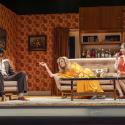
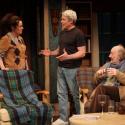
A Life in Three Acts started with conversations between Bourne and his friend, the playwright Mark Ravenhill. Ravenhill taped the conversations, had them transcribed, and on stage at the Soho Theatre the men sit with the transcriptions before them. Prompted by Ravenhill, Bourne, now 70, retells anecdotes and stories while photographs from his life and career are projected on a screen behind them. It’s a weird set-up, somewhere between scripted theatre and a chat between friends, but somehow it works. It was originally presented at last year’s Edinburgh Fringe in three separate segments but here is in two acts.
We learn that Bette (originally Peter) Bourne was born in a working-class family in the East End of London, and was close to his mother but had a difficult relationship with his violent father. He went to drama school and, with his matinee-idol looks, was in regular work, appearing in classical theatre and in television dramas. Bourne speaks in old-fashioned East End tones, but a fascinating bit of archive - a recording of him speaking Shakespeare - is a revelation. His voice is exquisite: expressive and perfect RP.
Bourne gave up acting in the early 1970s to become an activist with the Gay Liberation Front and live in a commune, but later returned to performing with New York gay cabaret group Hot Peaches and went on to found the influential drag troupe Bloolips. Although he didn’t put a word to it then, Bourne’s gay experiences started at school - “Scripture class was the picking-up place. You’d have a little J Arthur and that would be that. Lovely.” It was in GLF that Bourne discovered the joys of women’s clothing. The first time he wore a dress, he says, the feeling was of being “feminine, not sexual, but dangerous”. Bourne is never seen in public without his lipstick and make-up, and his attire last night - black and spangly - was, he said, “Golders Green drag”.
He occasionally gets up to sing a song or tell a story, and these are funny and wistful by turns, but the most poignant moments are when he talks about the friends he lost to Aids and, shockingly, how much of the world hasn’t moved on. Stallholders may share a joke with Bourne as he walks through his local market in Notting Hill, but two streets away they will ignore him. Similarly insults and aggression from strangers are still part of his life, but he is philosophical: “The abuse... goes with the territory.”
While the evening occasionally dips in pace and I would have welcomed more specific dates to set things in context, it is a mostly riveting hour and three-quarters. It’s most definitely not a specialist-interest piece - how could it be when it covers theatre and social history, the gay lib movement, life in a commune, the father-son dynamic, glittery tops and has some filthy East End jokes? A unusual treat.
Book tickets for A Life in Three Acts at the Soho Theatre, London W1 until 27 February.