Ah, 2015. Those halcyon days of packed theatres. Thank God the RSC had the presence of mind to film Polly Findlay’s production of The Merchant of Venice, now streaming on BBC iPlayer. Condensed into just over two hours, it’s a thoughtful take on Shakespeare’s most problematic of plays, with a blinding central performance from Patsy Ferran as Portia.
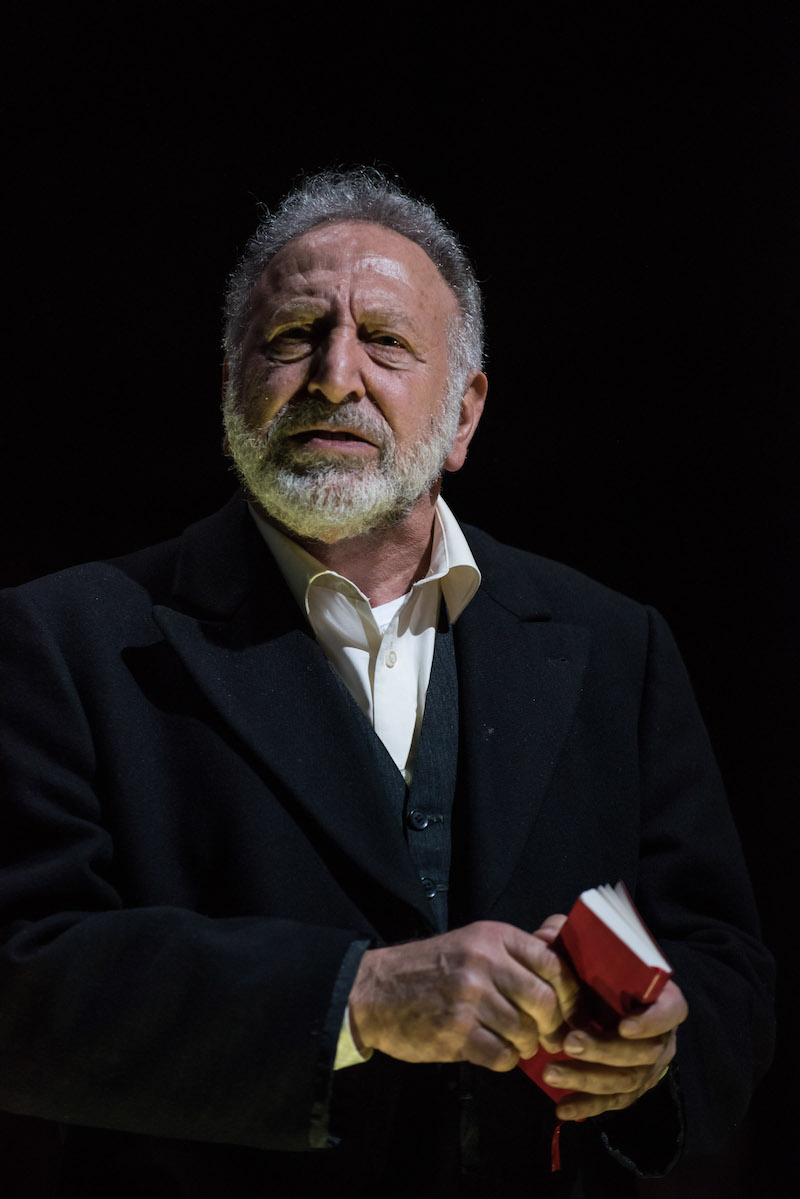 The character of Shylock (played here by Arab-Israeli actor Makram J Khoury, pictured left) and the gentile characters’ hostile reactions to his Jewishness have always sat uneasily in the Shakespearean pantheon. As has the play itself – it feels like a romcom welded to a courtroom drama. In Findlay’s hands, this Merchant becomes a parable on the limits of white liberal “tolerance”. The gentiles are happy to borrow money from Shylock, but God forbid he complain about the way they treat him – or claim what’s lawfully his.
Findlay brings the text’s homoerotic elements to the fore from the get-go: the nature of the relationship between Antonio (Jamie Ballard) and Bassanio (the aptly-named Jacob Fortune-Lloyd) is made clear in the first five minutes. Ballard’s Antonio is spot-on – he is the first character we see, tearstained and hopeless, and his yearning for Bassanio is beautifully contrasted with his hatred of Shylock. This shift of focus towards Antonio could draw us away from the racial intolerance theme, but Findlay is more subtle than that. Khoury’s fiercely dignified presence lingers even when he’s not onstage, affecting what we see; once you’ve witnessed Antonio spitting into Shylock’s face, it’s difficult to sympathise with his unrequited love for Bassanio.
Despite this, the production can’t seem to quite make up its mind on how it wants to present racial prejudice. Some of the actors tend towards the cartoonishly villainous in their delivery of anti-Semitic lines, while Portia’s racist dismissal of the Moroccan prince is conveniently left out. This might be down to timing, but it still feels like a cop-out. Portia’s racism is anti-black, not just anti-Semitic, which marks her out from the other gentile characters. And yet she’s such a strong character, running rings around her dead father and new husband. Fortune-Lloyd’s Bassanio is a lovable idiot who needs an awful lot of comic nudging to pick the right casket.
Ferran navigates these nuances as skilfully as you’d expect from an Olivier winner (she won Best Actress for the Almeida’s Summer and Smoke last year). This woman was born to speak these lines, sometimes delivering them at startling speed that still leaves every word clear as day. Her scenes with Nadia Albina (pictured below, with Ferran), who plays her maidservant Nerissa, are a particular joy to watch, but Ferran is like a kind of acting catalyst: everybody gets better whenever she’s onstage.
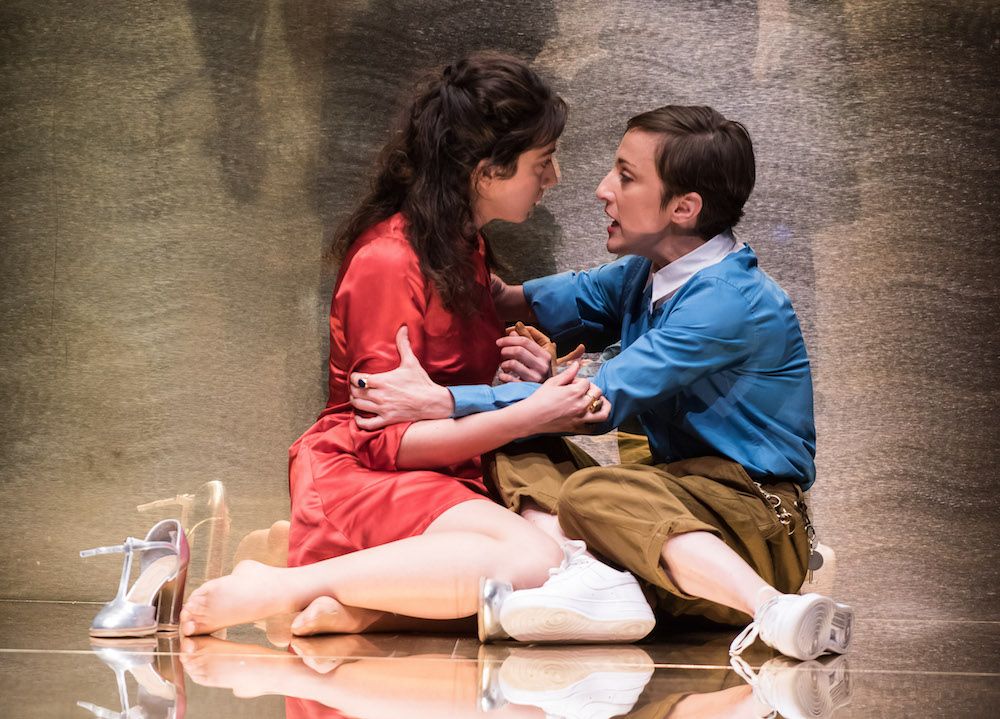 Although it (sort of) ends with a wedding, this might be the least romantic of Shakespeare’s plays. Johannes Schütz’s shiny golden set reflects the characters back at them: in Venice, everything is filtered through cash-tinted glasses. Let’s face it, Bassanio wants to marry Portia because she’s rich. He gets the money for the trip to Belmont from Antonio, who gets it from Shylock, who gets it from Tubal (Gwilym Lloyd), another Jewish merchant. These latter three aren’t bound by friendly or familial relationships, but by mercantile interest. The play deals with this inconvenient truth by pinning all the greed and selfishness on Shylock, the convenient scapegoat. His demise is the only way to ensure a happy ending for Portia and Bassanio, but not for Antonio, whose tearstained face Findlay leaves us with. For somebody to win, somebody else has to lose – and the system was rigged from the start.