Are Seán O'Casey's Dublin plays good for theatre today, or just for the history of Irish drama? My limited recent experience makes it hard to be sure: Juno and the Paycock in London was a liberty-taking mess, and when everyone in a large cast needs to be top-notch - as they are, for instance, in the new production of Gorky's Summerfolk at the National Theatre - any weak performances in The Plough and the Stars scotch O'Casey's experimental ambition as he drops characters for whole acts, introduces others and takes us in unexpected directions, from late 1915 to the Easter Uprising of 1916.
Supposed problems with Tom Creed's centenary production at Dublin's legendary Abbey Theatre where the play premiered on 8 February 1926 didn't bother me. In conjunction with designer Jamie Vartan, Creed has a through-composed vision which throws out most of O'Neill's detailed tenement and pub set directions and gives us bleak plywood with a handful of props for the first three acts: table and chairs, plus settee and Sleeping Venus above a calendar in Act One, tables and chairs, plus bar and big window on a revolve in Act Two; a blank wall with a door and an upstairs window to the right in Act Three. Act Four is the most contentious: now we get brick at the back, the revolve with only a coffin and candles on it, at odds with the claustrophobic attic room O'Casey asks for.
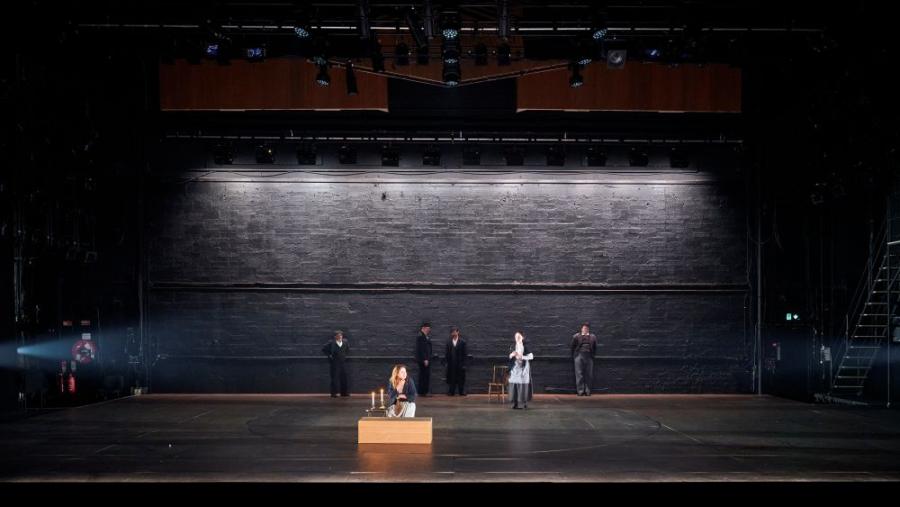
That also makes the actors who project least well virtually inaudible at times. Even in the Clitheroes' living room, which helps up-front in that respect, they can sometimes be lost when they turn upstage. But acting-wise, everything is adequate to good in that first act. Michael Glenn Murphy looks the part as Uncle Peter, "a little, thin bit of a man...like something you'd pick off a Christmas tree" getting ready for a meeting of patriots swearing fealty to the Irish Republic (their banner features the plough and the stars), but blusters overmuch. Dan Monaghan as door-fixer Fluther Good has an amusing way of saying "derogatory", though later he's rather quiet.
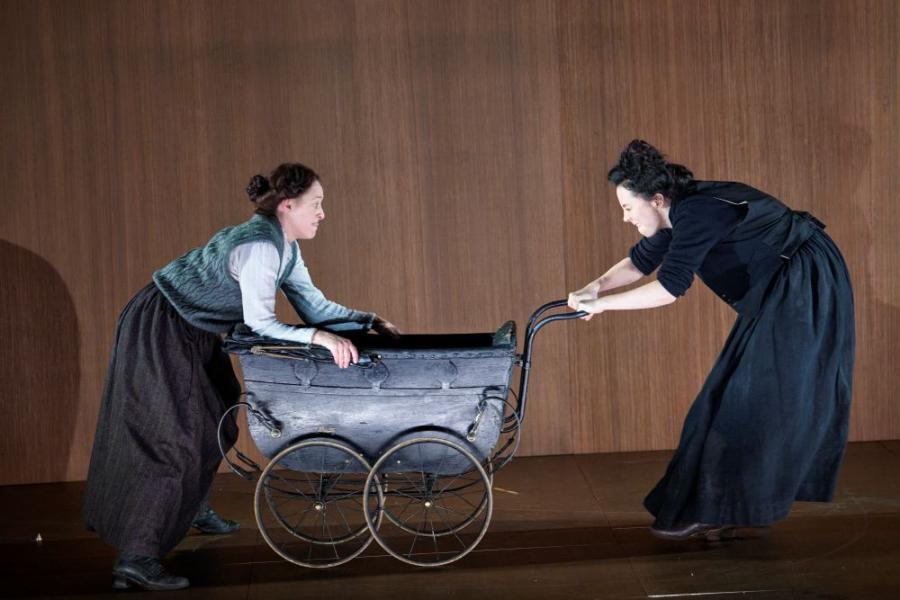
Kate Stanley Brennan's charwoman Mrs Gogan is energetic, very strong and powerful in Act Three (pictured above struggling for a pram with Mary Murray's Bessie Burgess), with Evie May O'Brien convincing as her consumptive daughter Mollser. Thomas Kane Byrne has a humorous mug for The Young Covey, combative socialist; Mary Murray's positively violent Bessie Burgess makes a fine start, and rises to the challenges when the role takes on much greater significance.
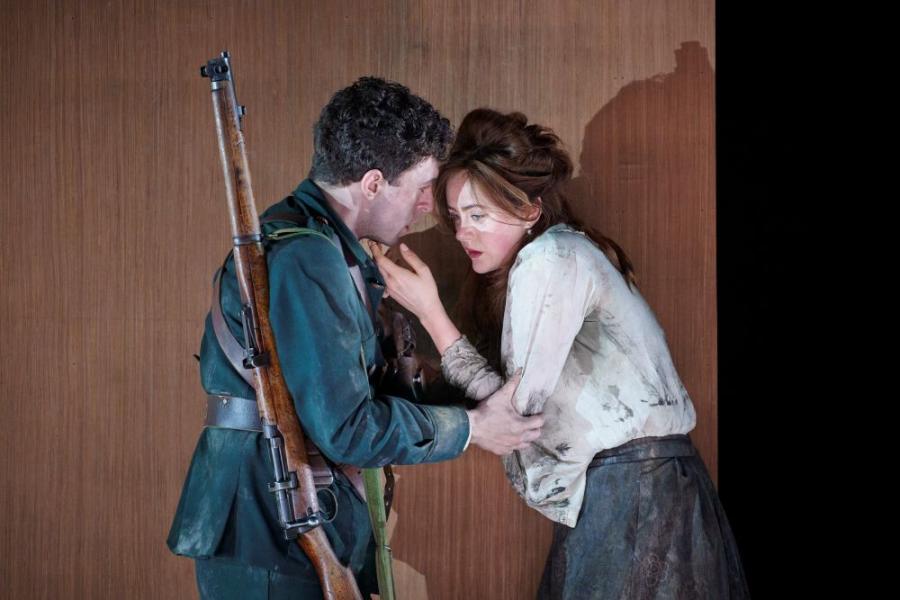
Imbalance is incipient, though, in what will - with a whole act of absence - become the central relationship of the play, that between Jack Clitheroe and his wife Nora, who feels marginalised by his Citizen Army duties. Eimhin Fitzgerald Doherty is resonant, powerful and a fine singer when he serenades Nora with "When You and I Were Young, Maggie". Kate Gilmore begins sympathetically, though already quieter than her fellow-actor. It's in Act Three, when we suddenly find ourselves on the street outside the tenement during the shooting and looting of Easter Monday 1916, that things start to go wrong. Nora's desperate, melodramatic clinging to Jack seems phoney; the soldier who's been shot cries out to wake the dead but Jack ignores him. Nora's Act Four mad scene is the production's worst liability; you really don't want her to come back on stage again in what seems like a real dog's dinner of a finale. Only Murray just about saves the day here.
The biggest pleasures are to be found in the Act Two pub scene, where Michael Tient's Barman nearly steals the show and Caitríona Ennis as prostitute Rosie Redmond - giving cause for riot in the first night audience - gets the nuances exactly right. Then there's Matthew Malone, completely authoritative as the slightly surreal Figure at the Window who spouts lines about war above servitude penned by the rather alarming Patrick Pearse (one of 16 men to be executed after the crushing of the rebellion). In Act Three, Marion O'Dwyer has instant command of the stage as a genteel lady, first amusing as she seeks a safe way to "Wrathmines" - still, without the W, a posh part of town - and then convincing in her justifiable fear. For moments like these, and an education in how Irish theatre reflected the times, the play is worth seeing. But I live in hope of seeing a better Nora.