Telling the truth about women in a war zone usually hits hardest through one of two means: clear reportage that presents the facts, or the devastating narrative of a survivor. Making a drama out of atrocity gets harder, though it's an age-old tradition, which is maybe why directors usually prefer to draw parallels through updating Euripides or Shakespeare. Lynn Nottage's Pulitzer Prize-winning play, fired by interviews with women in the Democratic Republic of Congo and premiered last year in New York, has two powerful assets which make it well worth seeing. It tries to show us how an attempt at normal life, and a living, can be made out of chaos, and it offers an optimistic epilogue which is hard-won but affecting, without affectation - as it has to be.
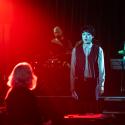
Jenny Jules is duty bound to dominate with slippery grace as Mama Nadi, a Mother Courage of the DRC who tries to keep out of the conflict, to encourage all visitors to lay down their weapons and leave their mess outside, and to convince herself she does the best she can for the "girls" she houses. The play's title is purposefully freighted beyond our conception of, say, Thomas Hardy's Victorian "ruined maiden", its embodiment one of the two village girls brought to Mama's shack by poet-entrepreneur Christian. In a sympathetic portrayal by Lucian Msamati of a rather more complicated good man than the one he played in The No 1 Ladies' Detective Agency, he's the uncle of Sophie (Pippa Bennett-Warner), a girl so "ruined" by what's been inflicted on her that she can't serve the clients other than to sing and pour the drinks. You can see the crisis looming, but not the way in which the two other unwanted refugees from the harsh judgments of village life, Salima (Michelle Asante) and Josephine (Kehinde Fadipe), become implicated.
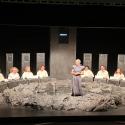
Designer Robert Jones painstakingly evokes on the Almeida's revolving stage a bar where the food may be short but the fabrics and the bright lights create an illusion of some escape from the chameleonic civil war raging beyond the door. It helps to set the scene as consummately as Jules and Msamati, but for the next hour the deeper notes remain unsounded in Indhu Rubasingham's production. Presumably Sophie pours the horror of her rape and injuries into her songs, though you wouldn't know it from Bennett-Warner's delivery, for all her simple charm - not that she has much to work on with Dominic Kanza's rather anonymous numbers. While Josephine expresses her rage in dance-hysteria, Salima is the one who gets to speak of her ordeal in a long monologue, the one point where Nottage attempts to gild the lily with poetic imagery (elswhere it can fall into platitudes, not least the expected one about the war waged over women's bodies). Unfortunately, Asante doesn't manage to touch the truthfulness of a Congolese woman's testimony. Nottage records her "strong visceral response" to the "gentle cadences and the monumental space" between her interviewees' "gasps and sighs"; we don't feel any of that here.
The men need to convey irrational anger, hatred and fear erupting without warning. That only really emerges at the end of the first half with the arrival of Salima's agitated husband. The crises then come in waves, with strong performances from Okezie Morro and Steve Toussaint, and Rubasingham duly sets the pulses racing. The real payoff, though, is the quiet aftermath, shockingly simple and then simply moving. Nottage serves up a satisfying symmetry, with Jules and Msamati unflinching in the human way they take the story of Mama and Christian further than we thought possible. Ultimately, Ruined offers a phoenix from the ashes at the last minute, and Almeida partner Amnesty International gets the dramatic incarnation its message deserves.
Designer Robert Jones painstakingly evokes on the Almeida's revolving stage a bar where the food may be short but the fabrics and the bright lights create an illusion of some escape from the chameleonic civil war raging beyond the door. It helps to set the scene as consummately as Jules and Msamati, but for the next hour the deeper notes remain unsounded in Indhu Rubasingham's production. Presumably Sophie pours the horror of her rape and injuries into her songs, though you wouldn't know it from Bennett-Warner's delivery, for all her simple charm - not that she has much to work on with Dominic Kanza's rather anonymous numbers. While Josephine expresses her rage in dance-hysteria, Salima is the one who gets to speak of her ordeal in a long monologue, the one point where Nottage attempts to gild the lily with poetic imagery (elswhere it can fall into platitudes, not least the expected one about the war waged over women's bodies). Unfortunately, Asante doesn't manage to touch the truthfulness of a Congolese woman's testimony. Nottage records her "strong visceral response" to the "gentle cadences and the monumental space" between her interviewees' "gasps and sighs"; we don't feel any of that here.
The men need to convey irrational anger, hatred and fear erupting without warning. That only really emerges at the end of the first half with the arrival of Salima's agitated husband. The crises then come in waves, with strong performances from Okezie Morro and Steve Toussaint, and Rubasingham duly sets the pulses racing. The real payoff, though, is the quiet aftermath, shockingly simple and then simply moving. Nottage serves up a satisfying symmetry, with Jules and Msamati unflinching in the human way they take the story of Mama and Christian further than we thought possible. Ultimately, Ruined offers a phoenix from the ashes at the last minute, and Almeida partner Amnesty International gets the dramatic incarnation its message deserves.
- Ruined runs at the Almeida Theatre until Saturday, 5 June
- For more information about the background to the play visit www.ruinedtheplay.co.uk