Should the BBC take the piss out of itself? Of course we must all laugh at our own failings, but the function of satire is to laser in on the faults of others for comedic ends. Isn’t it? The satirist's task is to point the finger elsewhere. Juvenal and Swift and Hislop don’t get up in the morning, look in the mirror and say, “Christ, I’m hilariously bad at what I do. I must tell the world.”
So what are we to make of W1A? John Morton, the great anthropologist of Planet Lanyard, was granted permission to do to the BBC what he had done to the organisation of the London Olympics. But where Twenty Twelve wonderfully tapped into British pessimism and self-loathing, the first series of W1A offered less for the audience to recognise in themselves. We have to live with the BBC, to fund its steepling managerial structure, and the vast severance packages of the people it has carelessly overpaid. And of course we are all still living with the unresolved catastrophe of Savile.
So it’s slightly harder to enjoy the joke that the BBC is overwhelmingly useless on pretty much every level you can imagine. It’s crap at governance. It’s crap at commissioning. It’s crap at decision-making. It’s crap at presentation. It’s crap at empowering talent. It’s crap, in short, at everything. Yes but they’re only joking, aren’t they? Ah but are they? Everyone I ask who works at the BBC finds W1A excruciating because for them it looks like one of those grim workplace documentaries about sewage plants or posh magazines.
The new series opened with an hour-long special. The first half busily reminded us of the catchphrases everyone uses to erect a defensive wall of back-covering consensus (“brilliant”, “fabulous”, “so that’s all good”), and the almost plausible job titles: entertainment format executive, generic head of comedy and/or drama, and (my favourite) the director of better.
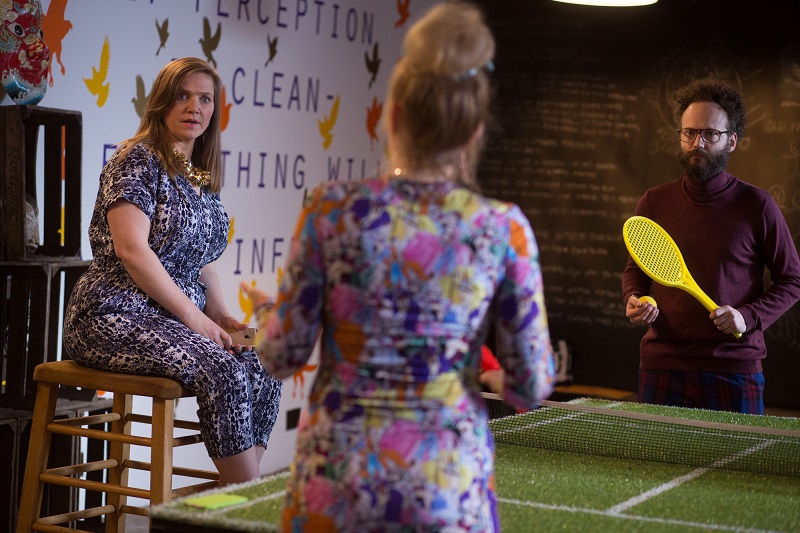 The BBC’s vacuous preoccupation with self-improvement (or as someone put it, striving to be “better than different”) was carefully skewered. Siobhan Sharpe (Jessica Stevenson), the PR executive with a brain fashioned from Play-Doh, was charged with revamping the BBC’s relationship with Wimbledon to appeal to an ethnically diverse demographic (pictured above, Sharpe batting ideas about with her cohorts). The Corporation prepared for a visit to Broadcasting House by the Prince of Wales, triggering the paralysis of the entire building by its syncopatic security software. Meanwhile, a northern dramatist had his entire series concept uprooted to Walthamstow by a meddling exec who asked, all too pertinently, “Who do we want to be telling stories about, and to?”
The acting, led by Hugh Bonneville as head of values Ian Fletcher, brilliantly conveys the sheer incredulity and bafflement that pervades a much loved organisation which – if W1A is to be believed – contrives continually to put its trousers on back to front, the cart before the horse, and its foot in its mouth. Sarah Parrish and Monica Dolan are a hoot as a pair of cheerless higher-ups, while the delicious Jason Watkins had a quiet episode playing the DG’s henchman as a limp-wristed velociraptor. Sharpest as ever is the voiceover wrily delivered by David Tennant to highlight the kind of breathless documentary the BBC continues to make.
There were no guest celebrities queuing to send themselves up this time, but there was a running gag about a potty-mouthed Jeremy Clarkson, his name creatively beeped out since Tony Hall had to let him go for real. Hall was twitted as someone who gets “into an unnecessary state about his hair”.
As the Olympics in London came ever nearer, Twenty Twelve had a reason to come back for a second helping. It’s huge fun sniggering at the BBC’s venalities, but W1A landed all its blows last time. A second series of comedy glasnost takes self-flagellation too far.