From Apocalypse Now to Blue Velvet to Speed, as a screen presence Dennis Hopper grew ever more scary. Lately gallery-goers have got to know another side of Hopper via his painting. Now there is a belated run-out for his work as a photographer, although work is maybe the wrong word. He spent much of the Sixties with a camera slung round his neck, but didn’t make a dime from any of his pictures. “They cost me money,” he said, “but kept me alive.” Hopper rode out of the decade on a Harley as director of Easy Rider and he didn’t pick up a camera again. What this trip to the Sixties reveals is a surprisingly humane Hopper.
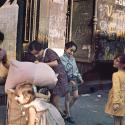
The photographs on show at the Royal Academy have a strong flavour of the time capsule. There are 400 of them shot between 1961 and 1967, almost all of them prints unearthed after his death in 2010, and they fall across two main categories. A busload of famous faces crops up in his viewfinder, mainly actors encountered on set and artists he met in the burgeoning art scene of LA. A tour of Hopper’s world is like entering an elegant if breathless gossip column through whose pages the likes of Hockney and Lichtenstein, Warhol and the dashing Ruscha wander. He also seems to have popped up at all the important moments in Sixties iconography. That’s Hopper tagging along on the Selma-Montgomery civil rights march, snapping riots in LA or hanging with Timothy Leary’s flower children or Hell’s Angels encrusted in leather (see gallery overleaf). All the way through he’s hunting for the humanity, which explains his particular affinity for children who have not yet learned to pose.
 Hopper may have shot as he found, but he evidently did a lot of looking first. Across all the images the predominant obsession is with light. Hence his abjuring of colour. A mesh of shadows falls across Paul Newman’s face (pictured right), and you just have to imagine the famous blue of those irises. A series of still lifes observe the play of light on wood grains in close-up, or monumental masonry in a Mexican graveyard. A shot of the surface of the moon as seen on TV is the ultimate destination in his pursuit of texture. The sun is a supporting player throughout, constantly on his shoulder. There are very few umbrellas in Hopper’s line of vision, even when he snaps the orators of Speaker’s Corner. Indeed an image titled Hopper House (Porch with Chiaroscuro) is a rarity, offering only flat light. Perhaps the title is a joke at the photographer’s expense.
He called himself a Duchampian finger-pointer (one of the figures at whom he pointed his finger was Duchamp himself). But while this feels like a pop-up portrait of a decade, Hopper’s own personal weirdness would thrust itself into the lens. He was creepily keen on shooting dolls and mannequins, a somehow unnatural extension of his all-American passion for airbrushed lovelies on billboards. He also had a wit’s eye for the unusual – a yard full of identical clown figures, a man standing on a set of scales in the street.
The narrative of the show’s hang suggests he outgrew a young man’s interest in persuading women to take their clothes off. For a decade in which sexual intercourse is said to have been invented, there is very little of that going on. The most erotic image finds Jane Fonda’s leg draped across the lap of her new husband Roger Vadim. The flower children look as if sex is the last thing on their innocent minds.
Overleaf: view a gallery of images from the exhibition
Click on the thumbnails to enlarge